Gyeongui–Jungang Line: Connecting the Seoul Metropolitan Area
The Gyeongui–Jungang Line serves as a critical artery within the Seoul Metropolitan Subway system, providing essential commuter rail services that link various regions across Gyeonggi Province and Seoul. By merging the historic Gyeongui Line and the Jungang Line, this expansive network facilitates travel across a massive 134 km corridor, connecting northern reaches like Munsan to eastern destinations such as Yongmun and Jipyeong.
Operated by Korail, the line is easily identifiable on transit maps by its distinct jade color. Whether you are a daily commuter or a traveler exploring the outskirts of the capital, understanding the various routes and express services is key to navigating this complex system efficiently.
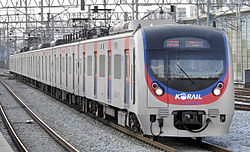
Key Facts
- Total Line Length: 134 km (83 mi)
- Total Stations: 57
- Primary Operator: Korail
- Main Termini: Munsan and Yongmun
- Track Gauge: 1,435 mm (Standard Gauge)
- Electrification: 25 kV AC 60 Hz
- Rolling Stock: Korail Class 321000 and Class 331000
Service Types and Routes
The Gyeongui–Jungang Line is not a single uniform service; rather, it is a collection of interconnected routes that vary in length and destination. Most frequent services operate between Munsan and Yongmun using 8-car trains. However, passengers should be aware of several variations:
Main Line and Shuttle Services
- Standard Service: Most trains run from Munsan to Yongmun.
- Extended Services: Select trains extend further east to Jipyeong, or head toward Seoul Station, Deokso, or Paldang.
- Shuttle Services: Specialized shuttle services operate beyond the main terminus, including the Munsan–Imjingang shuttle and the Imjingang–Dorasan shuttle.
- Split Services: Some 4-car trains split at Gajwa to provide service toward Seoul Station.
Rapid (Express) Services
To reduce travel time, Korail operates several rapid (express) services. While a full journey can take approximately 3 hours, express services can cut this travel time down to roughly 2 hours and 15 minutes. These include:
- Gyeongui Line Express (via Seoul Station): Express between Munsan and Gajwa, continuing as a local service to Seoul Station.
- Gyeongui Line Express (via Yongsan Line): Express between Munsan and Yongsan, continuing as a local service on the Jungang Line.
- Jungang Line Express: Express between Yongmun and Yongsan, continuing as a local service on the Gyeongui Line.
Technical Specifications and Infrastructure
The line utilizes a standard gauge of 1,435 mm and is electrified via 25 kV AC 60 Hz. The infrastructure consists of varying track configurations: most sections feature 2 tracks, while the segment between Neunggok and Gajwa utilizes 4 tracks to manage capacity. The line operates on the left-hand side of the track, consistent with all Korail-run subway lines in the Seoul Metropolitan area.
| Feature | Specification |
|---|---|
| Total Stations | 57 |
| Line Length | 134 km |
| Track Gauge | 1,435 mm |
| Electrification | 25 kV AC 60 Hz |
| Rolling Stock Models | Class 321000, Class 331000 |
Historical Development
The line's history is a gradual process of expansion and integration. The Jungang Line section originally opened in 2005 as the Yongsan-Deokso Line. Over the following years, it was extended eastward through Paldang and Guksu, eventually reaching Yongmun. The Gyeongui Line section opened in 2009, connecting Munsan to Digital Media City.
The modern Gyeongui–Jungang Line was officially formed on December 27, 2014, when the two lines were merged. Since then, the network has continued to grow through the addition of in-fill stations such as Sangbong, Obin, Yadang, and Hyochang Park. Looking ahead, an in-fill station at Hyang-dong is expected to open in 2025.
Frequently Asked Questions
How long does it take to travel the entire line?
A full journey across the line takes approximately 3 hours, though many express services can reduce this time to approximately 2 hours and 15 minutes.
What is the difference between the express and local services?
Express services (labeled as GY, GS, or J on maps) skip certain stations to provide faster regional transit, whereas local services stop at every station along their designated route.
Do all trains go to Seoul Station?
No. While some select services run via the Seoul Station branch, many trains terminate at other major hubs such as Yongsan, Cheongnyangni, or Deokso.
Which company operates the Gyeongui–Jungang Line?
The line is operated by Korail as part of the Seoul Metropolitan Subway system.
Are there services that go beyond Munsan?
Yes, there are shuttle services that extend the reach of the line to Imjingang and further to Dorasan.