Gustav Heinemann: The Citizens' President of West Germany
Gustav Heinemann (1899–1976) was a pivotal figure in the political and moral reconstruction of post-war Germany. Serving as the President of West Germany from 1969 to 1974, Heinemann was defined by his unwavering commitment to democratic values, his resistance to authoritarianism, and his desire to transform the presidency from a formal state office into a voice for the common citizen.
Key Facts
- President of West Germany: Served from July 1, 1969, to June 30, 1974.
- Political Versatility: Held memberships in the Christian Social People's Service, CDU, All-German People's Party (GVP), and the SPD.
- Moral Leadership: A key member of the Confessing Church, which opposed the Nazi regime.
- Government Roles: Served as Mayor of Essen, Minister of the Interior, and Minister of Justice.
- Legacy: Known as the "citizens' president" for promoting democratic participation over state subservience.
Early Life and Intellectual Foundations
Born on July 23, 1899, in Schwelm, Prussia, Gustav Heinemann was deeply influenced by the radical-democratic and left-liberal views of his maternal grandfather and father. These family roots instilled in him a lifelong dedication to the democratic traditions of the 1848 revolutions and a fierce opposition to subservience.
Heinemann's academic journey was extensive, studying law, economics, and history across several universities, including Berlin and Munich. He earned a PhD in 1922 and a doctorate of law in 1929. Professionally, he balanced a career as a legal adviser and director at the Rheinische Stahlwerke in Essen with a tenure as a lecturer at the University of Cologne.
His intellectual independence was tested during the rise of National Socialism. Heinemann's academic career ended likely due to his refusal to join the Nazi Party, and he was denied a board position at the Rhenish-Westphalian Coal Syndicate because of his continued support for the anti-Nazi Confessing Church.
Faith, Resistance, and the Confessing Church
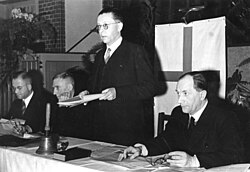
Religion played a central role in Heinemann's life and political ethics. Influenced by the Swiss theologian Karl Barth, he condemned nationalism and antisemitism. As an elder in his parish in Essen, he became a legal adviser to the Confessing Church—a movement of Protestant churches that resisted the Nazification of the German church.
During the Third Reich, Heinemann used his home in Essen to print information sheets for the Confessing Church and provided food and legal aid to persecuted Christians and Jews in hiding. Following the war, he was a member of the Council of the Protestant Church in Germany and supported the 1945 Stuttgart Declaration of Guilt, which acknowledged the church's failure to oppose the Nazi regime.
Political Ascent and Ideological Shifts
Heinemann's post-war political career began in 1946 when British authorities appointed him Mayor of Essen. He was a founding member of the Christian Democratic Union (CDU) in North Rhine-Westphalia, viewing it as a democratic bulwark against Nazism. In 1949, Chancellor Konrad Adenauer appointed him Minister of the Interior.
However, Heinemann's tenure was short; he resigned in 1950 after discovering Adenauer's secret plans for West German participation in a Western European army, fearing that armament would hinder German reunification. This led him to found the All-German People's Party (GVP) in 1952, which advocated for a neutral, reunited Germany. By 1957, he joined the Social Democratic Party of Germany (SPD), helping it evolve into a Volkspartei (people's party) by attracting middle-class Protestants.
Before reaching the presidency, Heinemann served as Minister of Justice from 1966 to 1969 under Chancellor Kurt Georg Kiesinger, where he implemented significant liberal reforms in criminal law.
The Presidency: A Voice for the People
Elected President in March 1969, Heinemann sought to redefine the role. He famously stated he wanted to be the "citizens' president" rather than the "president of the state." He broke protocol by inviting ordinary citizens to New Year's receptions and encouraged Germans to abandon their tradition of obedience to authority in favor of active democratic engagement.
His presidency was marked by a focus on reconciliation. He frequently visited countries previously occupied by German troops during World War II and supported policies of rapprochement with Eastern European states. He also championed environmental research and the commemoration of German liberation movements, leading to the opening of a museum in Rastatt in 1974.
Summary of Political Offices
| Office | Tenure | Key Focus/Context |
|---|---|---|
| Mayor of Essen | 1946–1949 | Post-war reconstruction |
| Minister of the Interior | 1949–1950 | Early Federal Republic administration |
| Minister of Justice | 1966–1969 | Liberal criminal law reforms |
| President of West Germany | 1969–1974 | Democratic engagement and reconciliation |
Final Years and Legacy
Due to failing health, Heinemann did not seek a second term in 1974. Shortly before his death in 1976, he published a critical essay against the 1972 Radikalenerlass (Radicals Decree), arguing that screening civil service candidates for political views was incompatible with the Constitution.
Today, his legacy lives on through the Gustav Heinemann Peace Prize for children's and young people's literature, as well as numerous schools and bridges named in his honor across Germany.
Frequently Asked Questions
Why was Gustav Heinemann called the "citizens' president"?
He earned this title because he shifted the focus of the presidency away from state formality and toward the people, inviting ordinary citizens to official events and urging them to exercise their democratic rights rather than blindly obeying authority.
What was Heinemann's role in the Confessing Church?
Heinemann served as a legal adviser and synod member of the Confessing Church, a Protestant movement that resisted the Nazi regime's attempts to control the church. He also used his home to print anti-Nazi information and helped Jews in hiding.
Why did he leave the CDU to form the GVP?
Heinemann resigned from the government and later the CDU due to disagreements with Chancellor Adenauer's plans for West German rearmament, which Heinemann believed would increase the risk of war and prevent German reunification.
What was the significance of the Stuttgart Declaration of Guilt?
Issued in October 1945, this declaration was a confession by the Protestant Church of its failure to oppose the Nazis. Heinemann viewed this admission of guilt as a "linchpin" for the church's moral recovery and his own subsequent work.
How did Heinemann view the Radikalenerlass?
He strongly criticized the 1972 decree, which screened civil service applicants for political radicalism, arguing that treating a large group of citizens as suspects was contrary to the spirit of the German Constitution.