Guna People: Culture, Governance, and Heritage of Panama and Colombia
The Guna (also spelled Kuna or Cuna) are an Indigenous people residing primarily in Panama and Colombia. Known for their fierce independence and vibrant artistic traditions, they maintain a unique social structure and a deep connection to their ancestral lands. In their own language, they refer to themselves as Dule or Tule, which simply means "people."
Most Guna live within three politically autonomous comarcas (autonomous reservations) in Panama: Guna Yala, Guna de Madugandí, and Guna de Wargandí. A significant portion of the population inhabits the San Blas Islands, a stunning archipelago off the coast of Guna Yala. While many remain in these traditional territories, Guna communities also exist in urban centers such as Panama City and Colón, as well as in small villages in Colombia.
Key Facts
- Population: Approximately 50,000 people.
- Language: Dulegaya (a Chibchan language) and Spanish.
- Location: Primarily the San Blas Islands and mainland comarcas in Panama, and parts of Colombia.
- Social Structure: Matrilineal and matrilocal families.
- Famous Art: Molas, intricate reverse-appliqué textile panels.
- Governance: Led by a saila (political and religious leader).
Political and Social Organization
The Guna maintain a sophisticated system of self-governance. In Guna Yala, each community is led by a saila, who serves as both the political and religious head. The saila is the keeper of the people's sacred history, memorizing songs that transmit laws, legends, and history to the community.
Community decisions are made in the Onmaked Nega (or Ibeorgun Nega), the Congress House. This structure serves as the spiritual and political heart of the village. Because the saila recites history in a high linguistic register with specialized vocabulary, they are often accompanied by voceros (interpreters) who translate the formal speech into informal Guna for the community.
Socially, Guna families are matrilineal and matrilocal. This means lineage is traced through the mother, and upon marriage, the groom moves into the bride's family home and adopts her last name.
At a regional level, Guna Yala is governed by the Guna General Congress, which is led by three Saila Dummagan, or "Great Sailas." Currently, there are 49 communities within Guna Yala.
Cultural Identity and Art
The Guna are globally recognized for their molas. A mola is a colorful textile art form created using appliqué and reverse-appliqué techniques. The word mola means "clothing" in the Guna language, and these panels are used to create the blouses of the women's national dress, known as Tulemola or dulemola.
The Guna flag also carries deep symbolic meaning. Adopted after the 1925 rebellion, it features a central ancestral symbol called the Naa Ukuryaa. This symbol is interpreted either as the four sides of the world or as an octopus that created the world, with tentacles pointing to the cardinal directions. While the official reservation flag features a white central stripe representing peace and purity, the ethnic flag often uses yellow.
Economy and Trade
The Guna economy is a blend of traditional subsistence and savvy mercantilism. Agriculture and fishing are foundational, with plantains, coconuts (ogob), and fish forming the core of their diet. Coconuts and lobsters (skungit) serve as primary exports.
The Guna have a long history of international trade, often selling goods through family-owned retail stores. They have historically traded with Colombian, Mexican, and Chinese ships. This tradition of economic self-determination is often cited as a key reason for their successful independence compared to other Indigenous groups.
In recent years, the sale of molas and Guna art has become a major income source, with vendors operating in various Panamanian cities. Additionally, tourism in the Carti region has grown into a significant economic driver.
History and Resilience
The Guna are part of a larger Chibchan migration that moved east from Central America into South America centuries before the Spanish conquest. Initially settling in the Urabá region near the borders of Antioquia and Caldas, they later moved westward toward Guna Yala to escape conflicts with Spanish colonizers and other Indigenous groups.
In the early 20th century, the Panamanian government attempted to suppress Guna customs. This led to the Dule Revolution of 1925, a successful revolt led by Iguaibilikinya Nele Kantule. The resulting treaty granted the Guna a significant degree of cultural autonomy.
Today, the Guna face new challenges from climate change. Rising sea levels threaten the San Blas Islands. In early 2025, the community of Gardi Sugdub was forced to evacuate their island for a new township on the mainland.
Language and Health
The native language, Dulegaya ("people-mouth"), is spoken by 50,000 to 70,000 people. While it remains the primary language for children in the comarcas, it is officially considered an endangered language. Spanish is widely used for education and official documentation.
Medical research has highlighted remarkable health trends among the Guna. They exhibit low average blood pressure (110/70 mm Hg) and do not experience the typical age-related increase in blood pressure seen in Western populations. Consequently, death rates from cardiovascular disease and cancer are significantly lower than in the general Panamanian population.
Albinism in Guna Culture
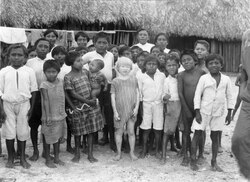
The Guna have a high incidence of albinism. In Guna philosophy, people with albinism, known as sipu, hold a sacred role. They are believed to be a special race of people tasked with defending the moon from a dragon during lunar eclipses. Only the sipu are permitted to go outside during an eclipse to use specially crafted bows and arrows to repel the dragon.
| Category | Details |
|---|---|
| Primary Regions | Panama (Guna Yala, Madugandí, Wargandí) and Colombia |
| Language | Dulegaya (Chibchan family) and Spanish |
| Social System | Matrilineal and Matrilocal |
| Key Exports | Coconuts, Lobsters, and Mola textiles |
| Political Leader | Saila |
| Health Note | Low rates of hypertension and cardiovascular disease |
Frequently Asked Questions
What is a mola?
A mola is a traditional Guna textile art form created using appliqué and reverse-appliqué techniques. These colorful panels are sewn into the blouses worn by Guna women as part of their national dress.
How is the Guna community governed?
Each community is led by a saila, who serves as both the political and religious leader. Regional governance is managed by the Guna General Congress, led by three "Great Sailas" (Saila Dummagan).
What is the significance of the Guna flag?
The flag features the Naa Ukuryaa, an ancestral symbol representing either the four sides of the world or an octopus that created the world. It was adopted following the 1925 Dule Revolution.
Why is the Guna diet and health unique?
The Guna have very low rates of cardiovascular disease and cancer, and they do not typically experience the age-related increase in blood pressure common in Western societies.
What role do people with albinism play in Guna society?
People with albinism (sipu) are viewed as a special race with the spiritual duty of protecting the moon from a dragon during lunar eclipses using special bows and arrows.