Guiana Space Centre: Europe's Gateway to the Stars
Located northwest of Kourou in French Guiana, the Guiana Space Centre (French: Centre spatial guyanais; CSG), widely known as Europe's Spaceport, serves as the primary launch site for the European Space Agency (ESA) and Arianespace. Established on April 14, 1964, and operational since 1968, this facility is strategically positioned just 500 kilometres north of the equator. This near-equatorial location provides a significant physical advantage: the Earth's rotation provides an extra boost to rockets, allowing them to carry heavier payloads into low-inclination or geostationary Earth orbits (orbits that remain fixed over a single point on the equator) compared to high-latitude launch sites.
Key Facts
- Location: Kourou, French Guiana (5°10′08″N 52°41′25″W).
- Parent Agencies: ESA and CNES (National Centre for Space Studies).
- Primary Operator: Arianespace.
- Workforce: 1,700 direct employees (as of 2020) and 7,500 indirect employees (as of 2011).
- Total Launches: 334 from the main pads.
- Strategic Advantage: Proximity to the equator increases payload capacity for geostationary transfer orbits (GTO).
The Strategic Advantage of Kourou
The geography of the Guiana Space Centre is its greatest asset. Because it is located at a latitude of 5°, rockets can take advantage of the maximum rotational speed of the Earth. This efficiency is evident when comparing launch vehicles; for instance, while a Proton rocket launched from Russia can send 6,270 kg to GTO, the Ariane 5 launched from Kourou can deliver over 10,000 kg to the same orbit. Additionally, the open sea to the north and east ensures that falling rocket stages do not land on populated areas, enhancing safety.
Launch Complex Infrastructure
The centre consists of several specialized launch complexes, each designed for specific rocket families and mission profiles.
The Ariane Series (ELA-2, ELA-3, and ELA-4)
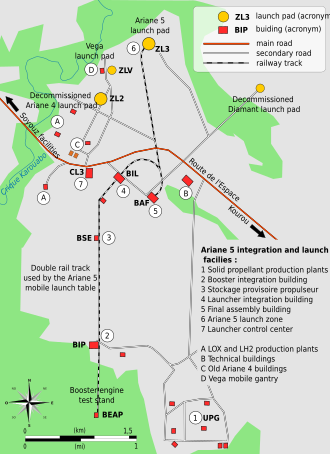
The ELA-2 (Ensemble de Lancement Ariane 2) was the workhorse for Ariane 4 from 1988 to 2003. It featured a unique design where the preparation zone and launch pad were separated by one kilometre, allowing one rocket to be assembled while another was ready for launch. The facility's service tower was demolished in 2011.
ELA-3 was the home of the Ariane 5, operating from June 1996 until July 2023. This massive facility covers 21 square kilometres and was used for high-profile missions, including the launch of the James Webb Space Telescope in 2021. ELA-3 is slated for future use by the Vega-E rocket.
The newest addition, ELA-4, is currently active and dedicated to the Ariane 6, which saw its first launch on July 9, 2024.
Vega and Small Launchers (ELV and ELM)
The ELV (Ensemble de Lancement Vega) is the active hub for the Vega C rocket, having previously hosted the Europa II and early Ariane models. Meanwhile, the ELM (Ensemble de Lancement Multilanceurs) is a reactivated site designed for a new generation of microlaunchers. Various companies, including Isar Aerospace and PLD Space, are expected to use this reconfigurable site for rockets such as the Spectrum, RFA One, and Miura 5.
The Soyuz Complex (ELS)
The ELS (Ensemble de Lancement Soyouz) was established through a Russo-European joint venture to integrate Soyuz rockets into the European fleet. Located 27 km from Kourou harbour, this site significantly boosted the Soyuz's payload potential—increasing it from 1.7 tonnes to 2.8 tonnes for GTO missions compared to launches from the Baikonur Cosmodrome. The site is currently undergoing renovation and is expected to host the Maia rocket in the future.
Operational Summary
The following table provides a snapshot of the various launch complexes at the Guiana Space Centre.
| Complex | Status | Primary/Future Rockets | Key Use |
|---|---|---|---|
| ELFS | Inactive | Sounding rockets | Atmospheric research |
| ELM | Inactive/Reactivating | Miura 5, RFA One, Spectrum | Microlaunchers |
| ELV | Active | Vega C | Small satellites |
| ELA-2 | Inactive | Ariane 2, 3, 4 | Retired heavy lift |
| ELA-3 | Inactive | Ariane 5 / Vega-E (Future) | Heavy lift / Future small |
| ELA-4 | Active | Ariane 6 | Current heavy lift |
| ELS | Renovation | Soyuz (Retired) / Maia (Future) | Medium lift |
Social and Local Impact
The presence of the spaceport has not been without local tension. In March and April 2017, the centre became a focal point for protests regarding infrastructure and insecurity in French Guiana. These strikes led to the blockade of the CSG, delaying an Ariane 5 launch for several months. In response, the French government and CNES pledged financial aid to fund economic and social programmes in the region, including an additional €10 million contribution from CNES.
Frequently Asked Questions
Why is the Guiana Space Centre located in South America?
Its location near the equator (5°N) allows rockets to utilize the Earth's rotational speed, which significantly increases the payload capacity for satellites entering geostationary orbits.
Which rocket is currently the primary heavy-lift vehicle at CSG?
The Ariane 6 is the current active heavy-lift vehicle, operating from the ELA-4 launch complex.
What happened to the Soyuz launches at Kourou?
Soyuz launches from the ELS site have been suspended, and the facility is currently undergoing renovation to accommodate future rockets, such as the Maia.
What is the difference between ELV and ELM?
ELV (Ensemble de Lancement Vega) is an active site for the Vega C rocket, while ELM (Ensemble de Lancement Multilanceurs) is a reconfigurable site being reactivated for various commercial microlaunchers.
How many people work at the Guiana Space Centre?
As of 2020, the centre employs 1,700 direct staff, with approximately 7,500 indirect employees supporting operations as of 2011.