Guava: The Tropical Superfruit of the Myrtle Family
Known in various regions as the "guava-pear," the guava is a vibrant tropical fruit cultivated across subtropical and tropical landscapes worldwide. Botanically classified as berries, these fruits come from small trees in the myrtle family (Myrtaceae). While several species exist, the most common is Psidium guajava, often referred to as the apple guava or lemon guava.
From its origins in the Americas to its current status as a global agricultural staple, the guava is prized for its intense fragrance, nutritional density, and versatility in the kitchen.
Key Facts
- Origin: Native to Mexico, Central America, the Caribbean, and northern South America.
- Global Production: Approximately 62 million tonnes in 2024 (combined with mangos and mangosteens), with India producing 45%.
- Nutritional Powerhouse: Exceptionally high in Vitamin C (254% of the Daily Value per 100g).
- Botanical Type: A many-seeded berry from the Psidium genus.
- Longevity: Trees grown from seed can bear fruit within two years and remain productive for up to forty years.
Origin, Distribution, and Cultivation
Archaeological evidence from Peru suggests that guavas were cultivated as early as 2500 BC. Over millennia, the plant spread from its native American range to tropical Africa, Oceania, and Asia. In the United States, guavas were introduced to Florida in the 19th century, where they are grown as far north as Fort Pierce and Chipley.
Commercial cultivation is widespread, with apple guava being the primary variety traded internationally. Interestingly, guavas have also found a home in southwestern Europe, specifically in Greece and the Costa del Sol in Spain, since the mid-20th century. While mature trees are relatively cold-hardy—surviving short periods slightly below −4 °C (25 °F)—younger plants are susceptible to freezing.
For home gardeners in subtropical regions like India, guavas are a popular choice because they are among the few tropical fruits capable of reaching fruiting size while grown in indoor pots.
Botanical Characteristics and Varieties
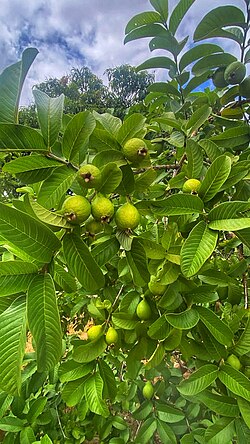
The apple guava (Psidium guajava) is the most widely consumed species. These trees feature tough, dark, opposite leaves that are elliptic to ovate, measuring between 5 and 15 centimeters in length. Their flowers are white with five petals and numerous stamens.
While the apple guava is the standard, other species include the strawberry guava (Psidium cattleyanum) and the pineapple guava (Feijoa sellowiana). In Hawaii, the strawberry guava has become an aggressive invasive species, threatening over 100 native plant species.
The Fruit: Appearance and Flavor
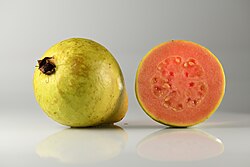
Guava fruits typically range from 4 to 12 centimeters in length and can be round or oval. They are characterized by a distinct fragrance reminiscent of lemon rind. The outer skin varies by species; it can be rough and bitter or soft and sweet, transitioning from green to yellow, maroon, or remaining green upon ripening.
The interior pulp is equally diverse, ranging from off-white ("white" guavas) to deep pink ("red" guavas), with a flavor profile that shifts between sweet and sour. The central pulp contains seeds that vary in hardness and number depending on the variety.
Nutrition and Phytochemicals
Guavas are highly nutritious, consisting of 81% water. They are particularly noted for their high concentration of Vitamin C, providing 254% of the Daily Value (DV) per 100 grams. They also offer significant amounts of dietary fiber, potassium (14% DV), and folate (12% DV).
The fruit contains lycopene, a powerful antioxidant. Additionally, guava leaves are rich in polyphenols (such as leucocyanidin and (+)-gallocatechin) and carotenoids. Generally, red-orange guavas possess higher polyphenol and carotenoid levels than yellow-green varieties.
| Nutrient | Amount | % Daily Value (DV) |
|---|---|---|
| Energy | 68 kcal | - |
| Vitamin C | - | 254% |
| Potassium | - | 14% |
| Folate (B9) | - | 12% |
| Dietary Fiber | 5.4 g | - |
| Lycopene | 5200 µg | - |
Culinary Uses and Industrial Applications
Guavas are used globally in a variety of sweet and savory dishes. In Latin America, they are used to make agua fresca and alcoholic beverages like pulque de guayaba. In the Philippines, ripe guava is an ingredient in sinigang, while in Taiwan and East Asia, it is often eaten raw with sweet and sour dried plum powder.
Due to their high pectin content (a gelatinous polysaccharide), guavas are ideal for jams, jellies, and preserves, such as the Brazilian goiabada. Red guavas are sometimes used as a low-acidity substitute for tomatoes in salted sauces. Beyond the fruit, guava wood is highly valued for meat smoking in Hawaii and at U.S. barbecue competitions.
The seeds of the guava are also processed into guava seed oil, which is rich in linoleic acid and used in both culinary and cosmetic products.
Ecology and Propagation
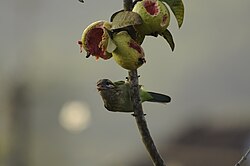
In nature, guavas are a food source for various birds and Lepidoptera caterpillars, such as the Ello Sphinx. However, they are also hosts to pests like the Caribbean fruit fly, which can cause massive economic losses in Central America. Fungal pathogens, such as Pestalotiopsis, can also cause guava scab.
For those looking to grow their own, air layering is the most effective propagation method. This involves making an incision in a healthy branch, applying rooting hormone, and wrapping it in moist peat moss and plastic. This technique ensures the new plant maintains the characteristics of the parent and reaches fruiting size more quickly.
Frequently Asked Questions
Which country is the largest producer of guavas?
India is the world leader in guava production, accounting for 45% of the global total in 2024.
What makes guava a "superfruit" nutritionally?
Guava is exceptionally rich in Vitamin C, providing 254% of the Daily Value per 100 grams, along with high levels of dietary fiber and antioxidants like lycopene.
Can guava trees be grown indoors?
Yes, guavas are one of the few tropical fruits that can be grown to fruiting size in pots indoors, making them ideal for home growers in subtropical areas.
What is the difference between apple guava and strawberry guava?
Apple guava (Psidium guajava) is the most commonly eaten and traded species. Strawberry guava (Psidium cattleyanum) is a different species that, in some regions like Hawaii, has become an aggressive invasive species.
How is air layering used to propagate guavas?
Air layering involves inducing roots to grow on a branch while it is still attached to the parent tree by using a rooting hormone and moist peat moss, allowing for a genetically identical and faster-fruiting new plant.