Guards Division
The Guards Division was an elite heavy infantry formation of the British Army, renowned for its discipline and combat effectiveness. Formed primarily from the prestigious Guards regiments of the Regular Army, the division played a pivotal role in some of the most grueling campaigns of the 20th century, serving with distinction on the Western Front during the First World War and reorganizing for service in the aftermath of the Second World War.
Under the patronage of King George V, the division adopted the "All Seeing Eye" as its official insignia, symbolizing its vigilance and presence across the battlefields of Europe.
Key Facts
- Role: Heavy Infantry.
- Active Periods: August 1915 – April 1919 and June 1945 – January 1947.
- Patron: King George V.
- Primary Theatre: Western Front (WWI).
- Notable Insignia: The "All Seeing Eye".
The First World War (1915–1919)
Formation and Structure
Approved by King George V in July 1915, the Guards Division was officially formed in August 1915 at Lumbres, near St Omer, France. The division was constructed from existing Guards battalions, with the 1st Guards Brigade transferring from the 2nd Division, while the 2nd and 3rd Guards Brigades were composed of units from England and transfers from the 1st and 7th Divisions.
To enhance its firepower, each brigade established a machine gun (M.G.) company of 16 guns. By early 1916, they were further equipped with Trench Mortar (T.M.) Batteries utilizing 3-inch Stokes Mortars—short-range, high-angle fire weapons used to clear enemy trenches.
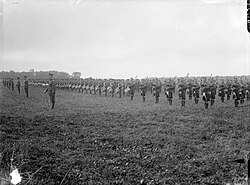
Combat Service on the Western Front
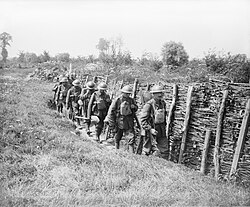
The division's baptism of fire occurred in 1915 during the Battle of Loos and the assault on the Hohenzollern Redoubt. Throughout 1916, the division was heavily engaged in the Battle of the Somme, specifically during the Capture of Lesboeufs and the Battle of Morval.
In 1917, the division faced the brutal conditions of the Third Battle of Ypres (Passchendaele), fighting at Pilckem Ridge and Poelcappelle, before participating in the Battle of Cambrai. As the war evolved, the division adapted to the German Spring Offensive of 1918, eventually transitioning to a war of movement. They fought through the Hindenburg Line and the Final Advance in Picardy, concluding their wartime service with the Capture of Maubeuge on November 9, 1918.
Post-War Transition
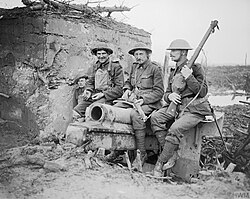
Following the Armistice on November 11, 1918, the division marched into Germany, reaching the Cologne area by December 19. The units gradually returned to England, with the final elements completing their move by April 29, 1919.
The Second World War and Reorganization
The Guards Division was reformed on June 12, 1945, through the reorganization of the Guards Armoured Division. This transition saw the conversion of armored units into infantry to meet the needs of the post-war occupation and stability operations.
- 5th Guards Brigade: Converted from the 5th Guards Armoured Brigade.
- 6th Guards Brigade: Converted from the 6th Guards Tank Brigade.
- 32nd Guards Infantry Brigade: Remained largely unchanged, with the 2nd Battalion, Welsh Guards joining as infantry.
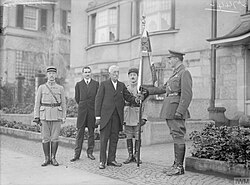
The reorganized division, commanded by Major-General Sir Allan Adair, included the 2nd Household Cavalry Regiment for reconnaissance. The division remained active until it was disbanded in January 1947.
Divisional Summary
| Period | Primary Role | Key Engagements | Final Status |
|---|---|---|---|
| 1915–1919 | Heavy Infantry | Loos, Somme, Passchendaele, Cambrai, Hindenburg Line | Disestablished 1919 |
| 1945–1947 | Infantry | Post-WWII Reorganization | Disbanded Jan 1947 |
Notable Members
Among the division's ranks was 2nd Lieutenant Jack Kipling, the 18-year-old son of author Rudyard Kipling. Serving as a platoon commander in the 2nd Battalion, Irish Guards, he was killed during the Battle of Loos in 1915. The exact circumstances of his death remain a mystery.
Frequently Asked Questions
What was the insignia of the Guards Division?
The division used the "All Seeing Eye" as its official divisional insignia.
How was the Guards Division formed in 1915?
It was formed in France at Lumbres, near St Omer, using battalions from the Regular Army's Guards regiments, approved by King George V.
What happened to the division after the First World War?
After marching into Germany following the Armistice, the division's units returned to England between February and April 1919, where it was subsequently disestablished.
How did the division change during the Second World War?
In June 1945, the Guards Armoured Division was reorganized and redesignated as the Guards Division, converting several armored and tank brigades into infantry brigades.
Who were some of the notable commanders of the division?
Notable commanders included the Earl of Cavan, Major-General G. P. T. Feilding, Major-General T. G. Matheson, and Major-General A. H. S. Adair.