Greeks in Syria: A History of Migration, Culture, and Community
The presence of Greek people in Syria is a story that spans nearly three millennia, weaving together threads of ancient conquest, trade, and forced migration. From the early seafaring tribes of the Iron Age to the sophisticated urban centers of the Hellenistic era and the modern-day enclaves of Greek-speaking Muslims, the Greek influence has left an indelible mark on the Levant. Today, this legacy persists in small but distinct communities across Syria's major cities and rural villages.
Key Facts
- Total Population: Approximately 17,000 people.
- Primary Locations: Damascus, Aleppo, Tartus, Latakia, and Al-Hamidiyah.
- Religious Diversity: Predominantly Greek Orthodox Christianity, with a significant minority of Greek-speaking Muslims of Cretan origin.
- Historical Roots: Presence dates back to the 7th century BC, peaking during the Seleucid Empire.
- Linguistic Legacy: Use of Greek and Arabic; historical use of Koine Greek as a regional lingua franca.
Ancient Origins and the Iron Age
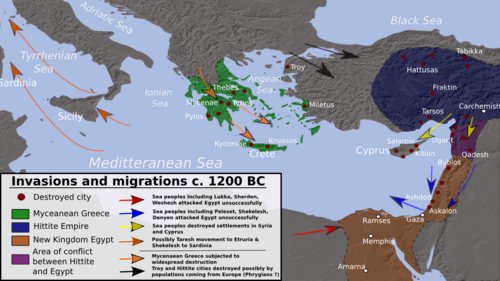
Greek presence in the Levant began long before the famous conquests of Macedonia. During the collapse of the Late Bronze Age, the region experienced a period of violent cultural disruption. This era saw the fall of the Hittite Empire and the New Kingdom of Egypt, creating a political vacuum.
Among the "Sea Peoples"—a collection of nine seafaring tribes that attacked the coastal regions—were the first ethnic Greeks. Scholars believe tribes such as the Denyen, Ekwesh, and Peleset were of Greek origin. The Peleset eventually settled the coast from Gaza to Joppa, becoming known as the Philistines, while the Denyen and Tjeker settled further north toward Acre. Additionally, Al-Mina served as an early Greek trading colony.
The Hellenistic Age and the Seleucid Empire
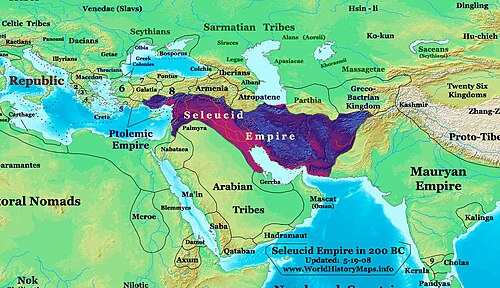
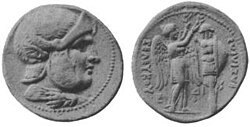
The most transformative period for Greeks in Syria began with Alexander the Great's conquest of the Persian Empire. Following his death, the region fell under the control of Seleucus I Nicator and the Seleucid Empire, a powerhouse of Hellenistic culture.
Unlike earlier migrations, this wave of colonization involved Greeks from across the entire Greek world. The Seleucids established a dominant Greek political elite in newly founded urban centers, most notably the capital, Antioch. To maintain control, the empire planted military colonies (katoikias), garrisons (choria), and villages (komai) throughout the territory.
This era saw the rise of Koine Greek, an Attic-Ionic based dialect that served as the lingua franca (a common language used between people who do not share a native tongue) across the Hellenistic world.
From Roman Rule to the Byzantine Era
Hellenism continued to flourish under Roman administration. In 64 BC, Pompey annexed Seleukeia during the Third Mithridatic War. By 135 AD, following the Bar Kokhba revolt, the region was merged into the province of Syria Palaestina. This province was a melting pot of Phoenicians, Arameans, Jews, and Greek colonists.
During the subsequent Byzantine era, the inhabitants identified as Romaioi (Romans) and Graikoi (Greeks). They spoke "Romaic," a medieval form of Greek that bridged the gap between the ancient Koine and modern Greek. The Diocese of the East became a critical intellectual and military hub for the Byzantine Empire, serving as a bulwark against the Sassanid Empire until the Arab conquests of the 7th century.
The Arab Conquest and Middle Ages
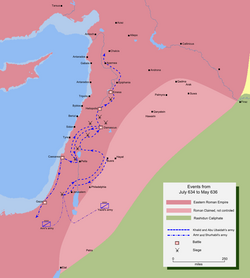
In the first half of the 7th century, the Islamic Province of Bilad al-Sham was established following the Arab Muslim conquests. On the eve of this transition, the region was inhabited by Aramaic-speaking Christians, Arabs, Greeks, and minorities of Jews and Samaritans.
In the Southern Levant, the surrender of Jerusalem to Caliph Umar in 637 or 638 AD resulted in the "Covenant of Umar." This agreement guaranteed the Christian population—including Greek communities—protection and the right to continue their religious practices in exchange for the jizya tax.
The Modern Greek Community in Syria
Modern Greek presence in Syria is characterized by two distinct groups. The first is an organized community in Damascus established in 1913, with other significant populations in Aleppo, Latakia, and Tartus. Most of these individuals hold Syrian nationality.
The second group consists of Greek-speaking Muslims of Cretan origin. Following the Greco-Turkish War of 1897–98, Sultan Abdul Hamid II resettled these populations from Crete to coastal towns in Syria and Lebanon. The village of Al-Hamidiyah remains the most notable enclave, where many residents still speak Greek as their first language.
In recent years, the Syrian Civil War has forced many of these Cretan Muslims to seek refuge in Cyprus or Crete, though they often continue to be viewed as foreigners in their ancestral homeland.
Summary of Greek Populations in Syria
| Group | Estimated Population | Primary Locations | Primary Religion | Language |
|---|---|---|---|---|
| Syrian Greeks | ~4,500 | Aleppo, Damascus, Tartus, Baniyas | Greek Orthodox | Greek, Arabic |
| Cretan Greeks | ~8,000 | Al-Hamidiyah | Islam | Greek, Arabic |
Frequently Asked Questions
Who were the first Greeks to arrive in Syria?
The first ethnic Greeks arrived during the Late Bronze Age collapse as part of the "Sea Peoples," specifically the Denyen, Ekwesh, and Peleset tribes, who settled along the coastal strips of the Levant.
What was the role of the Seleucid Empire?
The Seleucid Empire established a Greek political elite and founded major cities like Antioch, promoting Hellenistic culture and the use of Koine Greek as the regional lingua franca.
Who are the Greek Muslims of Al-Hamidiyah?
They are descendants of Muslims from Ottoman Crete who were resettled in Syria by Sultan Abdul Hamid II after the Ottoman Empire lost Crete to Greece in the late 19th century.
How did the Byzantine Greeks identify themselves?
They identified as Romaioi (Romans) and Graikoi (Greeks), viewing themselves as the political heirs of Imperial Rome and the cultural descendants of classical Greece.
What is the current status of Greeks in Syria?
There are approximately 17,000 people of Greek descent. While some are integrated Syrian citizens in major cities, others are Cretan Muslim refugees who have faced discrimination or displacement due to the Syrian Civil War.