Understanding The Great Learning: A Foundation of Confucian Philosophy
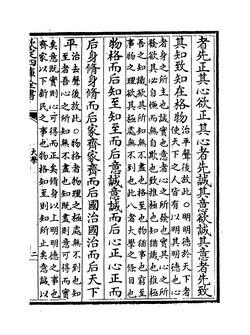
The Great Learning, known in Chinese as Dàxué, is a seminal text that has shaped the intellectual and moral landscape of East Asia for centuries. Originally a chapter within the Book of Rites (one of the Five Classics), it was later extracted and elevated to become one of the "Four Books" of Confucianism. This collection serves as a foundational introduction to Confucian thought, guiding individuals through the journey of self-cultivation and social harmony.
Attributed to the teachings of Confucius and transcribed by his disciple Zengzi, the text consists of a short main body of teachings followed by ten commentary chapters. While the ideals are rooted in the wisdom of Confucius, the written exposition is credited to Zengzi, who lived from 505 to 436 BCE.
Key Facts
- Core Classification: One of the "Four Books" of Confucianism.
- Primary Figures: Attributed to Confucius; transcribed and commented on by Zengzi.
- Historical Significance: Selected by the Neo-Confucian scholar Zhu Xi as a foundational text for the Chinese imperial examination system.
- Main Objective: To achieve "illustrious virtue" through self-cultivation and the "investigation of things."
- Geographic Influence: Deeply impacted the educational and political cultures of China, Japan, Korea, and Vietnam.
The Evolution of the Text
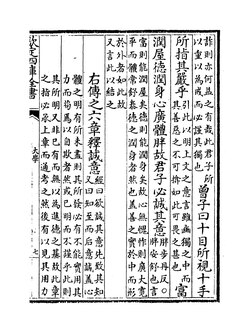
The Great Learning has undergone significant historical transformations. During the Song Dynasty, the Neo-Confucian scholar Zhu Xi played a pivotal role by rearranging the text. He separated it from the Book of Rites and organized it into a primary text followed by ten expositions. Zhu Xi’s goal was to create a more accessible curriculum; he believed the original Classics were too lengthy and complex for the common individual to use as a foundational guide.
Zhu Xi’s version, which included the Doctrine of the Mean, the Analects, and the Mencius, became the standard for the state civil service examinations in China. This ensured that the philosophies of the Great Learning permeated every level of the imperial bureaucracy.
Philosophical Debates and Critiques
The text has not been without controversy. Throughout history, scholars have debated the meaning of its core concepts. One major point of contention is the "investigation of things". In this context, investigation does not refer to modern scientific experimentation, but rather to introspection—the process of looking inward to understand the principles of morality, relationships, and nature.
Later scholars, such as Lu Xiangshan and Wang Yangming, expressed dissatisfaction with the text due to its heavy emphasis on scholarship. Wang Yangming eventually rejected Zhu Xi's structural changes, seeking to return the text to its original context within the Book of Rites.
Principal Teachings and Moral Philosophy
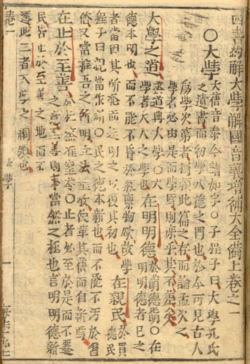
At its heart, the Great Learning provides a roadmap for personal and societal development. It posits that the path to a stable state begins with the individual. The teachings emphasize several interconnected pillars:
- Self-Cultivation: Refining one's moral self to achieve "illustrious virtue," which serves as an example for others.
- The Path of Order: Achieving peace of mind through reflection and calm deliberation. By knowing the "point of rest," an individual can determine their goals and attain the desired end.
- Social Harmony: The belief that one must bring their personal life and family into order before they can hope to bring order to the state.
- Universal Learning: The idea that every person, regardless of social or economic status, is capable of learning and self-improvement through effort.
- Interconnectedness: Education is viewed as an intricate system where no single aspect of learning is isolated; failure in one area affects the whole.
The Lasting Impact on Modern Education
While the imperial examination system is a thing of the past, the influence of the Great Learning remains visible in the educational culture of modern China. Several key characteristics of contemporary learning can be traced back to these Confucian roots:
- Valued Education: A profound respect for education as a means of social mobility and career success.
- Memorization: A tradition of absorbing vast amounts of knowledge to build a foundation for intelligent thought.
- Collaborative Learning: A focus on harmony and group work, reflecting the Confucian value of social relationships.
- Work Ethic: The belief that success is a result of individual effort and hard work rather than innate ability.
- Respect for Educators: A learning atmosphere where teachers are treated with immense respect, often comparable to that given to parents.
Summary of Historical and Cultural Context
| Category | Details |
|---|---|
| Original Source | A chapter in the Book of Rites |
| Key Scholar | Zhu Xi (Song Dynasty) |
| Core Concept | Dàrén zhī xué (Education of adults) |
| Methodology | Investigation of things through introspection |
| Modern Influence | Emphasis on hard work, respect, and collaboration |
Frequently Asked Questions
What does "investigation of things" mean in the text?
It does not refer to scientific experimentation. Instead, it refers to introspection and the study of principles to understand morality, civic duty, and the natural order.
How did Zhu Xi change the Great Learning?
Zhu Xi separated the text from the Book of Rites, organized it into a main text with ten expositions, and included it as one of the "Four Books" to make Confucianism more accessible for students and officials.
Is the Great Learning only for political leaders?
No. While it discusses governance and the state, Zhu Xi presented the text as a way of self-cultivation and governance that should be studied by all people, not just those seeking political office.
How does the text view human ability to learn?
The text suggests that all people are capable of learning and self-cultivation. It posits that failure to learn is typically a result of a lack of effort rather than a lack of inherent ability.
What is the relationship between the individual and the state in this philosophy?
The philosophy suggests a bottom-up approach to order: an individual must first cultivate their own character and bring their family into harmony before they can effectively contribute to the order and harmony of the state.