Gottlieb Daimler: The Engineering Pioneer of the High-Speed Engine
Gottlieb Daimler was more than just an industrialist; he was a visionary engineer whose relentless pursuit of speed and efficiency laid the groundwork for modern transportation. By inventing the high-speed liquid petroleum-fueled engine, Daimler transitioned the world from the era of massive, stationary steam power to the age of mobile, internal combustion machinery.
Working alongside his brilliant collaborator, Wilhelm Maybach, Daimler transformed the concept of the engine from a heavy industrial tool into a compact power source capable of propelling vehicles on land and water. His journey from a small-town gunsmith to the founder of the Daimler Motoren Gesellschaft (DMG) is a testament to the power of technical curiosity and industrial ambition.
Key Facts
- Primary Invention: The high-speed liquid petroleum-fueled internal combustion engine.
- First Motorcycle: Created the Reitwagen (riding car) in 1885.
- First Four-Wheeled Vehicle: Converted a stagecoach into an automobile in 1886.
- Company Foundation: Established Daimler Motoren Gesellschaft (DMG) in 1890.
- Key Partnership: Collaborated extensively with engineer Wilhelm Maybach.
- Legacy: Inducted into the Automotive Hall of Fame in 1978.
Early Life and Technical Education
Born on March 17, 1834, in Schorndorf, Württemberg, Gottlieb Daimler grew up in a modest household; his father was a baker. His fascination with engineering emerged early, and by age 13, he had completed his primary studies. He initially trained as a gunsmith under Master Hermann Raithel, graduating in 1852 after producing a pair of engraved double-barreled pistols.
Driven by a desire for broader mechanical knowledge, Daimler moved to Stuttgart to attend the School for Advanced Training in the Industrial Arts. His dedication led him to a foreman position at Rollé und Schwilque by the age of 22, where he gained experience in railway locomotive production.
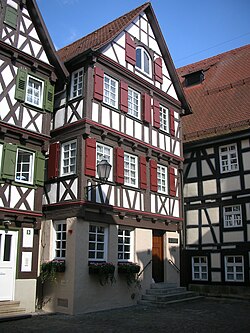
To master the cutting edge of technology, Daimler traveled to Paris and England between 1861 and 1863. In Manchester, he worked at Beyer, Peacock & Company, where he became an expert in machine tools. While he witnessed early steam carriages at the 1862 International Exhibition in London, his primary focus remained the improvement of metal and woodworking machinery.
The Path to the Internal Combustion Engine
Daimler's career progressed through various leadership roles at Maschinenfabrik Daniel Straub and Bruderhaus Reutlingen. It was at the latter that he met Wilhelm Maybach, a 15-year-old orphan who would become his most vital technical partner.
In the late 1870s, Daimler became interested in the four-stroke engine patented by Nicolaus Otto. However, a professional rift developed between the two. While Otto focused on large, stationary engines, Daimler envisioned small, high-speed engines suitable for transportation. After being fired from Otto's company in 1880, Daimler used his compensation to pursue his own independent designs.
The "Dream Engine" and the Grandfather Clock
In December 1883, Daimler and Maybach patented an engine fueled by ligroin (a petroleum solvent). This "Dream Engine" achieved a speed of 750 rpm, significantly faster than contemporary designs. By 1885, they developed the Standuhr, or "grandfather clock" engine, so named because its vertical cylinder resembled a pendulum clock.
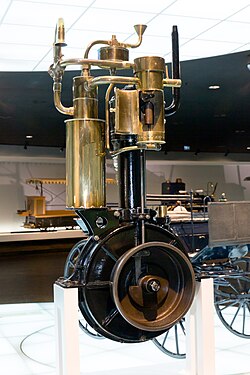
The 1885 engine featured a 264 cc single horizontal cylinder, air cooling, and a hot tube ignition system. It produced 0.5 hp at 600 rpm, far surpassing the 120 to 180 rpm typical of other engines of the era.
Revolutionizing Transport: Land and Water
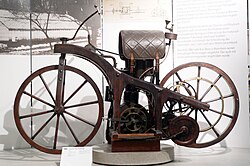
Daimler did not stop at the engine; he sought to apply this power to movement. In November 1885, he installed a small engine into a wooden frame with outrigger wheels, creating the Reitwagen, the world's first internal combustion motorcycle.
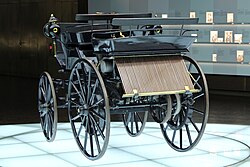
In March 1886, Daimler and Maybach took a bold step by installing a 1.1 hp version of their engine into an American Model coach. This created the first four-wheeled automobile capable of reaching 16 km/h (10 mph).
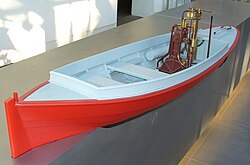
Daimler also expanded into marine transport. By mounting an engine in a 4.5-meter boat named the Neckar, he created the first motorboat. To soothe customers who feared the petrol engine might explode, Daimler initially hid the engine under a ceramic cover and described it as "oil-electrical."
The Rise of Daimler Motoren Gesellschaft (DMG)
As demand grew, Daimler established the Daimler Motoren Gesellschaft (DMG) on November 28, 1890. The company's goal was to build high-speed engines for land, water, and air—a vision represented by the three-pointed star that would eventually become a world-famous logo.

Despite the company's success, Daimler faced internal conflicts with stockholders and health issues. He resigned in 1893 but returned in 1894 after the intervention of Frederick Simms, who helped stabilize the company's finances through British licensing agreements. By 1895, DMG had assembled its 1,000th engine.
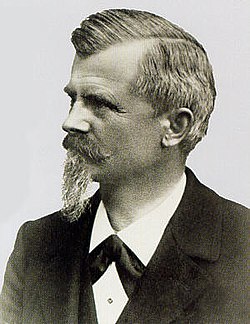
Daimler's later years were marked by legal battles over patents, including a successful suit against Karl Benz regarding hot tube ignition. Though the two pioneers never met during their inventive periods, their legacies eventually merged into the automotive giant known today as Daimler-Benz.
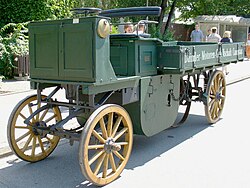
Technical Summary of Early Daimler Innovations
| Innovation | Year | Key Feature | Primary Application |
|---|---|---|---|
| Dream Engine | 1883 | Ligroin fuel, 750 rpm | Experimental |
| Grandfather Clock | 1885 | Vertical cylinder, 600 rpm | Stationary/General |
| Reitwagen | 1885 | Wooden frame, outriggers | Motorcycle |
| Motorcoach | 1886 | 1.1 hp, belt drive | Automobile |
| Neckar Boat | 1886 | Marine petrol engine | Motorboat |
Frequently Asked Questions
What was the Reitwagen?
The Reitwagen, created in 1885, was the first internal combustion motorcycle. It consisted of a wooden frame with two outrigger wheels for stability and was ridden by Wilhelm Maybach for a three-kilometer test run.
How did the "Grandfather Clock" engine get its name?
The engine was named the Standuhr (grandfather clock) because Gottlieb Daimler felt its vertical cylinder design resembled the appearance of an old pendulum clock.
What is the significance of the three-pointed star in Daimler's history?
The three-pointed star was based on a sketch by Daimler representing his ambition to use high-speed engines for transportation on land, on water, and in the air.
Did Gottlieb Daimler and Karl Benz work together?
No, they did not work together during their period of invention and never met while in court during a patent dispute. Their companies only merged much later to form Daimler-Benz.
What fuel did the first Daimler engines use?
The first engines were fueled by ligroin, a liquid petroleum solvent, before the development of carburetors allowed for the use of gasoline.