Gnateaters: The Elusive Insectivores of the Americas
Hidden within the dim, dense undergrowth of Central and South American forests live the gnateaters. Members of the family Conopophagidae, these small, enigmatic birds are suboscine passerines—a group of songbirds with a simpler vocal organ than the oscines. Because they inhabit remote and shadowy environments, gnateaters remain one of the least studied and most mysterious families of birds in the Western Hemisphere.
Key Facts
- Family: Conopophagidae, consisting of 12 species across two genera.
- Distribution: Found throughout Central and South America.
- Habitat: Primarily forest understories, bamboo stands, and the forest floor.
- Diet: Primarily insectivorous, feeding on spiders, larvae, and beetles.
- Physical Traits: Round bodies, short tails, and long legs.
Taxonomy and Evolution
The family Conopophagidae was first established in 1877 by English zoologist Alfred Henry Garrod. For many years, the family was thought to contain only the genus Conopophaga. However, a 2005 molecular phylogenetic study—the analysis of genetic relationships over time—revealed that the genus Pittasoma (previously placed in the Formicariidae family) is actually the sister group to Conopophaga.
This genetic link is supported by shared characteristics in their morphology, vocalizations, and natural history. Evolutionarily, gnateaters are most closely related to antbirds, and more distantly related to tapaculos and antpittas.
Physical Characteristics
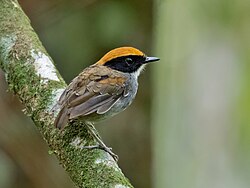
Gnateaters are characterized by their compact, round shapes, short tails, and relatively long legs, which they use to maintain an upright posture when standing. They typically measure between 12 and 15.5 cm (4.7 to 6.1 inches) in length, with species in the Pittasoma genus generally being larger than those in Conopophaga.
All species exhibit sexual dimorphism, meaning males and females differ in appearance, though the degree of this difference varies by species. A distinguishing feature for most Conopophaga species is a small white tuft of feathers located behind the eye.
Distribution and Habitat
These birds are specialists of the forest floor and understory. Their distribution is split between the two genera:
- Conopophaga: Found in the Atlantic Forest, the Amazon and Orinoco basins, and the central and eastern slopes of the Andes.
- Pittasoma: Located in Panama, Costa Rica, and the Chocó region.
While most gnateaters require humid environments, some species have adapted to the drier regions of eastern Brazil. Their behavior varies by genus; Conopophaga species rarely spend significant time on the ground and typically stay within 1.5 meters of the forest floor. In contrast, Pittasoma species are more frequently observed hopping directly on the ground.
Behavior and Diet
As their name suggests, gnateaters are primarily insectivorous. Species within the Conopophaga genus employ two main hunting strategies. The first involves perching above the forest floor, spotting prey, and lunging down to snatch it—returning to a perch within seconds. The second method is gleaning, where they pick insects directly from branches, trunks, and low foliage.
Their diet consists mainly of caterpillars, spiders, beetles, grasshoppers, and insect larvae. While rare, some individuals have been observed eating fruit or even a frog. While specific dietary data for Pittasoma is limited, they are presumed to be insectivorous as well.
Species Summary
| Genus | Number of Species | Notable Species |
|---|---|---|
| Conopophaga | 10 | Rufous, Chestnut-crowned, and Black-cheeked Gnateaters |
| Pittasoma | 2 | Black-crowned and Rufous-crowned Antpittas |
Frequently Asked Questions
What is the difference between Conopophaga and Pittasoma?
Pittasoma species are generally larger and more likely to hop on the ground, whereas Conopophaga species are smaller, often have a white tuft behind the eye, and prefer perching slightly above the forest floor.
Where can gnateaters be found?
They are native to Central and South America, inhabiting humid forest understories, bamboo stands, and the forest floor, with some species extending into drier areas of eastern Brazil.
What do gnateaters eat?
They are primarily insectivores that eat spiders, beetles, grasshoppers, and larvae. Occasional reports indicate they may also consume fruit or small frogs.
Why are gnateaters poorly understood by scientists?
Their preference for remote, dim, and often impenetrable forest habitats makes them difficult for researchers to observe and study in the wild.
Are gnateaters related to antbirds?
Yes, molecular and morphological evidence indicates that gnateaters are very closely related to antbirds, though they are more distantly related to tapaculos and antpittas.