Global Organism Populations: Mapping Earth's Biological Abundance
Quantifying the sheer volume of life on Earth is a monumental task that blends biology with mathematics. This effort falls under the scientific disciplines of population ecology (the study of how populations change over time and space) and biogeography (the study of the distribution of species). To reach these estimates, scientists employ various methods: direct censuses for species like the piping plover, the transect method for the mountain plover, and since 2012, satellite imaging, which was first used to count emperor penguins.
Key Facts
- Over 99% of all species that ever existed on Earth are now extinct.
- There are roughly 10 quintillion individual insects alive at any given time.
- The global tree population is estimated at 3 trillion individuals.
- Domesticated chickens are the most numerous bird species, totaling 23.7 billion.
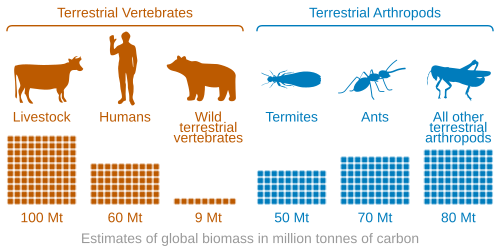
- Ants may number up to 20 quadrillion, with a biomass exceeding all wild birds and non-human mammals combined.
The Scale of Species Diversity
The history of life is defined by loss; it is estimated that over five billion species have lived on Earth, but more than 99% of them are extinct. Current estimates for existing species vary wildly. Some studies suggest between 10 million and 14 million species, with only 1.2 million documented. Other research indicates that as many as 1 trillion species may exist, meaning only 0.1% have been described.
The gap between quantified and described species is significant, particularly in the oceans, where marine microbial species alone could number 20 million. This disparity often means that lists of known species are biased toward those on the K side of the r/K selection continuum—organisms that produce fewer offspring but invest more in their survival, making them easier to track than rapid-breeding microbes.
On a molecular level, the total mass of the biosphere is estimated at 4 TtC (trillion tonnes of carbon). The total related DNA base pairs on Earth are estimated at 5.0 × 10 and weigh 50 billion tonnes. In 2016, scientists identified 355 genes from the Last Universal Common Ancestor (LUCA), the root from which all current life descended.
Comparing Domains: Prokaryotes vs. Eukaryotes
Life is divided into domains, with prokaryotes (single-celled organisms lacking a nucleus, such as bacteria) vastly outnumbering eukaryotes (organisms with complex cells, including plants and animals). Prokaryotes number between 4×10 and 6×10 cells, with a carbon mass of 350–550 Pg.
Despite their smaller size, eukaryotes maintain a collective global biomass roughly equal to that of prokaryotes because individual eukaryotic organisms are generally much larger.
The Microscopic Majority
The most numerous bacteria are believed to be from the Pelagibacterales (SAR11) clade, specifically Pelagibacter ubique. The oceans are estimated to hold 2.4 octillion SAR11 cells, which are in turn preyed upon by the world's most numerous viruses: bacteriophages. Beyond the surface, the Deep Carbon Observatory has found that life in the Earth's interior contains 15 to 23 billion tons of carbon.
Animal Populations and Biomass
The animal kingdom shows a stark contrast between the abundance of invertebrates and vertebrates. Insects are the dominant force, with roughly 1.4 billion insects for every single human. This totals approximately 10 quintillion individuals.
Ants are particularly successful, colonizing nearly every landmass. With a population estimated between 10 and 100 quadrillion, a mid-range estimate of 20 quadrillion ants results in 12 megatons of dry carbon—surpassing the combined biomass of all wild birds and non-human mammals.
![A swarm of common starlings. This species numbers over 310 million: at least as many individuals as the United States has humans.[1][2]](/images/c4/4d/c44d9e5472b6073a75d8cbec5c08cfc41427f4d7f2664d3a66aac5bfd264b30d.jpg)
Vertebrate Highlights
While mammals and birds are highly visible, their numbers vary greatly by species. In the avian world, the domesticated chicken is the clear leader with 23.7 billion individuals. In contrast, some reptiles face extreme scarcity. The Chinese alligator has only 100–200 individuals remaining in the wild, and the Komodo dragon population is limited to 4,000–5,000 individuals across a few Indonesian islands.
Global Flora and Forest Density
Plant populations have been revised upward as technology improves. In 2005, NASA estimated 400 billion trees globally; by 2015, this estimate rose to 3 trillion. A significant portion of this is concentrated in the Amazon, where the forest yields approximately 430 billion trees, with the broader Amazonia region (including the Guiana Shield) harboring around 390 billion.
| Group | Estimated Population/Biomass | Notes |
|---|---|---|
| Insects | 10 Quintillion | ~1.4 billion per human |
| Ants | 10–100 Quadrillion | 12 megatons dry carbon (at 20 quadrillion) |
| Trees | 3 Trillion | Revised from 400 billion in 2005 |
| Domestic Chickens | 23.7 Billion | Most numerous bird species |
| SAR11 Bacteria | 2.4 Octillion | Found in Earth's oceans |
Frequently Asked Questions
How many species are currently alive on Earth?
Estimates vary significantly. Some scientists suggest between 10 million and 14 million species, while a 2016 report suggests there could be as many as 1 trillion species, the vast majority of which remain undescribed.
Which animal has the highest population?
Among insects, ants are among the most numerous, with estimates reaching up to 100 quadrillion. Among birds, the domesticated chicken is the most numerous at 23.7 billion.
What is the difference between biomass and population?
Population refers to the total number of individual organisms, whereas biomass refers to the total mass of living biological organisms in a given area or biosphere, often measured in carbon (C).
How do scientists count animals from space?
Using satellite imaging, researchers can identify and count large colonies of animals. This method was first successfully applied to count emperor penguin populations in 2012.
Why are so many species undescribed?
Many organisms, particularly marine microbes and deep-earth bacteria, are too small or inaccessible for traditional census methods. Additionally, the sheer volume of diversity—potentially trillions of species—outpaces the rate at which scientists can document them.