Gilbert N. Lewis: The Architect of Modern Chemical Bonding
Gilbert Newton Lewis was a titan of 20th-century science whose insights into the behavior of electrons fundamentally changed how we perceive the molecular world. An American physical chemist and the dean of the college of chemistry at the University of California, Berkeley, Lewis provided the theoretical framework for the covalent bond—the shared pair of electrons that holds atoms together. From coining the term "photon" to redefining acids and bases, his intellectual curiosity spanned thermodynamics, quantum physics, and relativity.
Key Facts
- Primary Contribution: Discovered the covalent bond and developed the concept of electron pairs.
- Famous Tools: Created Lewis dot structures to visualize chemical bonding.
- Academic Legacy: Mentored numerous Nobel laureates, establishing UC Berkeley as a global chemistry hub.
- Scientific Breadth: Contributed to photochemistry, isotope separation, and the mass-energy relationship in relativity.
- Terminology: Coined the term "photon" in 1926 to describe the smallest unit of radiant energy.
Early Life and Academic Journey
Born in 1875 in Weymouth, Massachusetts, Lewis was an intellectually precocious child who learned to read by age three. After receiving a primary education at home, he pursued higher education at Harvard University, where he earned his PhD in chemistry under the guidance of Theodore William Richards. His early doctoral work focused on a general equation for free energy and physico-chemical equilibrium.
Lewis's career was marked by diverse experiences, including a period as the Superintendent of Weights and Measures for the Bureau of Science in Manila, Philippines, and a faculty position at the Massachusetts Institute of Technology (MIT). In 1912, he moved to California to join the University of California, Berkeley, where he served as a professor and dean for the remainder of his life.
Revolutionizing Chemical Theory
The Covalent Bond and Valence Theory
One of Lewis's most enduring legacies is his work on valence—the combining power of an element. In 1902, he conceptualized the "cubic atom," imagining atoms as concentric cubes with electrons at the corners to explain the periodic table's eight-element cycle.
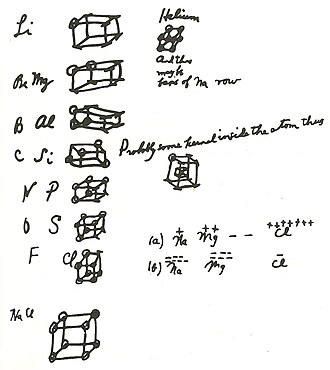
By 1916, this evolved into his theory of the shared electron pair bond. This breakthrough led to the creation of Lewis dot structures, which allow chemists to visualize how atoms share electrons to achieve stability, shaping modern valence bond theory.
Thermodynamics and Fugacity
Lewis sought to transform thermodynamics from a collection of isolated equations into a rigorous, logical system. He introduced the concept of activity and coined the term fugacity (meaning "escaping tendency") to describe the tendency of a substance to move from one chemical phase to another. While his goal of a universal system wasn't fully realized, fugacity remains essential for describing real gases.
Acids, Bases, and Heavy Water
Lewis expanded the definition of acids and bases beyond simple proton transfer. He proposed that a base is a substance that provides a lone pair of electrons, while an acid is a substance that accepts such a pair. Later, in 1933, he achieved a milestone in isotope separation by producing the first pure sample of deuterium oxide, commonly known as heavy water.
Contributions to Physics and Relativity
Beyond chemistry, Lewis explored the frontiers of physics. In 1908, he published research on relativity, deriving the mass-energy relationship independently of Albert Einstein. He also collaborated with Richard C. Tolman and Edwin Bidwell Wilson to apply synthetic geometry to the study of spacetime, noting the identity between a spacetime squeeze mapping and a Lorentz transformation.
Legacy and the Nobel Controversy
Despite being nominated 41 times, Gilbert N. Lewis never won the Nobel Prize in Chemistry. This remains one of the most significant controversies in the history of the prize. However, his influence is evident in the success of his students. He mentored a generation of scientists who went on to win 14 Nobel Prizes, including Harold Urey, Glenn T. Seaborg, and Melvin Calvin.
Lewis passed away on March 23, 1946, in his Berkeley laboratory. While the coroner cited coronary artery disease, some colleagues speculated the cause was related to his work with liquid hydrogen cyanide. Today, his legacy lives on through Lewis Hall at UC Berkeley.
| Field | Key Contribution | Impact |
|---|---|---|
| Chemical Bonding | Covalent Bond / Electron Pairs | Foundation of modern molecular structure |
| Thermodynamics | Fugacity and Activity | Improved description of real gases and solutions |
| Acid-Base Theory | Electron Pair Transfer | Broadened the chemical definition of acids/bases |
| Quantum Physics | Coined the term "Photon" | Standardized terminology for radiant energy |
| Isotope Chemistry | Purification of Heavy Water | Enabled study of deuterium and atomic nuclei |
Frequently Asked Questions
What is a Lewis dot structure?
A Lewis dot structure is a visual representation of the valence electrons of an atom, using dots to represent electrons and lines to represent shared pairs (covalent bonds), helping chemists predict molecular geometry and reactivity.
Why is the "Lewis Acid/Base" theory important?
It is important because it generalizes the concept of acids and bases. Instead of focusing only on hydrogen ions (protons), it defines them by the movement of electron pairs, allowing the theory to apply to many more chemical reactions.
What is "heavy water" and why did Lewis study it?
Heavy water is deuterium oxide, where hydrogen is replaced by its heavier isotope, deuterium. Lewis was the first to produce a pure sample, which allowed for the study of atomic nuclei and the effects of isotopes on life forms.
Why did Gilbert N. Lewis never win a Nobel Prize?
Despite 41 nominations and foundational contributions to chemistry, he never received the prize. This is considered a major controversy, potentially exacerbated by professional disputes or the Nobel Committee's specific criteria at the time.
What does the term "fugacity" mean in chemistry?
Coined by Lewis, fugacity refers to the "escaping tendency" of a substance. It is a measure of the chemical potential of a real gas, acting as a corrected version of pressure for non-ideal systems.