Giant Sequoia: Global Distribution and Ornamental Growth
The Giant Sequoia (Sequoiadendron giganteum) is one of the most iconic and popular ornamental trees in the world. While native to the mountains of California, its majestic stature and resilience have led to its successful cultivation across diverse climates in Europe, North America, Australia, and New Zealand.
These trees are prized for their scale and longevity, thriving in regions with moist soils and temperate climates. While they are generally hardy, their success outside their native range depends heavily on local conditions and, in some cases, specific horticultural varieties selected for cold resistance.
Key Facts
- Temperature Tolerance: Can withstand short periods of −31 °C (−25 °F) or colder if roots are insulated by mulch or snow.
- Global Reach: Successfully grown in Western/Southern Europe, the Pacific Northwest, Southern US, Southeast Australia, New Zealand, and Central-Southern Chile.
- Growth Speed: Known for remarkably fast growth rates in certain European and North American regions.
- Native Status: Approximately 60,000 individuals remain in their native California habitat as of 2021.
- Cultivars: Various ornamental types exist, including blue, compact blue, powder blue, hazel smith, and weeping (pendulum) varieties.
Cultivation in Europe
Europe has embraced the giant sequoia as a centerpiece for public parks and private estates. The species is particularly well-established in the United Kingdom, France, Germany, and Italy.
France and Germany
France holds the record for the tallest giant sequoia measured outside the United States. Planted near Ribeauvillé in 1856, this specimen reached a height of 57.7 m to 58.1 m (189–191 ft) by 2014.
In Germany, the oldest and largest specimen was planted in 1852 near Bensheim as a gift from the British Royal Family. By 2015, it measured 44.35 meters (145.5 ft) tall. Germany also utilized the species for forestry evaluations, with seedlings from the Wilhelma greenhouses in Stuttgart distributed across the country to test soil and elevation suitability.
United Kingdom
The giant sequoia arrived in Britain in 1853 via Patrick Matthew and later through a large shipment from the Calaveras Grove via the Veitch Nursery. Growth in the UK is exceptionally fast; the tallest tree, located at Benmore in southwest Scotland, reached 56.4 m (185 ft) by 2014.
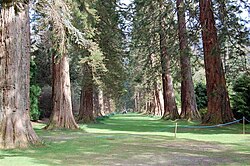
While the UK hosts thousands of notable sequoias, their volume remains small compared to native California giants. For instance, the largest UK specimens reach volumes of 90–100 m³, whereas the General Sherman tree in California boasts a volume of 1,489 m³.
Italy and Other European Regions
Italy features several specimens between 40 and 48 meters tall, with the largest located in Roccavione, Piedmont, featuring a basal circumference of 16 meters (52 ft). In other regions, such as Denmark and Poland, growth is limited by extreme winter cold, though some trees have survived temperatures as low as −37 °C (−35 °F) under heavy snow cover.
North American Distribution
Outside of their native California range, giant sequoias thrive in the Pacific Northwest, extending from Oregon north to southwest British Columbia. In these areas, they are common in both rural farms and urban settings.
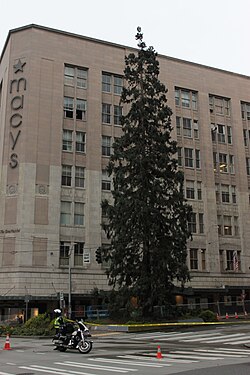
In the northeastern United States, growth is slower and trees are more susceptible to Cercospora and Kabatina (fungal diseases) due to hot, humid summers. However, the 'Hazel Smith' cultivar, selected around 1960 for its cold tolerance, has shown greater success in this region.
Conservation Challenges
In their native California, the population faces significant threats. Between 2020 and 2021, the Castle Fire and the KNP Complex & Windy Fire destroyed an estimated 13–19% of the mature population. Experts suggest that prescribed burns are essential to reduce fuel loads and protect the remaining trees.
Growth in the Southern Hemisphere
The giant sequoia has also found a home in Australia and New Zealand, where they are often associated with mid-Victorian era plantings.
Australia
Significant collections exist in the Ballarat Botanical Gardens and the Pialligo Redwood Forest near Canberra. In Tasmania, the species is found in both public and private gardens, including the National Trust-listed trees in St David's Park, Hobart, planted in 1937.
New Zealand
The South Island is home to several robust specimens. Notable examples include trees in Christchurch, Queenstown, and Picton. Some of the oldest specimens, such as those in the suburb of Redwood and at St James Church, are estimated to be around 160 years old.
Global Growth Summary
| Region | Notable Specimen/Location | Key Metric | Notes |
|---|---|---|---|
| USA (California) | General Sherman | 1,489 m³ volume | Native range; largest by volume |
| France | Ribeauvillé specimen | ~58.1 m height | Tallest outside the USA |
| UK (Scotland) | Benmore specimen | 56.4 m height | Fast growth in UK climate |
| Germany | Bensheim specimen | 44.35 m height | Oldest in Germany (planted 1852) |
| Italy | Roccavione specimen | 16 m circumference | Largest basal circumference in Italy |
Frequently Asked Questions
Can Giant Sequoias survive extreme cold?
Yes, they can withstand temperatures of −31 °C (−25 °F) or colder for short periods, provided the root system is insulated with heavy mulch or snow.
Why do Giant Sequoias grow slower in the Northeastern US?
Growth is slower in the Northeast due to the climate and a higher susceptibility to fungal diseases like Cercospora and Kabatina, which thrive in hot, humid summer conditions.
What is the 'Hazel Smith' cultivar?
The 'Hazel Smith' is a cold-tolerant clone selected around 1960. It has proven more successful for cultivation in the northeastern United States than standard seedlings.
How do European Giant Sequoias compare to those in California?
While European trees can reach impressive heights (over 50 meters), they are significantly smaller in volume. The largest UK specimens reach 90–100 m³, compared to the 1,489 m³ of the General Sherman in California.
What threats do native Giant Sequoias face today?
Native populations in California are threatened by drought and high-intensity wildfires, exacerbated by previous fire suppression efforts. Prescribed burns are recommended to manage fuel loads.