German Centre Party: The History of Political Catholicism in Germany
The German Centre Party (Deutsche Zentrumspartei) stands as one of the most influential forces in the history of German politics. Rooted in Political Catholicism—the application of Catholic social and moral principles to political governance—the party served as a critical bridge between diverse ideological factions for over a century. From its origins as a protector of church liberties to its role as a pillar of the Weimar Republic, the Centre Party has navigated the turbulent waters of German nationalism, religious conflict, and totalitarianism.
Founded in its original form on December 13, 1870, by Joseph Görres, the party sought to represent the interests of Catholics in a predominantly Protestant empire. Its name, "Centre," was not merely ideological but literal; in the Prussian Landtag, its representatives sat physically between the conservatives on the right and the liberals on the left.
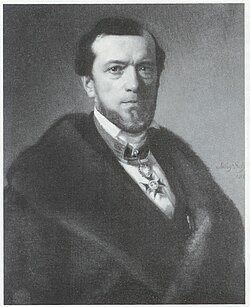
Key Facts
- Founded: December 13, 1870 (Original); 1945 (Current form).
- Core Ideology: Christian democracy and Political Catholicism.
- Historical Role: A mainstay of the Weimar Republic, participating in every government between 1919 and 1932.
- Key Figures: Ludwig Windthorst, Heinrich Brüning, and Wilhelm Marx.
- Current Status: A small party with limited electoral representation, headquartered in Dormagen, NRW.
Origins and the Struggle for Religious Liberty
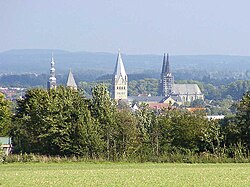
The seeds of the Centre Party were sown during the German revolutions of 1848–1849. During this era, Catholic federations and a "Catholic club" in the National Assembly worked to protect the liberties of the Church. While the demise of the National Assembly was a setback, the movement persisted in the Kingdom of Prussia.
By 1858, the group adopted the name "Fraction of the Centre" to signal an openness to non-Catholics. This strategic move allowed the party to broaden its appeal beyond a strictly confessional base, though it remained deeply rooted in the Catholic faith.
The Era of the German Empire
Under the leadership of figures like Ludwig Windthorst (1874–1891), the party became a formidable force in the Reichstag. It navigated the Kulturkampf (culture struggle), a period of intense conflict between the German Empire and the Catholic Church, emerging as a disciplined political machine that could swing elections and influence legislation.

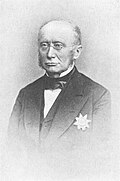
The party's composition was diverse, consisting of various Catholic politicians who often held differing views on the state of the empire, yet remained united by their religious identity.
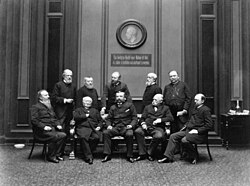
The Centre Party in the Weimar Republic
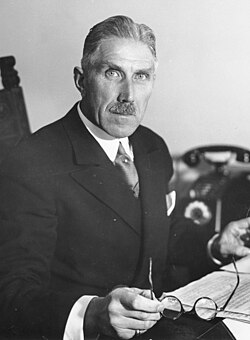
Following World War I, the Centre Party transitioned into a defender of Republicanism. It became a cornerstone of the Weimar Republic, forming the "Weimar Coalition" alongside the SPD (Social Democrats) and DDP (German Democratic Party). Because of its pragmatic nature, the party was ideologically flexible, housing both republicans like Matthias Erzberger and right-wingers like Franz von Papen.
This flexibility allowed the Centre Party to participate in every government from 1919 to 1932, providing four different Chancellors. However, this constant presence in power meant the party shared the blame for the Republic's failures, including the hardships of the Versailles Treaty and economic instability.
Leadership and Governance
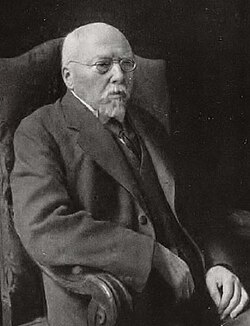
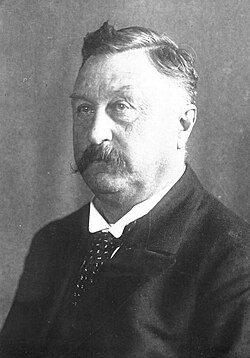
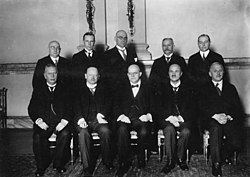
The party produced several key leaders during this era, including Constantin Fehrenbach and Wilhelm Marx. Marx served as Chancellor twice (1923–1925 and 1926–1928), attempting to stabilize the fragile democracy through centrist coalitions.
The Brüning Administration and the Rise of Nazism
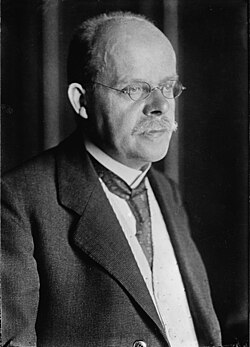
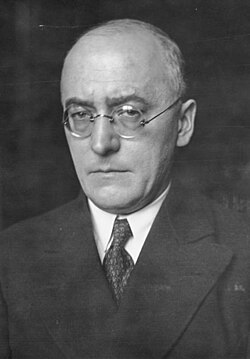
In the early 1930s, the party supported Heinrich Brüning, whose chancellorship was marked by austerity and the deepening Great Depression. Despite the rising tide of extremism, the Centre Party campaigned for the re-election of President Paul von Hindenburg in 1932 to block Adolf Hitler's path to power.
The Collapse and the Enabling Act of 1933
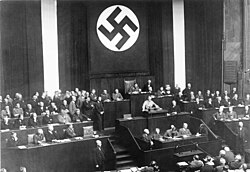
The rise of the Nazi regime brought brutal intimidation. Catholic lay organizations were forcibly closed, and journalists were arrested. In a desperate attempt to preserve the integrity of the Catholic community and its institutions, the Centre Party agreed to dissolve itself in exchange for a Concordat (a treaty between the Holy See and the German state).
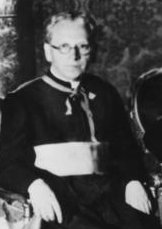
This decision was heavily influenced by the Enabling Act of 1933, which gave Hitler dictatorial powers. The party's leadership, including Ludwig Kaas, hoped that a formal agreement with the regime would protect the Church from total destruction.
Post-War Refounding and Modern Era
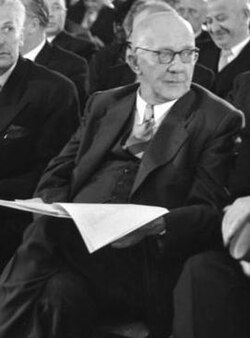
The party was refounded in 1945, but it faced a new challenge: the emergence of the Christian Democratic Union (CDU). The CDU appealed to both Catholics and Protestants, drawing away many former Centre politicians, including Konrad Adenauer. This shift ended the Centre Party's monopoly as the sole representative of the Catholic population.
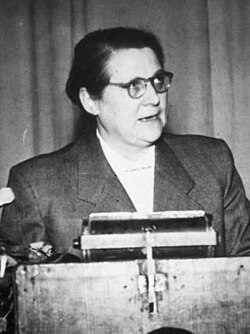
Despite some regional success in North Rhine-Westphalia and Lower Saxony, the party's national influence waned. Helene Wessel, the first woman to lead a German party, served as chairwoman from 1949 to 1952. However, her opposition to West German rearmament and subsequent departure to form the All-German People's Party (GVP) contributed to the party's decline.
Contemporary Status
In recent decades, the party has remained a marginal political force. It saw a brief moment of visibility in June 2022 when Jörg Meuthen joined the party, granting it representation in the European Parliament, though he departed in September 2023.
| Period | Political Role | Key Ideology | Outcome |
|---|---|---|---|
| German Empire (1870–1918) | Protector of Catholic interests | Political Catholicism | Major Reichstag force |
| Weimar Republic (1919–1933) | Government mainstay / Kingmaker | Republicanism / Pragmatism | Participated in all governments |
| Nazi Era (1933–1945) | Dissolved | Survival / Concordat | Forced dissolution |
| Post-War (1945–Present) | Minor regional party | Christian Democracy | Overshadowed by the CDU |
Frequently Asked Questions
Why was the party called the "Centre Party"?
The name originated from the physical seating arrangement in the Prussian Landtag, where Catholic representatives sat in the center, positioned between the conservative right and the liberal left.
What was the party's role in the Weimar Republic?
The Centre Party was a primary stabilizer of the Republic, participating in every government between 1919 and 1932 and providing four different Chancellors.
Why did the Centre Party dissolve in 1933?
The party dissolved under extreme pressure and intimidation from the Nazi regime, hoping that doing so would secure a Concordat to protect Catholic institutions and the community's integrity.
How does the Centre Party differ from the CDU?
While both are Christian democratic, the Centre Party was historically and specifically a party for Catholics, whereas the CDU was founded as an inter-confessional party for both Catholics and Protestants.
Who was the first woman to lead a German political party?
Helene Wessel served as the chairwoman of the Centre Party from 1949 to 1952, making her the first woman to lead a German party.