George Clarke Simpson: Pioneer of Modern Meteorology
Sir George Clarke Simpson was a towering figure in the field of atmospheric science, whose career spanned the globe from the frozen wastes of Antarctica to the humid landscapes of India. A man of immense academic rigor and resilience, Simpson transitioned from a university lecturer to the longest-serving Director of the Meteorological Office in London, leaving an indelible mark on how we measure and understand the wind and atmosphere.
Early Life and Academic Foundations
Born in Derby, England, to Arthur Simpson, a department store proprietor, and Alice Lambton Clarke, George Clarke Simpson began his journey into science at Derby School. He pursued his higher education at Owens College in Manchester, earning a BSc in 1900, followed by advanced postgraduate studies at the University of Göttingen.
Simpson's early career was marked by a drive for field research. In 1902, he traveled to Lapland to investigate atmospheric electricity—the naturally occurring electrical charges in the Earth's atmosphere. By 1905, he made history as the first person to lecture in meteorology at a British university upon his appointment at the University of Manchester.
Global Service and the Terra Nova Expedition
In 1906, Simpson expanded his horizons by joining the Indian Meteorological Service as an Imperial Meteorologist. Based in Simla, he spent significant time inspecting meteorological stations across India and Burma.
His career took a dramatic turn in 1910 when he and colleague Charles Wright were appointed as meteorologists for Robert Falcon Scott's Terra Nova Expedition to Antarctica. Affectionately nicknamed "Sunny Jim" by his peers, Simpson was instrumental in establishing one of the continent's first weather stations. He conducted balloon experiments to analyze the atmosphere and determine the relationship between altitude and temperature, while also managing wind and temperature observations at the Cape Evans base camp.

During the expedition, Simpson held command of the Cape Evans station for several months starting in November 1911, while Scott and his party ventured toward the South Pole.
Life in Simla and the Impact of War
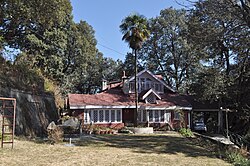
Returning to India in August 1912, Simpson rejoined the Indian Meteorological Services. He resided at Khud Cottage (now known as Madan Kunj) in Simla. It was within these walls that he compiled his Antarctic notes and later processed the devastating news of the death of Scott and the Polar Party in early 1913, an event that led him into a period of deep depression.
The outbreak of World War I in 1914 disrupted his research. Between March and May 1916, Simpson served as the meteorological adviser to the British Expeditionary Force in Mesopotamia (modern-day southern Iraq). He later transitioned to a role as Assistant Secretary to the Board of Munitions, necessitating his departure from Simla.
Leadership at the Meteorological Office
In 1920, Simpson reached a pinnacle of his professional career when he was appointed Director of the Meteorological Office in London. He held this position until 1938, becoming the office's longest-serving Director. His tenure was defined by extensive research into ionization (the process by which an atom or molecule acquires a negative or positive charge), radioactivity, solar radiation, and the causes of lightning.
One of his most enduring contributions came in 1926 with the establishment of the Simpson wind force scale. This was a modification of the Beaufort wind force scale; while the modern standard is still referred to as the Beaufort scale, it incorporates Simpson's refinements.
Final Years and Legacy
Recognized for his contributions to science, King George V knighted Simpson in 1935. Despite retiring in 1938, the onset of World War II saw him recalled to active service in 1939 to lead the Kew Observatory. He continued his research on the electrical structure of thunderstorms there until 1947.
Simpson's academic excellence was honored with honorary doctoral degrees from the universities of Manchester, Sydney, and Aberdeen. He passed away in Bristol on January 1, 1965, at the age of 86.
Key Facts
- First British Lecturer: The first person to lecture in meteorology at a British university (University of Manchester, 1905).
- Antarctic Pioneer: Established one of the first weather stations in Antarctica during the Terra Nova Expedition.
- Wind Scale Innovation: Created the Simpson wind force scale in 1926, modifying the existing Beaufort scale.
- Longest Tenure: The longest-serving Director of the Meteorological Office in London (1920–1938).
- War Service: Served as a meteorological adviser in Mesopotamia during WWI and led the Kew Observatory during WWII.
| Period/Year | Role/Achievement | Location/Organization |
|---|---|---|
| 1905 | First Meteorology Lecturer | University of Manchester |
| 1906 | Imperial Meteorologist | Indian Meteorological Service |
| 1910–1912 | Expedition Meteorologist | Terra Nova Expedition (Antarctica) |
| 1916 | Meteorological Adviser | British Expeditionary Force (Mesopotamia) |
| 1920–1938 | Director | Meteorological Office, London |
| 1939–1947 | Head of Observatory | Kew Observatory |
Frequently Asked Questions
What was George Clarke Simpson's contribution to wind measurement?
In 1926, Simpson developed the Simpson wind force scale, which was a modification of the Beaufort wind force scale. This refined scale remains the basis for the standard wind force scale used worldwide today.
What role did Simpson play in the Terra Nova Expedition?
Simpson served as one of the expedition's meteorologists. He built one of Antarctica's first weather stations, conducted balloon experiments to study the atmosphere and temperature changes at altitude, and commanded the Cape Evans station for several months.
Where did Simpson live while working in India?
Simpson lived at Khud Cottage in Simla, a residence also known as Madan Kunj. This location is historically significant as it was also the residence of the Governor of Burma during the Japanese occupation in World War II.
What scientific areas did Simpson research during his directorship?
As Director of the Meteorological Office, he focused on atmospheric electricity, ionization, radioactivity, solar radiation, and the mechanisms that cause lightning.
How was Simpson recognized for his achievements?
He was knighted by King George V in 1935 and received honorary doctoral degrees from the universities of Aberdeen, Manchester, and Sydney.