George Armstrong Custer's Military Career in the American Civil War
George Armstrong Custer entered the American Civil War as a determined young officer with a penchant for bravery and a lifelong pursuit of publicity. From his early days drilling volunteers in Washington, D.C., to becoming one of the youngest major generals in the Union Army, Custer's trajectory was marked by aggressive leadership and a distinct, often flamboyant, presence on the battlefield.
Early Service and the Peninsula Campaign
Commissioned as a second lieutenant in the 2nd U.S. Cavalry Regiment, Custer's early experience included the First Battle of Bull Run during the Manassas Campaign, where he served as a messenger for Major General Irvin McDowell. After a period of illness in late 1861, he returned to action in March 1862 during the Peninsula Campaign in Virginia.
Custer soon caught the attention of Major General George B. McClellan, commander of the Army of the Potomac. During a reconnaissance of the Chickahominy River, Custer famously demonstrated the river's depth by riding his horse directly into the water to show the General. His boldness continued when he led an attack with four companies of the 4th Michigan Infantry, capturing 50 Confederate soldiers and the first Confederate battle flag of the war. McClellan praised the action as a "very gallant affair," and Custer was promoted to captain on June 5, 1862, though he was later demoted to first lieutenant on July 17.
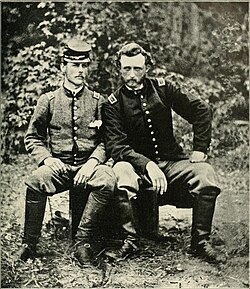
Following the Peninsula Campaign, Custer participated in the Maryland Campaign, including the Battle of South Mountain and the Battle of Antietam.
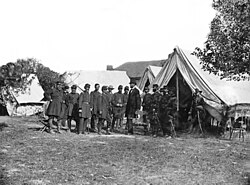
Rise to Brigade Command
In June 1863, Custer became an aide to Brevet Lieutenant Colonel Alfred Pleasonton, who commanded the Cavalry Corps of the Army of the Potomac. Pleasonton sought aggressive leaders to replace political generals, and he found a fit in Custer. At just 23 years old, Custer was promoted to brigadier general of volunteers, taking command of the Michigan Cavalry Brigade, known as the "Wolverines."
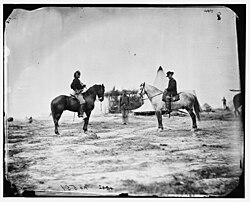
Custer's leadership style was mirrored in his appearance. He adopted a showy uniform, not merely for vanity, but as a tool for command presence. By making himself easily distinguishable, he ensured his men could identify him leading the charge into danger, which he believed was crucial for unit morale.
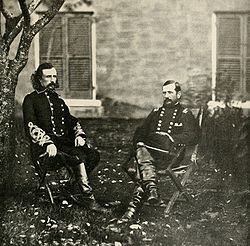
The Road to Gettysburg
During the Gettysburg campaign, Custer's brigade engaged in several critical skirmishes. On June 30, 1863, near Hanover, Pennsylvania, Custer's forces delayed the Confederate cavalry under J.E.B. Stuart, preventing them from joining General Robert E. Lee's main army more quickly.
On July 2, near Hunterstown, Pennsylvania, Custer employed a clever tactical bait. He led a small group of men in a charge to lure the rebels into a trap, where they were then decimated by hidden rifle fire and artillery canister. Although Custer's horse was shot and he was nearly captured, he was rescued by Private Norvell Francis Churchill.
The Climax at Gettysburg
On July 3, 1863, Custer's brigade faced a force of 6,000 Confederates with only 2,700 men. The fighting was brutal, evolving into hand-to-hand combat as ammunition ran low. Custer launched a counterattack with the Seventh Michigan Cavalry, shouting his famous cry, "Come on, you Wolverines!"
In a final, desperate clash, Custer led 400 veteran troopers of the First Michigan Cavalry in a direct charge against Stuart's forces. This action prevented the Confederate cavalry from attacking the Union rear at Cemetery Ridge. While the charge was a tactical success, Custer's brigade suffered 257 casualties—the highest of any Union cavalry brigade at Gettysburg. For his services, he received a brevet promotion to major.
The Shenandoah Valley and Appomattox
In 1864, Custer served under Major General Philip Sheridan in the Shenandoah Valley. This campaign included "The Burning," where the civilian population was specifically targeted. Custer led the 3rd Division in defeating Lieutenant General Jubal Early's army at the Third Battle of Winchester and the Battle of Cedar Creek.
By April 1865, Custer's division played a pivotal role in blocking Robert E. Lee's retreat toward Appomattox Court House. Custer was the officer who received the first flag of truce from the Confederate forces. During the subsequent negotiations, he encountered General James Longstreet, demanding the unconditional surrender of the army in the name of General Sheridan.
Custer was present at the final surrender at Appomattox Court House. As a token of his gallantry, General Sheridan gifted Custer the table upon which the surrender documents were signed, which is now housed in the Smithsonian Institution. On April 15, 1865, at age 25, Custer became the youngest major general in the Union Army.
Key Facts
- Youngest General: Custer became a brigadier general at 23 and a major general at 25.
- The Wolverines: He commanded the Michigan Cavalry Brigade, known for their aggressive charges.
- Gettysburg Impact: His charges on July 3 prevented J.E.B. Stuart from attacking the Union rear.
- Highest Losses: Custer's brigade suffered the most casualties of any Union cavalry brigade at Gettysburg (257 men).
- Appomattox: He received the first flag of truce from Lee's retreating army.
| Date/Period | Event/Role | Key Outcome |
|---|---|---|
| July 1861 | First Battle of Bull Run | Served as messenger for Gen. McDowell |
| May 1862 | Peninsula Campaign | Captured first Confederate battle flag |
| June 1863 | Promotion to Brig. General | Took command of Michigan Cavalry Brigade |
| July 3, 1863 | Battle of Gettysburg | Blocked Stuart's attack on Union rear |
| Oct 1864 | Valley Campaigns | Defeated Jubal Early's army |
| April 1865 | Appomattox Court House | Received first flag of truce; promoted to Maj. Gen. |
Frequently Asked Questions
Why did Custer wear such a flamboyant uniform?
Custer used his showy attire to establish a strong command presence. He believed it was essential for his men to be able to instantly identify him leading the way into danger during the chaos of a charge, thereby boosting unit morale.
What was Custer's role at the Battle of Gettysburg?
Custer commanded the Michigan Cavalry Brigade. He led several aggressive charges that successfully blocked Confederate General J.E.B. Stuart's cavalry from reaching the Union rear at Cemetery Ridge.
Who were the "Wolverines"?
The "Wolverines" was the nickname for the Michigan Cavalry Brigade, which Custer commanded and shaped into an aggressive fighting force.
What happened to the table from the Appomattox surrender?
The table was given to Custer by General Philip Sheridan as a gift for Custer's wife, Libbie. It is currently preserved in the Smithsonian Institution.
How did Custer's career end immediately after the war?
Shortly after the war, Custer illegally seized a valuable racehorse named "Don Juan." Despite orders from General Grant to return the horse to its owner, Richard Gaines, Custer kept the animal until its death.