Geopolitics: The Influence of Geography on Global Power and International Relations
Derived from the Ancient Greek words gê (earth) and politikḗ (politics), geopolitics is the study of how Earth's physical geography shapes political behavior and international relations. While often used as a general synonym for international political relations, it more specifically refers to the global structure of these relations. Historically, the field has evolved from early twentieth-century theories of geographic determinism—the idea that physical environment dictates social and political outcomes—into a sophisticated method for analyzing foreign policy.
At its core, geopolitics examines how variables such as climate, topography, demography, and natural resources influence the behavior of states. By analyzing these factors, scholars aim to understand, explain, and predict international political behavior, treating geography as a vital aid to statecraft.
Key Facts
- Core Focus: The link between political power and geographic space, including land territory, territorial waters, and natural resources.
- Primary Variables: Area studies, climate, topography, demography, and applied regional science.
- Major Schools: Includes the strategic school and the political-economic school, which analyze the intersection of geopolitics and geoeconomics.
- Critical Geopolitics: A modern approach that deconstructs classical theories to reveal the ideological functions they serve for great powers.
Foundational Theories of Global Power
Different nations have developed distinct geopolitical frameworks based on their unique geographic positions. These theories often center on the tension between land-based power and sea-based power.
Sea Power and the American Perspective
Alfred Thayer Mahan emphasized the critical importance of sea power. He argued that a nation's success depends on its ability to control the oceans, which requires a serviceable coastline, a large population capable of defending territory, and a society with an aptitude for commercial enterprise and maritime activity.
The Heartland Theory and British Strategy
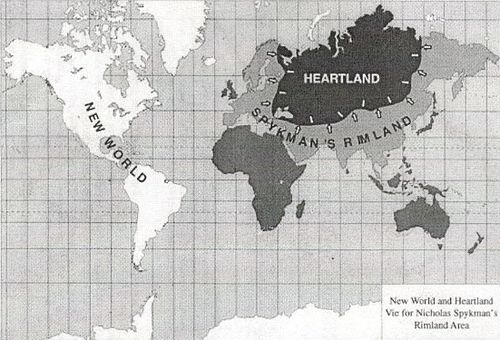
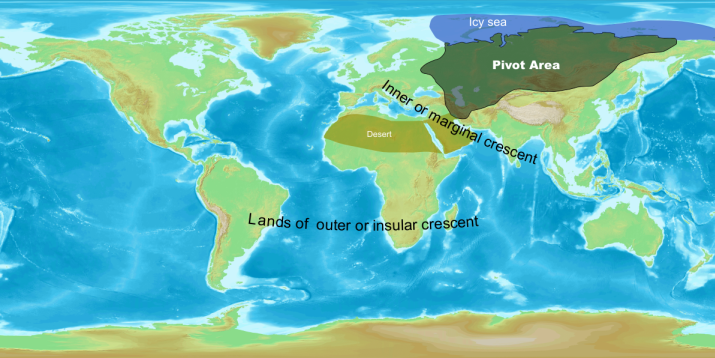
In contrast to Mahan, Sir Halford Mackinder proposed the Heartland Theory in his 1904 work, "The Geographical Pivot of History." Mackinder argued that the 20th century would be the era of land power rather than naval power. He divided the world into the "World Island" (Eurasia and Africa) and the "Peripheral islands" (the Americas, Australia, Japan, and the British Isles).
Mackinder hypothesized that whoever controlled the "Heartland"—the pivot area of Northern Eurasia—would possess sufficient natural resources to maintain a massive empire without relying on coastal or transoceanic transport, effectively dominating the globe.
The Evolution of German Geopolitik
German geopolitics, or Geopolitik, took a biological approach to geography. Friedrich Ratzel, influenced by Darwinism, posited that states are organic entities that must grow. He argued that static borders are a sign of national decline and introduced the concept of Lebensraum (living space), suggesting that a state's health is reflected in the expansion of its borders.
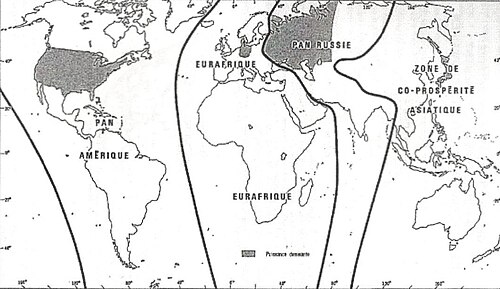
Following World War I, these ideas were expanded by Karl Haushofer. Haushofer emphasized autarky (economic self-sufficiency) and the doctrine of pan-regions, arguing that states have a right to seek natural borders to ensure their survival. These concepts were later co-opted for propaganda purposes by Nazi Germany.
Regional Perspectives and Modern Approaches
The French School
French geopolitics has historically rejected the determinism of the German school. Jacques Ancel was a pioneer in rejecting these views, and later, Yves Lacoste revitalized the field in the 1970s. Lacoste's approach emphasizes multi-level analysis and the use of maps to analyze conflicts, arguing that geography is fundamentally linked to the conduct of war.
Russia and China
Russia's geopolitical stance is rooted in a Eurasian perspective. Modern Russian thinkers, such as Vadim Tsymbursky, have explored concepts like "island-Russia" and the "Great Limitrophe" to describe Russia's unique position in the international order. Similarly, China integrates geopolitics with the law of the sea and large-scale infrastructure projects to expand its influence across Eurasia.
Geopolitical Summary Table
| Theorist/School | Key Concept | Primary Focus | Core Argument |
|---|---|---|---|
| Alfred Thayer Mahan | Sea Power | Maritime Control | Naval supremacy is the key to global dominance. |
| Halford Mackinder | Heartland Theory | Land Power | Control of Northern Eurasia leads to global control. |
| Friedrich Ratzel | Lebensraum | Organic State | States must expand their territory to remain healthy. |
| Yves Lacoste | Multi-scale Analysis | Spatial Dimension | Geography is a tool for understanding and conducting war. |
Frequently Asked Questions
What is the difference between geopolitics and political geography?
While closely related, political geography generally studies the spatial outcomes of political processes, whereas geopolitics focuses on how geography influences the foreign policy and strategic behavior of states.
What is the "World Island" in Mackinder's theory?
The World Island refers to the combined landmass of Eurasia and Africa, which Mackinder viewed as the primary center of global power due to its size and resources.
How does critical geopolitics differ from classical geopolitics?
Classical geopolitics seeks to use geography to predict and guide state behavior. Critical geopolitics deconstructs these theories, analyzing how they are used as ideological tools by powerful states to justify their actions.
What is the concept of autarky in Geopolitik?
Autarky is the pursuit of economic self-sufficiency, where a state seeks to control all necessary natural resources within its own borders to avoid dependence on foreign powers.
How is renewable energy affecting modern geopolitics?
The shift toward renewable energy is altering the traditional geopolitics of petroleum and natural gas, creating new strategic interests and changing the power dynamics associated with energy resource control.