Genus: The Fundamental Rank of Biological Classification
In the complex system of biological classification, a genus (plural: genera) serves as a critical taxonomic rank. It sits positioned above the species level and below the family level, providing a way for scientists to group organisms—including living creatures, fossils, and viruses—that share a close evolutionary relationship and similar characteristics.
The concept of the genus is most visible in binomial nomenclature, the formal system of naming species. In this system, the genus name forms the first part of a species' scientific name. For example, the lion (Panthera leo) and the jaguar (Panthera onca) both belong to the genus Panthera, which in turn is a member of the family Felidae.
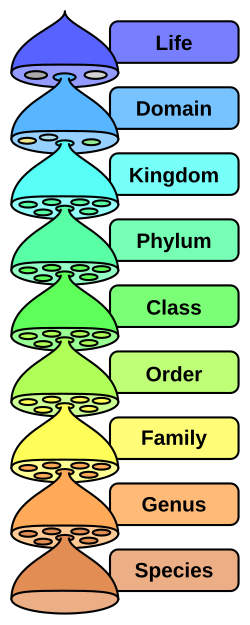
Key Facts
- Position: A taxonomic rank between family (above) and species (below).
- Naming: The first part of a binomial scientific name; always capitalized.
- Origins: Derived from the Latin genus (to bear/give birth to); popularized by Carl Linnaeus in 1753.
- Diversity: Estimated 310,000 accepted genus names exist across all kingdoms.
- Scale: Genus size varies wildly, from single-species genera to those containing thousands of species.
The History and Application of Genera
The modern concept of genera was founded by the French botanist Joseph Pitton de Tournefort (1656–1708) and later popularized by the Swedish taxonomist Carl Linnaeus in his 1753 work, Species Plantarum. Today, the generic name is a cornerstone of scientific communication, ensuring that researchers worldwide can identify the exact group of organisms being discussed.
In professional nomenclature, genus names are often cited with their authorities. In zoology, this typically follows the "author, year" format (e.g., Canis Linnaeus, 1758). In botany, a standard abbreviated author name is used (e.g., Hibiscus L.).
Nomenclature Rules and Categories
Because taxonomy is a dynamic science, the names assigned to genera are governed by strict codes to prevent confusion. These rules differ slightly between biological kingdoms.
Zoological Nomenclature
Under the International Code of Zoological Nomenclature (ICZN), names are classified as either available or unavailable. An available name is one published according to ICZN rules. Among available names, the earliest published name is typically selected as the valid (accepted) name. Unavailable names include those with incorrect spellings or those published in theses without a designated type species.
Botanical Nomenclature
Botany uses the International Code of Nomenclature for algae, fungi, and plants. Here, the equivalent of an available name is a validly published name. Other categories include nomen invalidum (invalidly published), nomen rejiciendum (rejected), and nomen illegitimum (a later homonym). The accepted name in botany is referred to as the correct name.
Synonyms and Homonyms
A synonym occurs when a genus has been described multiple times under different names, or when separate genera are consolidated into one. For instance, the sperm whale genus Physeter has eight listed genus-level synonyms. Conversely, a homonym occurs when the same name is accidentally given to two different genera. Within a single kingdom, homonyms are not permitted. For example, the name Platypus was used for both a beetle and the platypus; because both are animals, the platypus was renamed Ornithorhynchus.
Interestingly, homonyms are permitted across different kingdoms. For example, Aotus is the generic name for both night monkeys (Animalia) and golden peas (Plantae).
Global Distribution and Genus Size
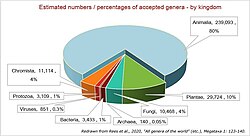
The number of accepted genera is not known with absolute precision, but estimates provide a glimpse into the scale of life. According to Rees et al. (2020), there are approximately 310,000 accepted genus names out of roughly 520,000 published names.
| Kingdom | Estimated Accepted Genera |
|---|---|
| Animalia | 239,093 (± 55,350) |
| Plantae | 28,724 (± 7,721) |
| Chromista | 11,114 (± 1,268) |
| Fungi | 10,468 (± 182) |
| Bacteria | 3,433 (± 115) |
| Protozoa | 3,109 (± 1,206) |
| Viruses | 851 (± 0) |
| Archaea | 140 (± 0) |
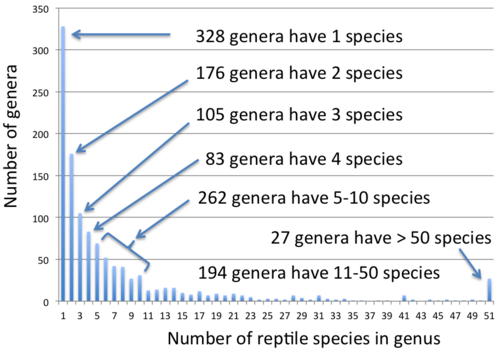
The size of a genus—the number of species it contains—varies dramatically. In non-avian reptiles, most genera contain only a few species, with only 27 genera containing more than 50 species. In contrast, some insect genera like Lasioglossum have over 1,000 species, and the flowering plant genus Astragalus exceeds 3,000 species.
Because there are no objective criteria for grouping species into genera, the process is somewhat arbitrary. This leads to ongoing debates among taxonomists about whether massive, species-rich genera should be split into smaller, more manageable groups to improve identification and classification.
Frequently Asked Questions
What is the difference between a genus and a species?
A genus is a broader taxonomic rank that groups one or more closely related species. In a scientific name, the genus is the first part (e.g., Panthera), while the species is the second part (e.g., leo).
Can two different organisms have the same genus name?
Within the same kingdom, no; this would be a homonym and is not permitted. However, organisms in different kingdoms (such as a plant and an animal) can share the same generic name.
What is a type genus?
A type genus is the genus that serves as the basis for naming higher taxonomic ranks. For example, the genus Poa provides the root for the family Poaceae and the order Poales.
Why do some genera have many synonyms?
Synonyms occur when a genus is described multiple times by different researchers who are unaware of previous descriptions, or when several previously distinct genera are merged into one based on new evidence.
How are genus names decided?
Genus names are established by taxonomists and must follow specific codes (like the ICZN for animals or ICN for plants) to be considered validly published and available for use.