Genes: The Molecular and Hereditary Foundations of Life
In the study of biology, a gene is the fundamental unit that carries the instructions for life. While we often speak of genes in a general sense, the term actually encompasses two distinct but related concepts: the Mendelian gene and the molecular gene. Together, these concepts explain how traits are passed from parents to offspring and how a cell knows how to build the proteins and molecules necessary for survival.
The Mendelian gene refers to the basic unit of heredity, while the molecular gene is a specific sequence of nucleotides in DNA that is transcribed to produce RNA. This process of gene expression—the synthesis of RNA or protein from a gene—is what allows an organism's genetic blueprint to manifest as physical reality.
Key Facts
- Two Types of Molecular Genes: Protein-coding genes (which provide templates for proteins) and non-coding genes (which produce functional RNA).
- Genotype vs. Phenotype: The genotype is the total DNA of an organism; the phenotype is the resulting set of physical traits.
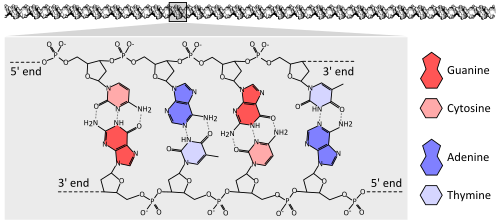
- Composition: DNA consists of a sugar-phosphate backbone and four nitrogenous bases: adenine (A), cytosine (C), guanine (G), and thymine (T).
- Mammalian Gene Scale: Typical mammalian protein-coding genes are approximately 62,000 base pairs long.
- Genome Distribution: Protein-coding genes occupy roughly 35–40% of the human genome.
The Molecular Structure of Genes
At its core, a molecular gene is a segment of DNA. DNA is composed of a five-carbon sugar called 2-deoxyribose, a phosphate group, and one of four nitrogenous bases. These bases pair specifically—adenine with thymine and cytosine with guanine—to form the iconic double helix structure.
Chromosomes and Organization
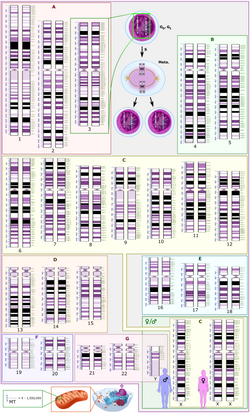
Genes are organized into larger structures called chromosomes. In humans, these are arranged in 23 pairs. The size of these chromosomes varies significantly, with the largest being roughly ten times the size of the smallest.
![Micrographic karyogram of human male, showing 23 pairs of chromosomes. The largest chromosomes are around 10 times the size of the smallest.[53]](/images/29/4b/294b196e3e6d2bd6fb21dc86770d295df024144682335000023d35391181bb22.png)
Advanced mapping techniques, such as G banding, allow scientists to identify specific regions on these chromosomes through dark and white bands, helping to locate specific genes and the mitochondrial genome.
How Genes Work: Expression and Translation
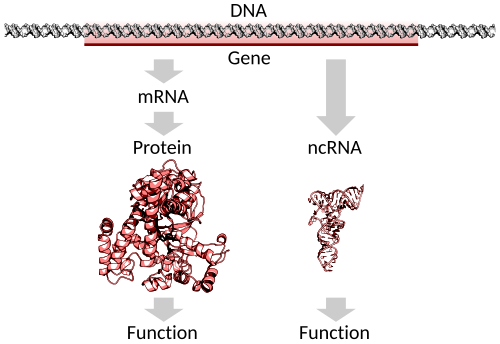
The journey from a DNA sequence to a functional trait involves several critical steps. First, DNA is copied into RNA through a process called transcription. Depending on the type of gene, this RNA may become the final functional product or serve as an intermediate template.
For protein-coding genes, the resulting messenger RNA (mRNA) is translated into a protein. This is achieved via codons—sequences of three nucleotides that each correspond to a specific amino acid.
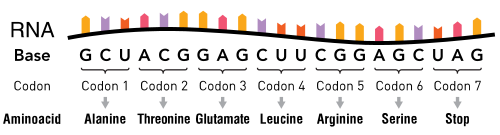
This flow of information—from DNA to RNA to protein—is the central mechanism of biological function. RNA-coding genes, by contrast, skip the protein stage and produce functional non-coding RNA.
Inheritance and the Genome
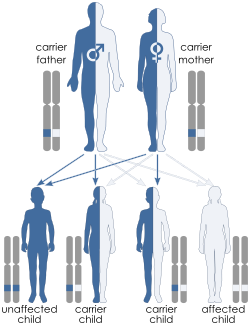
Inheritance follows specific patterns, often described as Mendelian inheritance. For example, when a gene has two different alleles (versions), one may be dominant (e.g., blue) and the other recessive (e.g., white). The probability of an offspring inheriting a specific combination depends on the parents' genotypes.
Genome Complexity and Size
The number of genes varies wildly across different forms of life. While viruses and bacteria have relatively small, streamlined genomes, plants and vertebrates possess far more complex genetic architectures.
![Depiction of numbers of genes for representative plants (green), vertebrates (blue), invertebrates (orange), fungi (yellow), bacteria (purple), and viruses (grey). An inset on the right shows the smaller genomes expanded 100-fold area-wise.[87][88][89][90][91][92][93][94]](/images/b0/68/b0688f8c35c94d46e7b0f3f621a54aa3a129ed865832a4539381acbf17268079.webp)
Scientists have even created synthetic organisms, such as Syn 3, to determine the "minimal genome" required for life, identifying the absolute essential genes needed for a cell to function.
![Gene functions in the minimal genome of the synthetic organism, Syn 3[105]](/images/0d/e0/0de08598ea9be9333f09744e4b1243fcc2e77e58115249f4301b4ab9f5d67c33.webp)
Genetic Engineering
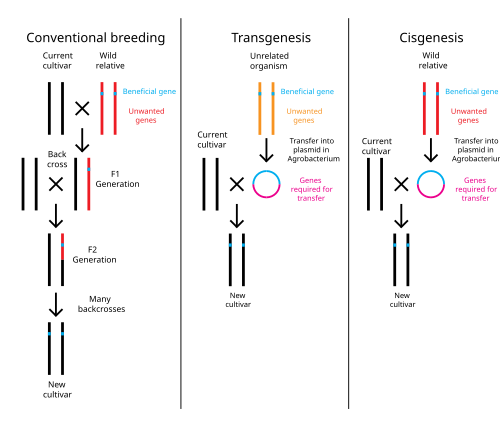
Modern science allows for the modification of these sequences. This ranges from conventional plant breeding to more precise transgenic and cisgenic modifications, where specific genes are added or altered to achieve desired traits.
Summary of Genetic Concepts
| Term | Definition | Role/Example |
|---|---|---|
| Genotype | Total DNA including functional and non-functional elements | The complete genetic blueprint |
| Phenotype | Observable physical traits | Eye color, height, leaf shape |
| Intron | Non-coding sections within a gene | Increases gene size in eukaryotes |
| Codon | Three-nucleotide RNA sequence | Codes for one amino acid |
| Allele | Alternative version of a gene | Dominant vs. Recessive traits |
Frequently Asked Questions
What is the difference between a protein-coding gene and a non-coding gene?
Protein-coding genes are transcribed into mRNA, which is then translated into a functional protein. Non-coding genes are transcribed into RNA molecules that are functional on their own and do not produce proteins.
What are introns and why do they matter?
Introns are non-coding sequences found within eukaryotic genes. Their discovery in the 1970s revealed that genes are often much larger than the proteins they produce, as introns must be removed during RNA processing.
How does the genotype differ from the phenotype?
The genotype is the internal genetic makeup of an organism (the actual DNA sequence), whereas the phenotype is the external expression of those genes, such as physical appearance or biochemical properties.
What are the four bases of DNA?
The four nitrogenous bases are adenine (A), cytosine (C), guanine (G), and thymine (T). They pair specifically (A-T and C-G) to store genetic information.
Who were the key figures in the discovery of gene sequencing?
Max Birnstiel's lab first isolated single genes in 1965. In 1972, Walter Fiers determined the first gene sequence. Later, in 1977, Frederick Sanger developed chain-termination sequencing, which became a standard laboratory tool.