General Carbajal and the Struggle for Mexican Federalism
The mid-19th century in Mexico was defined by a violent tug-of-war between Centralists, who sought concentrated power in Mexico City, and Federalists, who advocated for state autonomy. At the center of this turbulence was General Carbajal, a military leader and political strategist whose career spanned multiple wars, breakaway republics, and international conspiracies.
Carbajal's journey began during the Federalist wars of Mexico. Following the loss of Texas, the Mexican public viewed the Centralist regime of Santa Anna as responsible. When Anastasio Bustamante assumed the presidency in 1837, many saw him as a puppet of Santa Anna. In response, Carbajal and Antonio Canales Rosillo recruited insurgents to resist Centralist forces and attempt to establish a breakaway republic. It was during these early skirmishes that Carbajal suffered a life-altering injury, losing the use of his left arm to a musket ball.
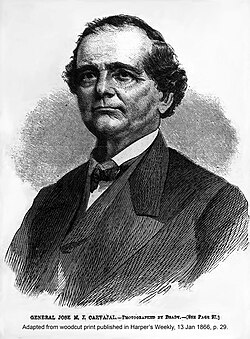
The Mexican–American War and Shifting Loyalties
The 1845 annexation of Texas by the United States triggered the Mexican–American War. Mexico viewed the Republic of Texas as illegitimate and sought its return, while the status of the Nueces Strip—a disputed territory between the Nueces River and the Rio Grande—further complicated tensions.
Seeking to revive the Federalist cause, Canales Rosillo and Carbajal reached out to U.S. General Zachary Taylor in early 1846. Carbajal submitted a formal proposal requesting money, ammunition, and permission to recruit thousands of U.S. volunteers to help oust the Centralist government. In exchange, the Federalists offered only to keep the Nueces Strip open for negotiation. U.S. Secretary of War William L. Marcy denied the request, though he allowed individual Mexicans to enlist in the U.S. military.
Following this rejection, Carbajal and Canales Rosillo shifted their allegiances back to the Centralist government, engaging in guerrilla warfare against United States forces until the conflict ended with the Treaty of Guadalupe Hidalgo in 1848.
The Merchants War and the Republic of Sierra Madre
In 1851, Carbajal attempted to establish a new Federalist state called the Republic of Sierra Madre. This movement was fueled by two primary factors: high Mexican import tariffs and the issue of runaway slaves from Texas. While abolitionists helped slaves escape into Mexico, bounty hunters followed them across the border to reclaim them.
The rebellion, known as the Merchants War, was largely funded by disgruntled Texas merchants who bought Mexican land grants. Carbajal also utilized a $6,000 loan from his late mother-in-law, Patricia de la Garza De León. His forces included thirty Texas Rangers led by Colonel John S. Ford.
The campaign saw several key engagements:
- Camargo: Captured on September 19, 1851. Carbajal immediately lowered tariffs to increase trade and revenue.
- Reynosa: Captured on October 6, 1851.
- Matamoros: After a ten-day attack beginning October 20, Carbajal was forced to retreat on October 30 due to fierce resistance from General Francisco Avalos.
- Cerralvo: After a siege beginning November 24, Carbajal retreated on November 27 to avoid a thousand Centralist reinforcements.
By February 1852, Carbajal's forces were beaten back at Camargo by National Guard troops under the command of his former ally, Antonio Canales Rosillo. Despite facing indictments in the U.S. for violating the Neutrality Act of 1818, Carbajal continued to raise funds for the Federalist cause, even appearing as a featured speaker at the May 1852 Texas state fair in Corpus Christi.
Personal Loss and the Reform War
Carbajal's personal life was marked by the volatility of the border. He built a grand residence in Camargo known as "Carbajal's Castle," but it was eventually destroyed in 1856. Additionally, his home in Piedras Negras was burned to the ground in 1855 by Texas Ranger James Hugh Callahan during a retreat from a skirmish with Seminole Indians.
Political instability returned when Santa Anna regained power in 1853. In 1854, Santa Anna sold approximately 29,640 square miles of land (now part of Arizona and New Mexico) to the U.S. for $10 million to fund the army. This sale sparked the Plan of Ayutla, which removed Santa Anna from office in 1855 and ignited a struggle between conservatives and liberals. Carbajal aligned himself with the liberal Minister of Justice, Benito Juárez.
During this era, Carbajal acted as a mediator and military figure. In 1859, he persuaded the insurgent Juan Cortina to depart Brownsville, Texas, and loaned the city's militia twenty-five muskets. However, political disputes in Tamaulipas led to another clash; after an incursion into Matamoros in 1861, Carbajal fled to Texas, where he was narrowly saved from arrest by Colonel John S. Ford, who allowed him to escape.
The French Incursion and Final Command
The Reform War left Mexico heavily indebted to France, England, Spain, and the United States. This debt provided a pretext for Napoleon III to invade Mexico. President Benito Juárez appointed Carbajal as a general of the Liberal forces and authorized him to recruit up to ten thousand foreign citizens in 1864.
During this period, U.S. President Abraham Lincoln and Secretary of War Edwin M. Stanton covertly assisted Carbajal through General Lew Wallace to procure arms and ammunition. When Napoleon III withdrew French troops in 1866, Carbajal took control of Matamoros as the Governor and Military Commandant of Tamaulipas. His tenure was marked by the seizure of churches from French clerics and forced loans from pro-French merchants, eventually leading to his replacement by Santiago Tapia and a rebellion by the Matamoros military garrison.
Key Facts
- Military Injury: Carbajal permanently lost the use of his left arm during the early Federalist wars.
- Republics: He attempted to establish the Republic of Sierra Madre in 1851.
- The Merchants War: A rebellion driven by import tariffs and funded by Texas land grants.
- U.S. Relations: He sought aid from General Zachary Taylor and later received covert support from the Lincoln administration.
- Political Alignment: He was a staunch Federalist and a key ally of President Benito Juárez.
| Period/Event | Role/Action | Outcome |
|---|---|---|
| Federalist Wars (1837) | Insurgent Leader | Resisted Centralists; suffered arm injury. |
| Mexican-American War | Guerrilla Fighter | Initially sought U.S. aid, then fought for Centralists. |
| Merchants War (1851-52) | President of Republic of Sierra Madre | Captured Camargo and Reynosa; retreated from Matamoros. |
| Reform War Era | Ally of Benito Juárez | Opposed Santa Anna; served as Governor of Tamaulipas. |
| French Incursion (1860s) | General of Liberal Forces | Recruited foreigners; reclaimed Matamoros from the French. |
Frequently Asked Questions
What was the primary cause of the Merchants War?
The Merchants War was primarily triggered by Mexico's ban on certain imported goods and the exorbitant import duties placed on allowed goods, which led merchants in Texas and the border regions to support Carbajal's rebellion.
How did the United States respond to Carbajal's request for aid in 1846?
Secretary of War William L. Marcy declined Carbajal's request for money, supplies, and the recruitment of U.S. volunteers, although he did permit Mexicans to enlist in the U.S. military.
What was the Republic of Sierra Madre?
The Republic of Sierra Madre was a short-lived Federalist state established by General Carbajal in 1851, supported by Texas merchants and funded through land grants.
Who was Benito Juárez in relation to General Carbajal?
Benito Juárez was the liberal President of Mexico and an ally of Carbajal. Juárez appointed Carbajal as a general during the French incursion and later as the military governor of Tamaulipas.
Why was Carbajal's "Castle" destroyed?
Carbajal's castle in Camargo was destroyed in 1856 during a dispute between Santiago Vidaurri and Camargo regarding customs receipts.