Robert F. Stockton: Naval Innovator and Architect of California's Conquest
Robert Field Stockton was a multifaceted figure in 19th-century American history. A Commodore in the United States Navy, he is most remembered for his pivotal role in the capture of California during the Mexican–American War. Beyond his military achievements, Stockton was a forward-thinking naval innovator and a political leader who served as a U.S. Senator from New Jersey.
Born into a distinguished political lineage in Princeton, New Jersey, Stockton's life was defined by a blend of public service, entrepreneurial ventures, and a relentless drive for technological advancement in warfare.
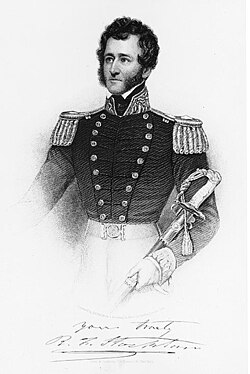
Key Facts
- Military Rank: Commodore, United States Navy.
- Key Role: 2nd Military Governor of California (1846–1847).
- Political Office: U.S. Senator from New Jersey (1851–1853).
- Naval Innovation: Championed the first screw-propelled steam warship, the USS Princeton.
- Major Conflicts: War of 1812 and the Mexican–American War.
- Legacy: The city of Stockton, California, is named in his honor.
Early Life and Naval Beginnings
Robert F. Stockton was born on August 20, 1795, at Morven in Princeton, New Jersey. He descended from a powerful political family; his father, Richard Stockton, was a U.S. senator and representative, and his grandfather was a signer of the Declaration of Independence. Stockton entered the U.S. Navy as a midshipman in September 1811, just after turning 16.
His early career saw him serving during the War of 1812 and later operating in the Mediterranean, the Caribbean, and off the coast of West Africa. Notably, Stockton was the first naval officer to take action against the slave trade. In 1821, while commanding the USS Alligator, he helped negotiate a treaty that led to the founding of the state of Liberia.
Business Ventures and Technological Innovation
During the 1820s and 1830s, Stockton balanced his naval duties with business interests. He owned the Tellurium gold mine in Virginia and purchased a property in Monmouth County, New Jersey, known as "Sea Girt," which later gave its name to the borough of Sea Girt.
Returning to active service as a captain in 1838, Stockton became a vocal advocate for a steam-powered navy. He successfully pushed for the construction of the USS Princeton, the Navy's first screw-propelled steamer (a ship driven by a propeller rather than paddle wheels). Designed by John Ericsson, the ship featured massive 225-pounder wrought iron guns. However, the ship became the site of a tragedy in February 1844 when one of the guns, the "Peacemaker," exploded, killing several people, including two cabinet secretaries. Stockton was later cleared of any wrongdoing in the incident.
The Conquest of California
In July 1846, during the Mexican–American War, Stockton arrived in Monterey, California, taking command of the Pacific Squadron from Commodore John D. Sloat. As the senior military commander and military governor, Stockton became the primary driving force behind the American possession of Alta California.
Stockton's campaign included a march on Pueblo de Los Angeles in August 1846, which forced General Castro to retreat toward Sonora. His leadership was further tested in December 1846 when he led a relief column to rescue General Stephen Kearny's forces, who were besieged by Californio-Mexican cavalry at the Battle of San Pasqual.
Following victories at the Battle of Río San Gabriel and the Battle of La Mesa in January 1847, the Californios signed the Treaty of Cahuenga, ending the fighting in the region. Stockton eventually turned over control of the temporary government to General Kearny.
Political Career and Later Years
Stockton resigned from the Navy in 1850 to pursue politics. As a Democrat, he was elected to the U.S. Senate representing New Jersey from 1851 to 1853. During his tenure, he sponsored legislation to abolish flogging as a punishment in the Navy. He later served as president of the Delaware and Raritan Canal Company until 1866.
In his final years, Stockton attempted to help settle the secession crisis as a delegate to the Peace Conference of 1861. During the American Civil War, he commanded the New Jersey militia in 1863 during the Confederate invasion of Pennsylvania. He died on October 7, 1866, and is buried in Princeton Cemetery.
Summary of Robert F. Stockton's Career
| Period | Role/Achievement | Key Impact |
|---|---|---|
| 1811–1850 | US Navy Commodore | Naval innovation and combat leadership |
| 1821 | Commander, USS Alligator | Negotiated treaty for the founding of Liberia |
| 1843 | Commander, USS Princeton | Introduced the first screw-propelled steamer to the USN |
| 1846–1847 | Military Governor of California | Led the conquest of Alta California |
| 1851–1853 | U.S. Senator (NJ) | Advocated for the abolition of naval flogging |
Frequently Asked Questions
What was Robert F. Stockton's most significant naval innovation?
Stockton was a primary advocate for the USS Princeton, the United States Navy's first screw-propelled steamer, which moved away from traditional sail and paddle-wheel propulsion.
How did Stockton contribute to the founding of Liberia?
While commanding the USS Alligator in 1821, Stockton negotiated a treaty with King Peter that facilitated the establishment of the state of Liberia.
What role did he play in the Mexican-American War?
He served as the 2nd Military Governor of California and led the military operations that secured the territory for the United States, including the relief of General Kearny at the Battle of San Pasqual.
What political achievements did he have as a Senator?
During his time in the U.S. Senate representing New Jersey, Stockton sponsored a bill aimed at abolishing the practice of flogging as a form of punishment within the Navy.
Which places are named after Robert F. Stockton?
His name is memorialized in the cities of Stockton, California, and Stockton, Missouri, as well as the borough of Stockton, New Jersey, and various streets and creeks in California and Liberia.