Gauge Fixing in Physics: Managing Redundancy in Field Theories
In the realm of theoretical physics, gauge theories are essential frameworks used to describe the fundamental forces of nature. However, these theories often contain a mathematical redundancy: multiple detailed field configurations can represent the exact same physical state. This redundancy is known as gauge freedom.
Gauge fixing (or choosing a gauge) is the mathematical procedure used to handle these redundant degrees of freedom. By selecting a specific "cross section" of the configuration space, physicists can suppress unphysical variables and derive quantitative predictions. While the choice of gauge does not change the physical outcome—a property known as gauge invariance—a judicious choice can drastically simplify complex calculations.
Key Facts
- Gauge Fixing: A method to remove redundant mathematical degrees of freedom in field variables.
- Gauge Invariance: The principle that physical observables remain unchanged regardless of the chosen gauge.
- U(1) Gauge Freedom: The specific type of symmetry found in classical electromagnetism.
- Physical vs. Unphysical: Field strengths (E and B) are physical, while potentials (A and φ) contain unphysical redundancies.
- Quantum Impact: In quantum field theory, gauge fixing is critical for renormalization and calculating particle interactions.
The Concept of Gauge Freedom
The most prominent example of a gauge theory is the Heaviside–Gibbs formulation of electrodynamics. In this model, the electric field (E) and magnetic field (B) are the physical observables. These are expressed using an electric scalar potential (φ) and a magnetic vector potential (A).
Gauge freedom arises because we can transform A and φ using a scalar function ψ (the gauge function) without altering the resulting E and B fields. Because any number of such functions can be used, the theory possesses U(1) gauge freedom. While potentials were once viewed as mere mathematical shortcuts, the discovery of the Aharonov–Bohm effect proved that potentials are fundamental to the physical configuration of a system in quantum mechanics.
Visualizing Gauge Fixing
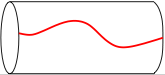
To understand this abstract concept, imagine a perfectly cylindrical rod. If you want to determine if the rod is twisted, the circular symmetry of the cross-section makes it impossible to tell. However, if you draw a straight line along the length of the rod, the twist becomes immediately apparent. Drawing that line is equivalent to gauge fixing; it breaks the symmetry to reveal the underlying physical state. The energy of the torsion remains the same regardless of where the line is drawn, illustrating gauge invariance.
Common Gauge Fixing Conditions
Depending on the problem being solved, different gauges are employed to simplify the mathematics.
The Coulomb Gauge
Also known as the transverse or radiation gauge, the Coulomb gauge is widely used in condensed matter physics and quantum chemistry. It is defined by the condition that the divergence of the vector potential is zero. This is a complete gauge, meaning it removes all gauge arbitrariness.
While it is highly effective for semi-classical calculations and Hamiltonian formulations, it is not Lorentz covariant. This means that if you change your inertial frame of reference, you must perform a new gauge transformation to maintain the condition, making it less ideal for relativistic quantum field theories.
The Lorenz Gauge
The Lorenz gauge (named after Ludvig Lorenz) is unique because it retains manifest Lorentz invariance. It simplifies Maxwell's equations into inhomogeneous wave equations, showing that potentials propagate at the speed of light in a vacuum.
Unlike the Coulomb gauge, the Lorenz gauge is incomplete. Some gauge freedom remains, which propagates at the speed of light. To fully fix the gauge, physicists must apply boundary conditions along the light cone. To remove unphysical longitudinal and time-like polarizations, auxiliary constraints called Ward identities are used.
R ξ Gauges
R ξ gauges are a generalization of the Lorenz gauge used in theories based on an action principle. Instead of a strict constraint, a gauge-breaking term is added to the Lagrangian. The parameter ξ determines the specific gauge:
- Landau Gauge (ξ → 0): Classically equivalent to the Lorenz gauge.
- Feynman–'t Hooft Gauge (ξ = 1): The most common choice for simplifying quantum field theory computations.
- Yennie Gauge (ξ = 3): Used in specific tractable computations.
In non-abelian theories (like Yang–Mills theory or QCD), R ξ gauges require the introduction of Faddeev–Popov ghosts—unphysical fields that violate the spin-statistics theorem—to ensure mathematical consistency.
Summary of Major Gauges
| Gauge Name | Primary Use Case | Key Characteristic | Completeness |
|---|---|---|---|
| Coulomb | Quantum Chemistry / Condensed Matter | Non-covariant; minimal A integral | Complete |
| Lorenz | Relativistic Electrodynamics | Lorentz invariant; wave equations | Incomplete |
| R ξ (Feynman) | Quantum Field Theory (QED/QCD) | Simplifies photon propagators | Varies by ξ |
| Weyl | Hamiltonian Dynamics | Eliminates negative-norm ghosts | Incomplete |
Other Specialized Gauges
- Multipolar Gauge: Also known as the Poincaré gauge; expresses potentials simply in terms of instantaneous fields.
- Fock–Schwinger Gauge: A relativistic version of the Poincaré gauge using the position four-vector.
- Dirac Gauge: A nonlinear gauge condition developed by Paul Dirac.
- Maximal Abelian Gauge: Used in non-abelian theories to fix freedom outside the maximal abelian subgroup.
Frequently Asked Questions
What is the difference between a gauge and a gauge function?
A gauge is a specific choice of scalar and vector potentials. A gauge function is the scalar function used to transform one gauge into another.
Why is gauge fixing necessary if the results are gauge invariant?
While the final physical results are the same, the mathematical equations are often unsolvable or redundant without gauge fixing. Fixing the gauge removes unphysical degrees of freedom, making calculations computationally tractable.
What are Faddeev–Popov ghosts?
Ghosts are unphysical fields introduced in the quantization of non-abelian gauge theories. They are necessary to cancel out unphysical effects arising from the non-trivial Jacobian of the gauge transformation.
Is the Lorenz gauge the same as the Lorentz transformation?
No. The Lorenz gauge is named after Ludvig Lorenz. While it is designed to be compatible with Lorentz transformations (the principle of relativity), they are distinct concepts.
What is the Aharonov–Bohm effect?
It is a quantum mechanical phenomenon where a charged particle is affected by electromagnetic potentials even in regions where the electric and magnetic fields are zero, proving that potentials have physical significance beyond classical theory.