Fruit Botany: From Biological Structures to Culinary Delights
In the world of botany, a fruit is defined as the seed-bearing structure of flowering plants, known as angiosperms. These structures form from the ovary of a plant after the flowering process is complete. While we often think of fruit in terms of sweetness and snacks, their biological purpose is fundamental to the survival of plant species: they serve as the primary means for seed dissemination.
Through a symbiotic relationship, many edible fruits have evolved to use the movements of humans and animals for seed dispersal. In exchange for nutrition, animals help spread the seeds of the plant, ensuring the next generation can grow. This relationship has made fruits a substantial part of global agricultural output and has even imbued certain species, like the apple and pomegranate, with deep cultural and symbolic significance.
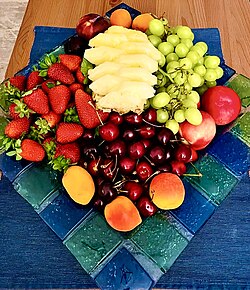
Fruit platter – seasonal fruits
Botanical vs. Culinary Definitions
It is important to distinguish between how a botanist views a fruit and how a chef or consumer does. In culinary usage, "fruit" typically refers to the fleshy, seed-associated produce of plants that are sweet or sour and can be eaten raw, such as strawberries, grapes, and oranges.
However, in botanical usage, the definition is much broader. Many items we call vegetables in the kitchen are technically fruits. For example, tomatoes, corn kernels, bean pods, and even wheat grains are classified as fruits by scientists because they develop from the ovary of a flower.
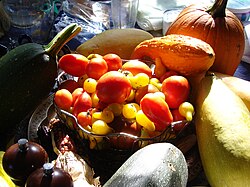
An arrangement of fruits commonly thought of as culinary vegetables, including maize, tomatoes, and squashes
The Structure and Development of Fruit
Fruits are categorized based on how they develop from the flower's reproductive organs. The complexity of a fruit often depends on the number of carpels (the female reproductive organs) involved.
Simple, Aggregate, and Multiple Fruits
- Simple Fruits: These develop from a single flower. They can be apocarpous (having separate, unfused carpels) or syncarpous (having two or more fused carpels).
- Aggregate Fruits: These form from a single flower that contains multiple separate ovaries, resulting in a cluster of small fruitlets.
- Multiple Fruits: These are unique because they develop from an entire inflorescence, or a cluster of many different flowers.
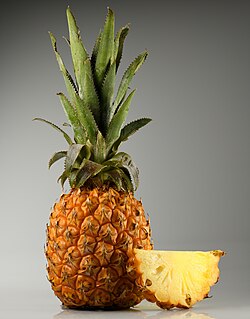
The fruit of a pineapple includes tissue from the sepals as well as the pistils of many flowers. It is a multiple-accessory fruit.
Anatomy of a Fruit
A typical fleshy fruit consists of several layers. The outermost layer is the epicarp (or exocarp), which is the skin. Beneath that lies the mesocarp (the fleshy middle) and the endocarp (the innermost layer surrounding the seed). In a drupe, such as a nectarine, this development occurs over several months, transitioning from a winter bud to a ripe fruit in midsummer.
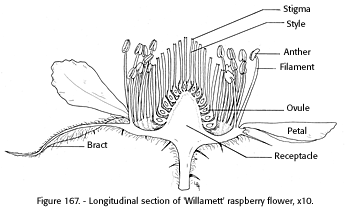
Detail of the raspberry flower: there is a clustering of pistils at the center of the flower. (A pistil consists of stigma, style, and ovary.) The stigma is the apical (at the apex) nodule that receives pollen; the style is the stem-like column that extends down to the ovary, which is the basal part that contains the seed-forming ovule.
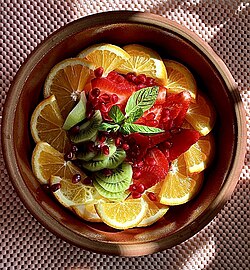
Fresh fruit plate
Classification of Fruits
Botanists classify fruits into two main categories based on whether the fruit wall, or pericarp, is fleshy or dry at maturity.
Fleshy Simple Fruits
When the pericarp is soft and juicy, it is considered a fleshy fruit. Common types include:
- Pomes: Fleshy fruits like apples and pears that develop from a half-inferior ovary.
- Berries: This includes many citrus fruits (known as hesperidium, which have a rind and juicy interior) and even bananas.
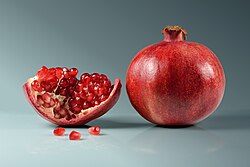
Pomegranate fruit – whole and piece with arils
Dry Simple Fruits
Many fruits have a dry pericarp. These are further subdivided into several types:
- Legumes: Such as beans, peas, and peanuts.
- Nuts: True botanical nuts include hazelnuts and acorns.
- Caryopsis: The type of fruit found in cereal grains like wheat, rice, and oats.
- Samaras: Winged fruits like those found on maple trees.
- Achenes: Small, dry fruits often found in aggregate structures, such as the individual parts of a strawberry.
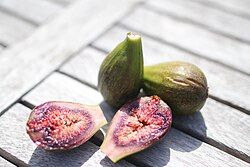
Fresh figs
![Porcelain vine is usually planted for its showy, colourful berries.[56]](/images/b2/4f/b24f749a64d8b7fdacfacb511f5e82205e50972e02ef20b749f71425dcecda57.jpg)
Porcelain vine is usually planted for its showy, colourful berries.[56]
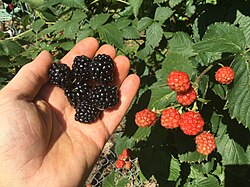
Picking blackberries in Oklahoma
Nutritional and Non-Food Uses
Beyond their role in plant reproduction, fruits are vital to human health. Meta-analyses of nutritional studies suggest that regular fruit and vegetable consumption is associated with reduced markers of inflammation and an enhanced immune cell profile. Fruits are also excellent sources of essential nutrients like fiber, potassium, and vitamin C.
![Comparing fresh fruits for fiber, potassium (K), and vitamin C.[43] Each disk-point refers to a 100 g (3.5 oz) serving of the fresh fruit named. The size of the disk represents the amount of fiber (as percentage of the recommended daily allowance, RDA) in a serving of fruit (see key at upper right). The amount of vitamin C (as percent RDA) is plotted on the x–axis and the amount of potassium (K), in mg on the y–axis. Bananas are high in value for fiber and potassium, and oranges for fiber and vitamin C. (Apricots are highest in potassium; strawberries are rich in vitamin C.) Watermelon, providing low levels of both K and vitamin C and almost no fiber, is of least value for the three nutrients together.](/images/69/81/6981005c0a490e736e399a529f2f090eb5f2ceca3bcbd731af4fe03a3d098247.png)
Comparing fresh fruits for fiber, potassium (K), and vitamin C.[43] Each disk-point refers to a 100 g (3.5 oz) serving of the fresh fruit named. The size of the disk represents the amount of fiber (as percentage of the recommended daily allowance, RDA) in a serving of fruit (see key at upper right). The amount of vitamin C (as percent RDA) is plotted on the x–axis and the amount of potassium (K), in mg on the y–axis. Bananas are high in value for fiber and potassium, and oranges for fiber and vitamin C. (Apricots are highest in potassium; strawberries are rich in vitamin C.) Watermelon, providing low levels of both K and vitamin C and almost no fiber, is of least value for the three nutrients together.
Interestingly, fruits have several non-food applications. For example, bayberry fruits provide wax for candles, and the spiny fruit of the cocklebur actually inspired the invention of Velcro. Some species, like the Osage orange, are even used to repel cockroaches.
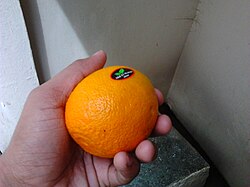
A rangpur
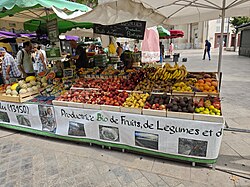
A selection of fruit for sale in a market in France

Fruit consumption per capita
Summary of Fruit Types
| Category | Description | Examples |
|---|---|---|
| Simple Fleshy | Pericarp is soft/juicy | Apples (Pome), Citrus (Hesperidium), Bananas (Berry) |
| Simple Dry | Pericarp is hard/dry | Wheat (Caryopsis), Beans (Legume), Acorns (Nut) |
| Aggregate | From one flower with many ovaries | Raspberries, Strawberries |
| Multiple | From an inflorescence of many flowers | Pineapple |
Key Facts
- Botanical Definition: A fruit is the seed-bearing structure formed from the ovary of a flowering plant.
- Culinary vs. Science: Many "vegetables" like tomatoes and corn are botanically classified as fruits.
- Seed Dispersal: Some fruits use explosive mechanisms to fling seeds up to 100 meters away.
- Health Benefits: Fruit consumption is linked to reduced inflammation and improved immune profiles.
- Allergies: Fruit allergies account for approximately 10% of all food-related allergies.
Frequently Asked Questions
Is a tomato a fruit or a vegetable?
Botanically, a tomato is a fruit because it develops from the ovary of a flower and contains seeds. However, in culinary terms, it is commonly treated as a vegetable.
What is the difference between a simple and an aggregate fruit?
A simple fruit develops from a single flower with one ovary, whereas an aggregate fruit develops from a single flower that has multiple separate ovaries.
Are peanuts actually nuts?
No. Botanically, a peanut is the seed of a legume, not a true nut.
How do fruits help plants reproduce?
Fruits protect the seeds and often serve as a food source for animals. When animals eat the fruit, they disperse the seeds to new locations through their movements.
What are the main parts of a fruit?
The main parts include the epicarp (outer skin), the mesocarp (fleshy middle), and the endocarp (inner layer surrounding the seed).