Friedrich von Payer: The Liberal Statesman and Vice-Chancellor of the German Empire
Friedrich Ludwig von Payer was a distinguished German lawyer and liberal politician who played a pivotal role during one of the most turbulent eras of European history. Serving as the Vice-Chancellor of the German Empire during the final year of World War I, Payer was a voice for moderation and diplomacy amidst the chaos of global conflict.
Early Life and Legal Career
Born on June 12, 1847, in Tübingen, within the Kingdom of Württemberg, Payer's academic journey began at the seminary at Blaubeuren. He returned to his hometown in 1865 to pursue the study of law, a foundation that would later inform his extensive political career. After completing his university education, he established himself as a professional lawyer in Stuttgart.
Political Ascent in the Reichstag
Payer's entry into national politics began in 1877 when he was first elected to the Reichstag (the imperial parliament of the German Empire) representing the Tübingen-Reutlingen district. His commitment to public service was marked by long-term tenure, serving multiple terms in the Reichstag across several decades: from 1877 to 1878, 1880 to 1887, and finally from 1890 until 1918.
Throughout his career, Payer aligned himself with various liberal factions. He was associated with the DVP (German People's Party) from 1907 to 1909, the FVP (Free-minded People's Party) from 1909 to 1918, and later the DDP (German Democratic Party) from 1918 until his death in 1931.
Vice-Chancellorship and World War I
The pinnacle of Payer's political influence occurred during the First World War. Appointed as Vice-Chancellor on November 9, 1917, he served under Chancellors Georg von Hertling and Maximilian of Baden. During this critical period, Payer became a prominent advocate for a negotiated peace with the Allied powers, seeking a diplomatic resolution to end the devastating war.
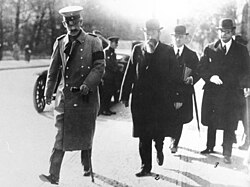
His term as Vice-Chancellor concluded on November 10, 1918, coinciding with the collapse of the imperial government and the transition toward a republic.
Post-War Life and the Weimar Republic
Following the war, Payer continued his political engagement within the newly formed Weimar Republic. He served as the chairman of the German Democratic Party and remained a member of the new Weimar Reichstag until June 6, 1920. Payer lived his final years in Stuttgart, where he passed away on July 14, 1931, at the age of 84. He was married to Alwine Schöninger.
Key Facts
- Role: Vice-Chancellor of the German Empire (Nov 1917 – Nov 1918).
- Political Stance: Liberal; advocated for negotiated peace during WWI.
- Parliamentary Service: Represented Tübingen-Reutlingen in the Reichstag for several decades.
- Party Affiliations: DVP, FVP, and DDP.
- Education: Studied law in Tübingen after attending the seminary at Blaubeuren.
| Category | Details |
|---|---|
| Lifespan | June 12, 1847 – July 14, 1931 |
| Primary Office | Vice-Chancellor of the German Empire |
| Tenure as Vice-Chancellor | November 9, 1917 – November 10, 1918 |
| Reichstag Constituencies | Tübingen - Reutlingen |
| Legal Background | Lawyer based in Stuttgart |
Frequently Asked Questions
When did Friedrich von Payer serve as Vice-Chancellor?
Friedrich von Payer held the office of Vice-Chancellor from November 9, 1917, to November 10, 1918.
What was Payer's primary goal during World War I?
During the war, Payer advocated for a negotiated peace with the Allied powers to end the conflict through diplomacy.
Which political parties was Payer affiliated with?
He was a member of the DVP (1907-1909), the FVP (1909-1918), and the DDP (1918-1931).
Where did Friedrich von Payer study law?
Payer studied law in his hometown of Tübingen after completing his early education at the seminary at Blaubeuren.
What role did he play in the Weimar Republic?
In the Weimar Republic, he served as the chairman of the German Democratic Party and was a member of the Reichstag until June 6, 1920.