French Language Geography and Global Distribution
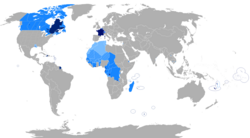
The French language has evolved from a regional tongue into a global powerhouse, serving as a vital tool for diplomacy, culture, and administration. Known as the Francophonie (or the Francophone world), the community of people and organizations that use French regularly spans every continent, creating a vast network of linguistic connection.
Historically, French became an international language during the Middle Ages, starting around the 14th century. Interestingly, its initial spread was not driven by the political power of the Kingdom of France, but rather by the prestige of the French court, which served as the gold standard for chivalric culture. By the 18th century, this cultural influence solidified into political utility, establishing French as the primary language of European diplomacy and international relations.
Key Facts
- Global Reach: French is the third most geographically widespread language in the world.
- Official Status: It is a de jure (legally recognized) official language in 26 independent nations and 10 territories.
- Speaker Ranking: It ranks as the 6th most spoken language by total number of speakers and the 22nd most natively spoken.
- Educational Demand: In 2017, it was the second most studied language globally, with approximately 120 million learners.
- Primary Use: While official in many countries, it serves as a native or majority language in only five states and territories; elsewhere, it often functions as a lingua franca (a common language used between people who do not share a native tongue).
Global Distribution and Statistics
The distribution of French speakers is heavily weighted toward Africa and Europe. According to figures from the Organisation internationale de la Francophonie (OIF), the regional breakdown of speakers is as follows:
- Sub-Saharan Africa: 44.1%
- Europe: 41.2%
- Maghreb: 12.7%
- Others: 1.50%
- North America: 0.50%
![Proportion of French speakers (including L2-speakers) by country in 2022, saturating at 50%, according to the OIF[12] 0–9% Francophone 10–19% Francophone 20–29% Francophone 30–39% Francophone 40–49% Francophone 50%+ Francophone](/images/be/c7/bec7458ae278b28043d293192c2dcf3ca0a77d86e6967b35e231735e4dfcb57d.webp)
French in Europe
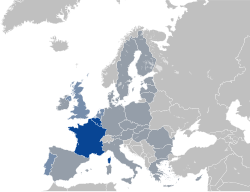
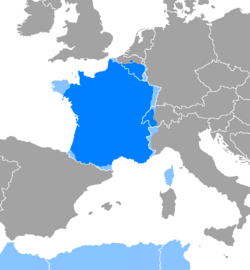
In Europe, French remains a cornerstone of cultural and political identity. Beyond France, where it is the dominant native language, it holds significant status in Belgium, Switzerland, and Luxembourg. In the European Union and the United Kingdom, a substantial portion of the population maintains the ability to understand French, reflecting its historical role in the region.
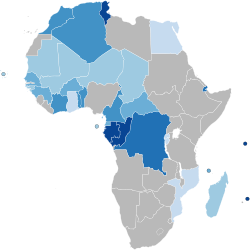
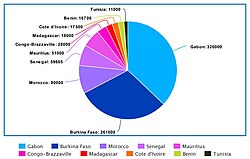
French in Africa
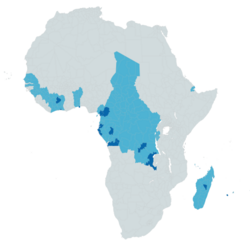
Africa represents the most dynamic growth area for the language. French is an official de jure language in numerous African nations, though its role varies from being a native language to a secondary administrative tool. The Democratic Republic of the Congo stands out as a massive hub of French speakers, with over 48 million people utilizing the language.
The Americas and Asia
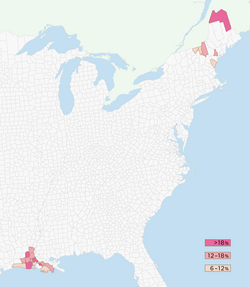
In North America, the presence of French is most concentrated in Canada, particularly in Québec and New Brunswick. In the United States, the language persists in pockets, most notably in Louisiana. In Asia, French is spoken in smaller communities in countries such as Vietnam, Cambodia, and Lebanon, often as a legacy of historical administrative ties.
Comparative Speaker Data
The following table provides a snapshot of French speaker populations across selected key regions and countries based on available census and survey data.
| Country | Total French Speakers | Percentage of Population | Basis of Data |
|---|---|---|---|
| France (Metropolitan) | 63,958,684 | 97.52% | Eurobarometer / AES |
| DR Congo | 48,924,702 | 51.37% | Demographic & Health Survey |
| Canada | 11,060,585 | 28.58% | 2016 Census |
| Belgium | 8,814,948 | 75.55% | Eurobarometer / AES |
| Algeria | 14,903,789 | 32.86% | 2008 Census |
| Switzerland | 5,889,496 | 67.13% | Adult Education Survey |
Frequently Asked Questions
Is French a native language in most Francophone countries?
No. While French is an official language in over two dozen countries, it is the native or majority language in only five states and territories. In most other Francophone nations, it serves as a second language or a lingua franca for administration and communication.
How did French become a global language?
French spread initially through the prestige of the French court and chivalric culture in the 14th century, rather than through political conquest. By the 18th century, it had become the primary language of international relations and European diplomacy.
Which region has the highest proportion of French speakers today?
Sub-Saharan Africa holds the largest share of the French-speaking population at 44.1%, followed closely by Europe at 41.2%.
What is the difference between a de jure and de facto official language?
A de jure official language is one that is legally recognized by a country's constitution or laws. A de facto official language is one that is used in practice for official purposes, even if it is not formally mandated by law.
How many people are currently learning French?
As of 2017, French was the second most studied language in the world, with approximately 120 million learners.