Fragmentation in Organisms: Mechanisms of Asexual Reproduction
Fragmentation is a form of asexual reproduction, or cloning, occurring in multicellular and colonial organisms. In this process, an organism splits into two or more fragments upon reaching maturation. If the resulting piece is large enough, it can regenerate the missing parts to create a completely new, genetically identical individual.
Some organisms evolve specialized zones or organs designed to be shed easily, while others fragment spontaneously. In the latter case, both resulting pieces must possess the biological capacity to regenerate a full organism for the process to be successful as a reproductive strategy.
Key Facts
- Fragmentation is a method of asexual reproduction that produces genetically identical clones.
- It occurs across diverse kingdoms, including Fungi, Plantae, and Animalia.
- Specialized mechanisms like architomy and paratomy define how certain animals split and regenerate.
- While efficient for rapid population growth, the lack of genetic diversity makes fragmented populations more vulnerable to disease and environmental changes.
- Humans utilize these natural processes for artificial plant propagation and coral reef conservation.
Fragmentation in Fungi and Simple Organisms
Many simple organisms utilize fragmentation as their primary means of expansion. For example, Spirogyra (a genus of algae) and filamentous cyanobacteria break into smaller fragments that grow independently. Similarly, sponges and certain molds use this method to spread.
In the Fungi kingdom, molds, yeasts, and mushrooms produce hyphae—tiny filaments used to absorb nutrients. When a piece of hyphae breaks off, it can grow into a new individual. Lichens also employ this strategy through specialized structures called soredia and isidia, which contain both the fungal partner (mycobiont) and the algal partner (phycobiont), allowing them to disperse and establish new colonies.
Vegetative Reproduction in Plants
Fragmentation is a cornerstone of vegetative reproduction in the plant world. Many ferns, shrubs, and nonwoody perennials create clonal colonies via rhizomes or stolons (horizontal underground or surface stems). If a rooted shoot becomes detached from the parent colony, it becomes an independent plant.
Plants have developed several specialized methods for fragmentation:
- Adventitious Plantlets: Some species, such as Kalanchoe daigremontiana and Tolmiea menziesii, grow small plants on their leaves that drop off to root independently.
- Cladoptosis: This is the natural shedding of twigs, common in willow trees, which can then root in suitable soil.
- Stem and Leaf Fragmentation: Cacti may drop stem segments called pads, while succulents like Sedum and Echeveria can grow new plants from fallen leaves.
- Nonvascular Propagation: Mosses and liverworts use wind or water to scatter fragments of stems or leaves. Some, like Marchantia polymorpha, produce gemmae in splash-cups for distribution.
These natural abilities allow humans to artificially propagate plants through techniques such as grafting, cuttings, layering, and micropropagation.
Fragmentation in Animals
In the animal kingdom, fragmentation is common among sponges, corals, annelid worms, and flatworms. Depending on how the split occurs, biologists use different terms to describe the process:
- Architomy: The animal splits at a specific point without prior tissue preparation. The headless fragment must then regenerate a new head and all missing organs.
- Paratomy: The split occurs perpendicular to the head-to-tail axis, but is preceded by the "pregeneration" of anterior structures in the posterior section, ensuring both pieces have a head-to-tail alignment.
- Budding: Similar to paratomy, but the new head may grow in any direction, such as sideways or backward, as seen in the acoel flatworm Convolutriloba retrogemma.
Coral and Anemones
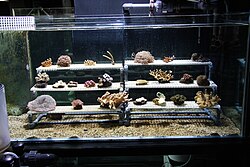
Coral colonies frequently increase their numbers through natural or artificial fragmentation. Genera such as Acropora, Montipora, Pocillopora, Euphyllia, and Caulastraea are particularly tolerant of this process. Sea anemones also reproduce this way via longitudinal fission (splitting down the middle) or basal laceration (small pieces splitting from the base).
Echinoderms
In echinoderms (such as sea stars), this process is called fissiparity. Some species use autotomy—the intentional shedding of a body part—to reproduce, a method most common during larval stages.
Summary of Fragmentation Types
| Kingdom | Mechanism/Term | Example Organisms | Key Characteristic |
|---|---|---|---|
| Fungi | Hyphal fragmentation | Molds, Mushrooms | Filaments break and grow independently |
| Plantae | Vegetative reproduction | Willows, Cacti, Mosses | Use of rhizomes, stolons, or cladoptosis |
| Animalia | Architomy / Paratomy | Flatworms, Annelids | Regeneration of missing body axes |
| Animalia | Fissiparity | Sea stars (Echinoderms) | Often involves intentional autotomy |
| Animalia | Longitudinal Fission | Sea Anemones | Splitting across the middle into two equals |
The Genetic Trade-off
While fragmentation allows for rapid colonization and recovery from injury, it has a significant biological disadvantage: a total lack of genetic diversity. Because the offspring are clones of the parent, the entire population shares the same genetic weaknesses. This makes them significantly more susceptible to parasites, diseases, and sudden changes in their environment.
Frequently Asked Questions
What is the difference between architomy and paratomy?
In architomy, the organism splits without prior preparation, and the fragment must regenerate missing organs from scratch. In paratomy, the organism "pre-generates" the necessary structures (like a head) before the split occurs.
How do humans use fragmentation in agriculture?
Humans use artificial fragmentation through methods like cuttings, grafting, division, and the use of storage organs such as tubers, bulbs, and rhizomes to clone desired plant varieties.
Why is fragmentation risky for a species?
Since it is a form of asexual reproduction, it produces clones. Without genetic variation, a single disease or environmental shift could potentially wipe out an entire colony.
Which corals are most suitable for fragmentation?
Genera that are highly tolerant of fragmentation include Acropora, Montipora, Pocillopora, Euphyllia, and Caulastraea.
What is cladoptosis?
Cladoptosis is the natural process where certain woody plants, such as the willow, shed their twigs, which can then root and grow into new plants if they land in a suitable environment.