Tubers: The Essential Underground Storage Organs of the Plant World
In the complex world of botany, some of the most vital structures are those hidden beneath the soil. Tubers are specialized, enlarged structures that plants use as storage organs to hold essential nutrients. Derived from either stems or roots, these organs serve several critical biological functions: they allow plants to perennate (survive through harsh winter or dry months), provide a concentrated source of energy, and facilitate asexual reproduction.
While the term "tuber" is often used broadly, botanists distinguish between two primary types based on their biological origin: stem tubers and root tubers. Understanding these differences is key to understanding how various crops grow and reproduce.

Key Facts
- Function: Tubers store nutrients for survival and enable asexual reproduction.
- Stem Tubers: Formed from thickened rhizomes or stolons (e.g., potatoes and yams).
- Root Tubers: Formed from modified lateral roots (e.g., sweet potatoes and cassava).
- Perennation: Tubers allow plants to survive dormant periods like winter.
- Reproduction: They act as a means of propagation, allowing new plants to grow from a single parent organ.
Stem Tubers: Growth from Stems and Stolons
Stem tubers develop from thickened rhizomes (underground stems) or stolons (horizontal connections between organisms). These structures typically form near the soil surface at the sides of the parent plant. A stem tuber is often a short-lived organ that develops from a shoot branching off a mature plant.
The lifecycle of many stem tubers is cyclical. In the autumn, the above-ground parts of the plant may die, but the new offspring tubers remain dormant. In the spring, a dominant bud on the tuber regrows into a new shoot, producing stems and leaves. By summer, the original tuber may decay as new ones begin to grow.
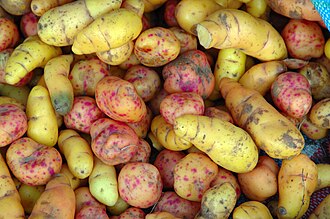
The Anatomy of a Potato
The potato is perhaps the most famous example of a stem tuber. It forms from enlarged stolons that thicken into storage organs. Unlike root tubers, a potato contains all the components of a normal stem, including nodes and internodes. The "eyes" of a potato are actually nodes, each containing a leaf scar and the potential to grow into a new shoot.
Internally, the potato is filled with starch stored in enlarged cells. It possesses a typical stem structure, including a pith, vascular zones, and a cortex. The development of these tubers is regulated by complex biological processes, including the enzyme lipoxygenase, which helps produce jasmonic acid to control tuber development.
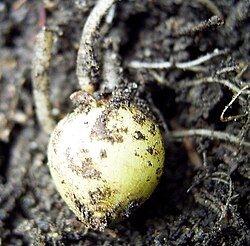
Other Stem Tuber Varieties
Beyond the potato, several other plants utilize stem tubers:
- Yams and Tuberous Begonias: Commonly grown for their ornamental or edible stem tubers.
- Mignonette Vine (Anredera cordifolia): Produces aerial stem tubers on long vines that eventually fall to the ground to grow.
- Plectranthus esculentus: A member of the mint family that produces large underground tubers from axillary buds.
- Lathyrus tuberosus: A legume that, unlike most of its family, produces stem tubers.
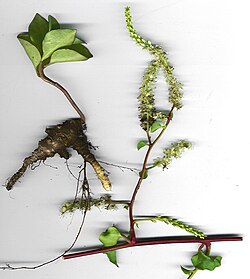
Root Tubers: Modified Lateral Roots
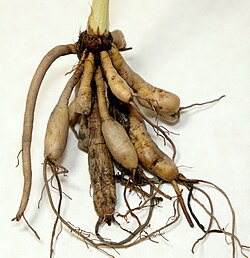
A root tuber (or tuberous root) is a modified lateral root that has been enlarged to function as a storage organ. While they serve a similar purpose to stem tubers, their biological origin is entirely different. Instead of growing from stem tissue, they are thickened sections of a root.
Common examples of plants with root tubers include the sweet potato, cassava, dahlia, and Sagittaria (arrowhead) species. These organs are essential for perennation, allowing the plant to store nutrients during periods when it cannot actively grow.
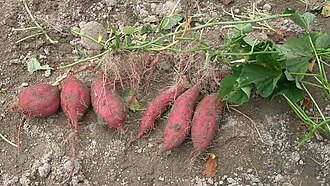
Distinguishing Root Tubers from Stem Tubers
One of the easiest ways to tell the difference is by looking at the structure. Root tubers lack the nodes and internodes found in stem tubers. Instead, the proximal end (the part attached to the old plant) features crown tissue that produces new stems, while the distal end produces unmodified roots. This is the reverse of a stem tuber, where the distal end typically produces the stems.
Root tubers are often biennial in nature. The plant produces the tubers in its first year; after the shoots die back, the tubers survive the winter. In the second growing season, the tubers use their stored reserves to produce new shoots, roots, and reproductive organs. Once the new generation is established, the original tuber tissue typically dies off.
Summary of Tuber Types
| Feature | Stem Tuber | Root Tuber |
|---|---|---|
| Biological Origin | Rhizomes or Stolons (Stems) | Modified Lateral Roots |
| Nodes/Internodes | Present (e.g., Potato "eyes") | Absent |
| Growth Direction | Distal end produces stems | Proximal end produces stems |
| Common Examples | Potato, Yam, Begonia | Sweet Potato, Cassava, Dahlia |
Frequently Asked Questions
What is the main difference between a stem tuber and a root tuber?
The primary difference lies in their origin: stem tubers develop from modified underground stems (rhizomes or stolons) and possess nodes, whereas root tubers develop from modified lateral roots and do not have nodes.
How do tubers help plants survive the winter?
Tubers act as storage organs that hold concentrated nutrients and energy. This allows the plant to enter a dormant state during cold or dry months and provides the necessary fuel to regrow shoots when favorable conditions return in the spring.
Can tubers be used for plant reproduction?
Yes. Tubers are a means of asexual reproduction. Because they contain buds and stored energy, a single tuber can be divided or planted to grow into a new, genetically identical plant.
Why are potato "eyes" important?
The "eyes" of a potato are actually nodes. Each eye contains the potential to grow into a new shoot, making them the primary points of regeneration for the plant.
Are all tubers edible?
While many tubers like potatoes, yams, and sweet potatoes are major food sources for humans and animals, not all tubers are intended for consumption. They are biological structures used by plants for survival and energy storage.