Fort Lesley J. McNair: A History of the Washington Arsenal
Located at the tip of Greenleaf Point, Fort Lesley J. McNair stands as a site of immense historical significance in the heart of the nation's capital. From its origins as a strategic defense point in the late 18th century to its current role as a center for military education and command, the installation has witnessed some of the most pivotal moments in American history.
Early History and the Washington Arsenal
The military reservation was established in 1791, covering approximately 28 acres. Major Pierre Charles L'Enfant integrated the site into his original plans for the Federal City to ensure the capital's defense. Under his direction, Andre Villard placed a one-gun battery on the site, and by 1795, it became one of the first two arsenals in the United States.
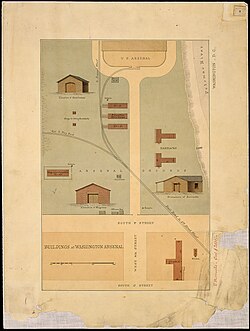
The site's early years were marked by conflict. During the War of 1812, British forces invaded Washington, D.C., in 1814. While soldiers managed to evacuate much of the gunpowder, a catastrophic accidental explosion occurred when a spark ignited an open barrel of black powder, killing approximately 30 men and several officers. Following the conflict, the facilities were rebuilt between 1815 and 1821 as the Washington Arsenal, featuring eight buildings arranged around a quadrangle.
Throughout the mid-19th century, the arsenal expanded. This included the reclamation of four acres of marshland and the construction of a penitentiary between 1825 and 1831, which featured a shoe factory to teach prisoners a trade. By 1860, the arsenal was a hub of innovation, utilizing early steam presses and developing the first automatic machine for manufacturing percussive caps.
The Civil War Era
During the American Civil War, the Washington Arsenal served the Union as a critical ammunition factory. The workforce included many lower-class women and Irish immigrants who were employed for their attention to detail and nimble fingers, which were essential for rolling and bundling cartridges with black powder.
Tragedy struck on June 17, 1864, when fireworks left in the sun ignited outside a cartridge room. The resulting fire killed 21 women, many of whom perished due to the flammable nature of their hoop skirts. President Abraham Lincoln attended the joint funeral procession, and a monument to these women remains at Congressional Cemetery.
The Trial of the Lincoln Conspirators
Following the assassination of Abraham Lincoln in 1865, the conspirators were imprisoned in the Washington Arsenal penitentiary. They were tried by a military tribunal in the complex now known as Ulysses S. Grant Hall. Four of the conspirators were hanged in the penitentiary yard, including Mary Surratt, the first woman ever executed under federal orders.
Medical Breakthroughs and the Walter Reed Legacy
From 1898 to 1909, the post housed a general hospital that served as the predecessor to the Walter Reed Army Medical Center. Major Walter Reed utilized the surrounding marshlands to conduct groundbreaking research on malaria, which eventually contributed to the discovery of the cause of yellow fever. Major Reed passed away at the post in 1902 due to peritonitis following an appendectomy.
20th Century Evolution and Renaming
The early 1900s saw a massive reconstruction of the site. In 1904, the Army War College began classes at Roosevelt Hall, a building designed by McKim, Mead and White. By 1908, nearly 90% of the current buildings on the 100-acre post had been constructed or remodeled.
The installation underwent several name changes and organizational shifts:
- 1924: The Army Industrial College was founded.
- 1935: The post was renamed Fort Humphreys.
- 1946: The National War College was established.
- 1976: The colleges merged to become the National Defense University.
In 1948, the post was renamed Fort Lesley J. McNair to honor Lieutenant General Lesley J. McNair. The commander of Army Ground Forces during World War II, McNair was killed in a friendly fire incident during Operation Cobra in France on July 25, 1944. Since 1966, the fort has served as the headquarters of the Military District of Washington.
Modern Security and Recent Events
In recent years, the fort has remained central to national security. In 2020, the Department of Defense proposed a restricted buffer zone in the Washington Channel to enhance security, a move that faced local resistance but was supported by intelligence reports regarding potential threats from the Iranian Revolutionary Guard in 2021.
The fort also served as a secure evacuation site for senior Congressional leadership during the United States Capitol attack on January 6, 2021. Leaders from both the Democratic and Republican parties, including Nancy Pelosi and Mitch McConnell, were moved to the installation for safety.
Key Facts
- Established: 1791 as a military reservation.
- Original Purpose: Capital defense and ammunition storage (Washington Arsenal).
- Medical Significance: Site of Major Walter Reed's malaria and yellow fever research.
- Legal History: Site of the military tribunal and execution of Lincoln's conspirators.
- Current Role: Headquarters of the Military District of Washington and home to the National Defense University.
| Period/Year | Event/Development | Significance |
|---|---|---|
| 1791 | Reservation Established | Initial site for capital defense. |
| 1814 | British Invasion | Arsenal damaged; catastrophic powder explosion. |
| 1864 | Cartridge Room Accident | 21 women killed in ammunition factory fire. |
| 1865 | Conspirator Trials | Execution of Mary Surratt and others. |
| 1898–1909 | Walter Reed Research | Crucial studies on malaria and yellow fever. |
| 1948 | Renamed Fort McNair | Honoring Lt. Gen. Lesley J. McNair. |
Frequently Asked Questions
Who was Mary Surratt?
Mary Surratt was one of the conspirators in the assassination of President Abraham Lincoln. She was tried by a military tribunal at the Washington Arsenal and became the first woman ever executed under federal orders.
What is the significance of Walter Reed's work at the post?
Major Walter Reed used the marshlands surrounding the post to conduct research on malaria, which provided essential insights that led to the discovery of the cause of yellow fever.
Why was the post renamed Fort Lesley J. McNair?
The post was renamed in 1948 to honor Lieutenant General Lesley J. McNair, the commander of Army Ground Forces during World War II, who was killed by friendly fire during Operation Cobra in France.
What happens at Ulysses S. Grant Hall today?
Ulysses S. Grant Hall, where the Lincoln conspirators were tried, periodically holds public open houses, allowing visitors to tour the courtroom and learn about the trials.
What is the National Defense University?
The National Defense University was formed in 1976 through the merger of the Army-Navy Staff College (later the National War College) and the Industrial College of the Armed Forces.