Fog: The Science, Ecology, and Impact of Low-Lying Clouds
Fog is a visible aerosol—a suspension of tiny particles in a gas—consisting of minute water droplets or ice crystals held near the Earth's surface. While often compared to clouds, fog is specifically characterized by its low altitude and its tendency to form locally due to nearby bodies of water, specific topography, or local wind conditions. Because it significantly reduces visibility, fog plays a critical role in human activities ranging from maritime shipping and aviation to historical military strategy.
Beyond its impact on travel, recent atmospheric research has revealed that fog is more than just a weather phenomenon; it functions as an active aquatic ecosystem. Within these tiny droplets, microbiomes exist where bacteria grow, divide, and interact with the surrounding atmospheric chemistry.

Light fog in Bangladesh
Key Facts
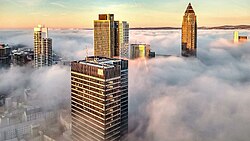
- Definition: Fog is distinguished from mist by its ability to reduce visibility to less than 1 km (0.62 mi).
- Formation: It occurs when the difference between air temperature and the dew point is less than 2.5 °C (4.5 °F).
- Ecology: Fog droplets harbor bacteria that can degrade toxic pollutants like formaldehyde.
- Water Source: Coastal fog provides essential moisture for ecosystems like the California Redwood forests.
- Extreme Types: Ice fog requires temperatures at or below −35 °C (−31 °F).
How Fog Forms
Fog forms through condensation, the process where water vapor (water in its gaseous form) transforms into liquid droplets. This typically happens when the air reaches a relative humidity near 100%, meaning the air can no longer hold additional moisture. This moisture often condenses around condensation nuclei—tiny particles such as dust, salt, or ice.
Several environmental mechanisms can trigger this condensation:
- Wind convergence creating upward motion.
- Precipitation or virga (rain that evaporates before hitting the ground) falling from higher altitudes.
- Daytime heating evaporating water from oceans, lakes, or moist ground.
- Transpiration from plants.
- Cool, dry air moving over warmer water surfaces.
- Air being lifted over mountain ranges.
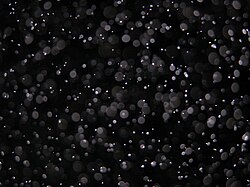
A close-up view of water droplets forming fog. Those outside the camera lens's depth of field appear as orbs.
Fog often behaves as a stable cloud deck, similar to stratus clouds, particularly when a cool, stable air mass is trapped beneath a layer of warmer air.

Minute droplets of water constitute this after-dark radiation fog, with an ambient temperature of −2 °C (28 °F). Their motion trails are captured as streaks.
Types of Fog and Environmental Influences
Radiation and Advection Fog
Radiation fog typically forms under clear skies when the ground cools rapidly. In contrast, advection fog occurs when warm, moist air moves over a cooler surface. This type is common in coastal regions, such as San Francisco, where it can create thick layers that roll in from the sea.
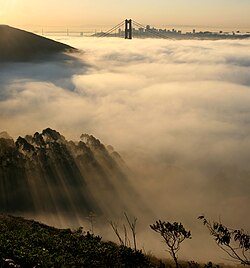
Advection fog layer in San Francisco with the Golden Gate Bridge and skyline in the background
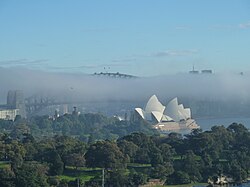
Advection fog over Sydney Harbour and the Sydney Opera House, Australia
Freezing Conditions and Ice Fog
In extremely cold environments, such as the Arctic or Antarctic, ice fog can occur. This happens when water droplets freeze into tiny ice crystals midair, a phenomenon requiring temperatures at or below −35 °C (−31 °F). In urban areas, ice fog can be exacerbated by the freezing of water vapor from automobile exhaust and heating combustion.
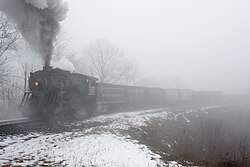
Light radiation fog over 1916-built steam locomotive No. 734 on the Western Maryland Scenic Railroad, in winter conditions
Ice fog is often associated with diamond dust—tiny ice crystals that fall slowly through clear blue skies, often creating optical phenomena like halos or light pillars.
Topographical and Regional Variations
Geography heavily dictates fog patterns. The Columbia Plateau in the Pacific Northwest frequently experiences temperature inversions that lead to fog lasting for weeks. In California, tule fog is a notable phenomenon in valley regions.
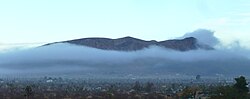
Yucca Valley, California tule fog
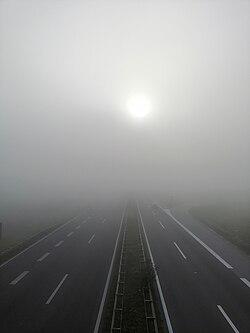
Fog in Serbia
The Fog Microbiome and Atmospheric Chemistry
One of the most fascinating aspects of fog is its role in atmospheric chemistry. The microbiome within radiation fogs plays a vital role in mitigating air pollution. Specifically, certain strains of Methylobacterium specialize in metabolizing C1 carbon compounds.
These bacteria degrade formaldehyde—a toxic pollutant and a precursor to ozone smog—at rates approximately 200 times faster than what is observed in cloud water. By breaking down formaldehyde into carbon dioxide as a detoxification mechanism, fog events actively help cleanse the lower atmosphere of specific toxic compounds.
Fog as a Vital Water Source
In certain climates, fog is not just a weather event but a lifeline. In the Redwood forests of California, coastal fog provides approximately 30–40% of the trees' moisture through fog drip. In arid coastal areas of Africa, some insects and animals rely on wet fog as their primary water source. To combat water scarcity, some communities utilize fog nets to extract liquid water directly from the atmosphere.
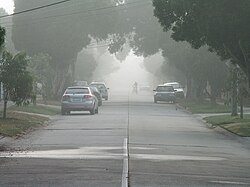
Light fog reduces visibility on a suburban street, rendering the cyclist very hazy at about 200 m (220 yd). The limit of visibility is about 400 m (440 yd), which is before the end of the street.
Summary of Fog Characteristics
| Type/Feature | Primary Cause/Mechanism | Key Characteristic |
|---|---|---|
| Radiation Fog | Ground cooling | Forms under clear skies near the surface |
| Advection Fog | Warm air moving over cold surface | Common in coastal areas |
| Ice Fog | Temperatures below −35 °C | Consists of tiny ice crystals |
| Sea Fog | Condensation on salt particles | Occurs near saline water bodies |
| Microbiome Role | Bacterial metabolism | Degrades formaldehyde and cleanses air |
Frequently Asked Questions
What is the difference between fog and mist?
The primary distinction is visibility. Fog is defined as reducing visibility to less than 1 km (0.62 mi), whereas mist is thinner and causes less impairment to visibility.
How does fog affect visibility and safety?
Fog reduces the visual range, which can impact shipping, travel, and aviation. Historically, it has even been used strategically in warfare, such as during the Battle of Long Island in 1776 and the D-Day landings in 1944.
Can fog be used for something other than weather?
Yes. Beyond its natural ecological roles, artificial fog can be used for security (to scare off burglars) or for scientific and industrial purposes.

An artificial opacifying fog triggered remotely to scare off burglars.
Does fog create shadows?
Yes, certain structures can cast shadows through fog. For example, tall towers can cast 3-dimensional fog shadows.
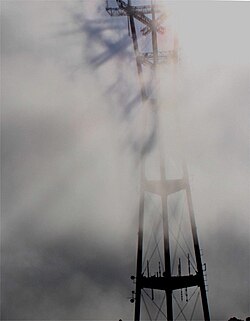
Sutro Tower casts a 3-dimensional fog shadow
Why is San Francisco's fog decreasing?
While San Francisco is famous for its fog, there has been a decline in dense fog since the 1980s, which researchers largely attribute to reduced levels of air pollution.