Flamingos: Evolution, Taxonomy, and Species Diversity
Flamingos are some of the most visually striking birds in the world, known for their vibrant plumage and specialized anatomy. Belonging to the order Phoenicopteriformes and the family Phoenicopteridae, these birds have a temporal range extending from 25 million years ago to the present day. Their unique evolutionary path has led to highly specialized adaptations for filter feeding and survival in diverse aquatic environments across the globe.
While often viewed as a single group, flamingos exhibit significant diversity in size, geography, and genetic lineage. Modern research continues to refine our understanding of how these birds are related to one another and to other avian families.
Key Facts
- Six Extant Species: There are currently six recognized species of flamingos living today.
- Two Primary Genera: Modern classification generally divides them into Phoenicopterus (deep keel bone) and Phoenicoparrus (shallow keel bone).
- Global Reach: Species are distributed across the Old World (Africa, Eurasia) and the New World (The Americas).
- Size Variance: Heights range from the small Lesser flamingo (80–90 cm) to the large Greater and American flamingos (120–145 cm).
- Ancient History: The fossil record includes numerous prehistoric genera such as Harrisonavis and Leakeyornis.
Taxonomy and Systematics
The classification of flamingos has undergone several revisions. Historically, all species were placed within a single genus, Phoenicopterus. However, a 2014 publication initiated a reclassification into two genera. By 2020, some sources recognized three genera, but a 2026 study suggested returning to two. This current consensus merges Phoeniconaias into Phoenicoparrus because they are sufficiently closely related, with Phoenicoparrus taking priority as it was published earlier (1856).
A primary anatomical distinction between these two genera is the keel bone (the extension of the sternum where flight muscles attach); Phoenicopterus possesses a deep keel, while Phoenicoparrus has a shallow one.
Phylogeny and Relationships
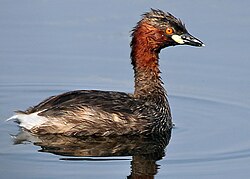
Phylogenetic studies, including research published in 2022 and confirmed in 2026, have mapped the relationships between the six living species. Interestingly, many molecular and morphological studies suggest an evolutionary relationship between flamingos and grebes.
The Six Extant Species
The living flamingo species are divided by their geographic distribution and physical characteristics.
| Species | Genus | Geographic Location |
|---|---|---|
| Lesser flamingo | Phoenicoparrus (formerly Phoeniconaias) | Old World |
| Andean flamingo | Phoenicoparrus | New World |
| James's (Puna) flamingo | Phoenicoparrus | New World |
| Chilean flamingo | Phoenicopterus | New World (Temperate S. South America) |
| Greater flamingo | Phoenicopterus | Old World |
| American (Caribbean) flamingo | Phoenicopterus | New World |

Physical Characteristics
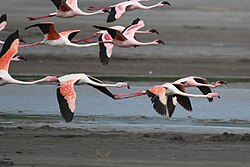
Flamingos vary significantly in scale. The Greater and American flamingos are the largest, standing between 120 and 145 centimeters tall and weighing between 2.1 and 4.1 kilograms. Their wingspans can reach up to 165 centimeters.
In contrast, the Lesser flamingo is the smallest, with a height of 80–90 centimeters and a weight of 1.5–2 kilograms. The James's flamingo is slightly larger than the Lesser, typically reaching 90–92 centimeters in height.
Prehistoric Flamingos
The evolutionary history of flamingos is documented through various prehistoric species and genera. These fossils provide insight into how the family diversified across different continents:
- Europe: Elornis (Late Oligocene) and Harrisonavis (Middle Oligocene–Middle Miocene).
- Africa: Leakeyornis (Early to Middle Miocene) found near Lake Victoria, Kenya.
- Australia: Phoeniconotius (Late Oligocene), Xenorhynchopsis (Pliocene to Pleistocene), and Phoenicopterus novaehollandiae.
- North America: Phoenicopterus copei (Late Pleistocene) and Phoenicopterus floridanus (Early Pliocene).

Human Interaction and Culture
Flamingos have appeared in human history both as artistic subjects and as food sources. In ancient Peru, the Moche culture created ceramics depicting flamingos as early as 200 AD.

In Ancient Rome, flamingos were occasionally part of the cuisine. The historian Suetonius mentioned flamingo tongues in the context of the Emperor Vitellius, and the poet Martial wrote an ironic epigram regarding the delicacy of their tongues.

In modern times, flamingos are popular in zoological settings. The first flamingo to hatch in a European zoo was a Chilean flamingo at Zoo Basel in Switzerland in 1958. This facility became a major hub for the species, distributing over 389 birds to other zoos worldwide.
Frequently Asked Questions
How many species of flamingos are there?
There are six accepted extant species of flamingos distributed across the Old and New Worlds.
What is the difference between the two main flamingo genera?
The primary anatomical difference is the keel bone; Phoenicopterus has a deep keel bone, whereas Phoenicoparrus has a shallow keel bone.
Which flamingo is the largest?
The Greater flamingo and the American flamingo are the largest, both reaching heights of 120–145 centimeters.
Where were the earliest prehistoric flamingos found?
Prehistoric flamingo fossils have been found in various locations, including France (Late Oligocene), Kenya (Miocene), and South Australia (Late Oligocene).
Are flamingos related to any other birds?
Yes, multiple molecular and morphological studies support an evolutionary relationship between flamingos and grebes.