FIFA Ballon d'Or: The Era of Football's Most Prestigious Merger
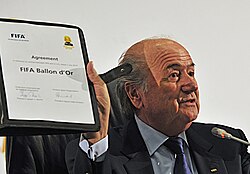
For a brief but intense period between 2010 and 2015, the world of association football witnessed a unification of its two most coveted individual honors. The FIFA Ballon d'Or (the "Golden Ball") was an annual award presented to the best men's player on the planet, representing a strategic partnership between FIFA, the sport's global governing body, and the French publication France Football.
This merger combined the legacy of the original Ballon d'Or, established in 1956, with the FIFA World Player of the Year award, which began in 1991. By joining forces, the two organizations created a single, definitive benchmark for excellence in the sport.
Key Facts
- Duration: The joint award existed for six editions, from 2010 to 2015.
- Most Successful Player: Lionel Messi won the award 4 times.
- Dominant Rivalry: Every single FIFA Ballon d'Or was won by either Lionel Messi or Cristiano Ronaldo.
- Voting Body: Winners were decided by international journalists, national team coaches, and national team captains.
- Legacy: The partnership ended in 2016, leading to the separate Ballon d'Or and The Best FIFA Men's Player awards.
The History and Evolution of the Award
Before the merger, the football world was split between two primary honors. The Ballon d'Or was historically the European Footballer of the Year award, while the FIFA World Player of the Year was a global initiative. Interestingly, from 2005 onward, the winners of both awards were identical every year, making a formal merger a logical step.
The creation of the FIFA Ballon d'Or was officially announced during the 2010 FIFA World Cup in South Africa. The inaugural trophy was awarded to Argentine superstar Lionel Messi. This era was defined by the legendary rivalry between Messi, playing for Barcelona, and Cristiano Ronaldo, playing for Real Madrid.
The End of the Partnership
After six years, FIFA and France Football terminated their agreement. Following the final award presented to Messi in 2015, the two entities returned to their independent formats. France Football reintroduced the original Ballon d'Or structure, and FIFA launched "The Best FIFA Men's Player" award.
Voting Process and Criteria
The FIFA Ballon d'Or utilized a positional voting system to ensure a comprehensive evaluation of a player's performance over the calendar year. Voters were provided with a shortlist of 23 eligible players.
Each voter cast three votes, which were weighted as follows:
- First place: 5 points
- Second place: 3 points
- Third place: 1 point
The player with the highest total point accumulation was declared the winner. This method integrated the perspectives of professional journalists with the tactical insights of national team captains and coaches.
Award Winners and Statistics
The following table summarizes the top three finishers for each edition of the FIFA Ballon d'Or.
| Year | Winner | Runner-up | Third Place |
|---|---|---|---|
| 2010 | Lionel Messi | Andrés Iniesta | Xavi |
| 2011 | Lionel Messi | Cristiano Ronaldo | Xavi |
| 2012 | Lionel Messi | Cristiano Ronaldo | Andrés Iniesta |
| 2013 | Cristiano Ronaldo | Lionel Messi | Franck Ribéry |
| 2014 | Cristiano Ronaldo | Lionel Messi | Manuel Neuer |
| 2015 | Lionel Messi | Cristiano Ronaldo | Neymar |
Club and National Dominance
Barcelona was the most successful club during this period, with Messi securing four wins. Real Madrid followed with two wins via Cristiano Ronaldo. In terms of nationality, Argentina led with four titles, followed by Portugal with two.
The Prix d'Honneur
In 2013, the awarding bodies recognized the legendary Brazilian forward Pelé with the FIFA Ballon d'Or Prix d'Honneur. This honorary award was granted because Pelé, despite winning three FIFA World Cups, was ineligible for the original Ballon d'Or during his playing career, as that award was restricted to players based in Europe.
Frequently Asked Questions
What is the difference between the FIFA Ballon d'Or and the current Ballon d'Or?
The FIFA Ballon d'Or (2010–2015) was a joint venture between FIFA and France Football that included votes from national team coaches and captains. The current Ballon d'Or is managed solely by France Football and relies on votes from international journalists.
Who won the most FIFA Ballon d'Or awards?
Lionel Messi won the most awards during this specific period, taking home the trophy four times (2010, 2011, 2012, and 2015).
Why did Pelé receive an honorary award in 2013?
Pelé was given the Prix d'Honneur because the original Ballon d'Or rules only allowed players based in Europe to win, meaning he could not be nominated during his active career despite his immense success.
How were the winners decided?
Winners were chosen via a positional voting system where international journalists, national team captains, and coaches assigned points (5, 3, and 1) to their top three choices from a 23-player shortlist.
What happened to the award after 2015?
The partnership between FIFA and France Football ended. Consequently, France Football returned to its own Ballon d'Or format, and FIFA established "The Best FIFA Men's Player" award.