Understanding Fertilisation: The Biological Spark of Life
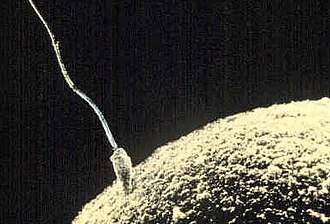
At the heart of sexual reproduction lies fertilisation—also known as syngamy or impregnation. This critical biological process occurs when two haploid gametes (sex cells) fuse to create a single diploid cell called a zygote. This fusion not only combines the genetic material of two parents but also initiates the development of a new, genetically unique individual organism.
While terms like pollination in plants or insemination in animals are often used interchangeably with fertilisation, they are technically separate events. Pollination and insemination are the delivery mechanisms that bring gametes together; fertilisation is the actual moment of fusion.
Key Facts
- Definition: The fusion of male and female gametes to form a zygote.
- Plant Specialisation: Flowering plants undergo "double fertilisation," creating both an embryo and a nutrient-rich endosperm.
- Animal Mechanisms: Fertilisation involves three main steps: chemotaxis (chemical attraction), the acrosomal reaction, and adhesion.
- Genetic Diversity: Meiosis and fertilisation ensure that offspring are genetically distinct from their parents, helping species adapt and avoid inbreeding depression.
- Alternative Paths: Some organisms can reproduce via parthenogenesis, where an unfertilised egg develops into an offspring.
The History of Discovery
Our scientific understanding of fertilisation evolved over centuries. In 1784, Lazzaro Spallanzani demonstrated that frogs require the interaction of sperm and ovum to form a zygote. By 1827, Karl Ernst von Baer provided the first observation of a therian mammalian egg. Later, in 1876, Oscar Hertwig described the fusion of nuclei in sea urchins, providing a foundational look at the cellular mechanics of the process.
Fertilisation in Plants
Plant fertilisation varies significantly across species, depending on how the male sperm and female egg cells meet.
Primitive Land Plants
In bryophytes (such as mosses) and pteridophytic plants, fertilisation occurs within a specialized structure called the archegonium.
Seed and Flowering Plants
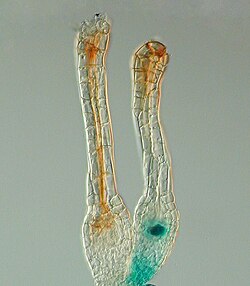
In seed plants, the male gametophyte is housed within a pollen grain. Following pollination, the pollen grain germinates and grows a pollen tube. This tube penetrates the micropyle (a small opening in the ovule wall) to deliver sperm to the egg.
Research on tobacco plants has shown that this growth is enhanced by TTS proteins (floral transmitting tissue-specific glycoproteins). In transgenic plants lacking these proteins, pollen tube growth is slower, leading to reduced fertility.
Double Fertilisation in Angiosperms
Flowering plants (angiosperms) employ a unique process called double fertilisation. Two sperm cells are released from the pollen tube:
- First Sperm: Fuses with the egg cell to form a diploid (2n) zygote.
- Second Sperm: Fuses with two haploid polar nuclei in the central cell, creating a triploid (3n) cell. This cell develops into the endosperm, a nutrient-rich tissue that feeds the developing seed.
Mating Strategies in Plants
Plants utilize different strategies to ensure reproduction, balancing the costs and benefits of genetic diversity.
- Outcrossing (Cross-fertilisation): The fertilisation of an egg by a gamete from a different individual. This increases genetic variability and helps avoid inbreeding depression.
- Autogamy (Self-fertilisation): The fusion of gametes from the same individual. This provides "reproductive assurance" when pollinators or mates are scarce, though it can limit genetic diversity.
Fertilisation in Animals
Animal fertilisation is a highly specific process designed to ensure that only one sperm of the correct species fertilises the egg.
External vs. Internal Fertilisation
External fertilisation is common in ovuliparous animals (those producing eggs with thin or no membranes). This method reduces the risk of disease transmission and can increase genetic variation.
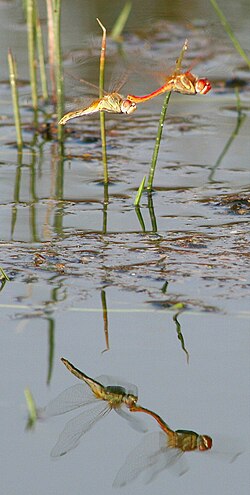
Internal fertilisation occurs inside the female reproductive tract, providing a more protected environment for the zygote.
The Sea Urchin Model
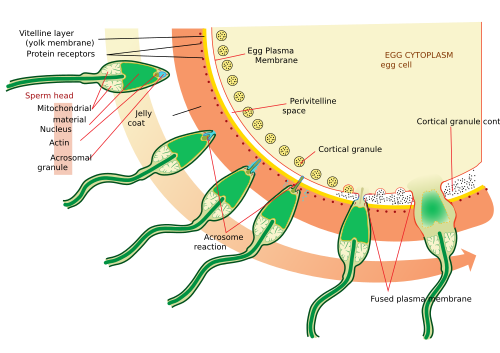
Sea urchins use chemotaxis—a ligand/receptor interaction—to guide sperm. A peptide called Resact attracts sperm to the egg. Once there, a protein called bindin on the sperm surface binds to the EBR1 receptor on the egg's vitelline membrane, triggering the fusion of plasma membranes.
Mammalian Fertilisation
In mammals, sperm must undergo capacitation and hyperactivation to become capable of fertilisation. This is influenced by a pH gradient (from approximately 5 in the vagina to 8 in the oviduct) and the protein CatSper, which increases calcium permeability in the sperm.
Sperm are guided toward the egg in the ampulla of the fallopian tube via several mechanisms:
- Rheotaxis: Response to fluid flow.
- Thermotaxis: Response to a temperature gradient (approx. 2 °C).
- Chemotaxis: Response to chemical signals, such as progesterone.
The sperm binds to the zona pellucida (an extracellular matrix) via the ZP3 glycoprotein and the GalT receptor. This triggers the acrosome reaction, releasing hyaluronidase to digest the surrounding matrix. Finally, the protein CD9 likely mediates the fusion of the sperm and egg membranes.
Human Fertilisation and Conception
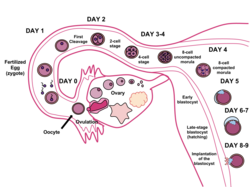
In humans, fertilisation typically occurs in the ampulla of the fallopian tube. While the term "conception" is often used in general conversation, scientific literature avoids it due to varying definitions. Some define it as fertilisation, while others include implantation (when the zygote attaches to the uterine wall 8–9 days later).
Fertilisation in Other Kingdoms
Fertilisation is not limited to plants and animals; it takes various forms across the biological spectrum.
| Kingdom/Group | Primary Process | Key Characteristic |
|---|---|---|
| Fungi | Plasmogamy $\rightarrow$ Karyogamy | Cytoplasms fuse first, followed later by nuclei (except in chytrids). |
| Protozoa | Gametogamy, Autogamy, Gamontogamy | Diverse methods of nuclear fusion. |
| Algae | Syngamy | Often involves alternation of generations; some are oogamous. |
| Plants | Syngamy / Double Fertilisation | Use of pollen tubes in seed plants; triploid endosperm in angiosperms. |
| Animals | Syngamy | Complex receptor-mediated fusion (e.g., ZP3 in mammals). |
Genetic Recombination and Variants
The primary evolutionary advantage of sexual reproduction is genetic diversity. Because of meiosis, each gamete is unique. In humans, excluding sex chromosomes and assuming no crossover, there are $2^{23} \times 2^{23}$ (approximately $17.6 \times 10^6$) possible chromosomal combinations for a zygote. If chromosomal crossover occurs, the possibilities increase to $309 \times 10^6$ or more.
Atypical Forms of Reproduction
- Parthenogenesis: Development of an embryo from an unfertilised egg.
- Gynogenesis: A sperm stimulates an egg to develop without actually fusing with it.
- Canina Meiosis: A system where some genomes are transmitted via Mendelian inheritance while others are transmitted clonally.
Frequently Asked Questions
What is the difference between pollination and fertilisation?
Pollination is the physical transfer of pollen from the male anther to the female stigma. Fertilisation is the subsequent biological process where the male gamete actually fuses with the female egg cell to form a zygote.
What is double fertilisation in flowering plants?
Double fertilisation is a process unique to angiosperms where two sperm cells enter the ovule. One fertilises the egg to create the embryo, and the other fuses with two polar nuclei to create the triploid endosperm, which provides nutrients for the seed.
How do sperm find the egg in mammals?
Sperm use a combination of rheotaxis (sensing current), thermotaxis (sensing temperature differences), and chemotaxis (sensing chemical signals like progesterone) to navigate toward the oocyte.
What is the purpose of the acrosome reaction?
The acrosome reaction allows the sperm to penetrate the protective outer layers of the egg. It releases enzymes, such as hyaluronidase, that digest the extracellular matrix (like the zona pellucida in mammals), enabling the sperm nucleus to enter the egg.
Why is cross-fertilisation generally preferred over self-fertilisation?
Cross-fertilisation increases genetic variability within a population. This diversity makes a species more resilient to environmental changes and prevents "inbreeding depression," which occurs when harmful recessive mutations become more common.