Felix Bloch: The Physicist Behind NMR and the Foundations of MRI
Felix Bloch was a towering figure in 20th-century theoretical physics whose work bridged the gap between abstract quantum mechanics and practical medical technology. From his early collaborations with the giants of European science to his leadership at CERN and his tenure at Stanford University, Bloch's career was marked by a relentless pursuit of understanding the magnetic properties of matter.
Key Facts
- Nobel Prize: Awarded the 1952 Nobel Prize in Physics for the discovery of nuclear magnetic induction.
- Medical Impact: His research into nuclear magnetic resonance (NMR) provided the underlying principles for modern Magnetic Resonance Imaging (MRI).
- CERN Leadership: Served as the first Director-General of CERN starting in 1954.
- Magnetic Theory: Developed the concept of Bloch walls (boundaries between magnetic domains) and proposed spin waves.
- Academic Legacy: Became the first professor of theoretical physics at Stanford University.
Early Academic Journey and European Collaborations
Bloch's early career was characterized by a series of high-profile collaborations across Europe. He worked with Wolfgang Pauli in Zurich on superconductivity—the phenomenon where certain materials conduct electricity without resistance—and collaborated with Hans Kramers and Adriaan Fokker in the Netherlands.
His work with Werner Heisenberg on ferromagnetism led to the development of a description of boundaries between magnetic domains, now known as Bloch walls. During this period, he also theoretically proposed the concept of spin waves, which are excitations of magnetic structure. Further research took him to Copenhagen to work with Niels Bohr on the stopping of charged particles in matter, and to Rome to collaborate with Enrico Fermi.
In 1932, Bloch returned to Leipzig as a Privatdozent (lecturer). However, the rise of Adolf Hitler in 1933 forced Bloch to flee Germany due to fear of anti-Jewish persecution. He returned briefly to Zurich before lecturing at the Institut Henri Poincaré in Paris.
Emigration and Contributions to U.S. Science
In 1934, Bloch accepted an invitation to join the faculty of Stanford University, emigrating to the United States. By 1939, he had become a naturalized U.S. citizen and the first professor of theoretical physics at Stanford.
His research expanded into experimental physics in 1938 when he utilized the 37-inch cyclotron at the University of California, Berkeley, to determine the magnetic moment of the neutron.
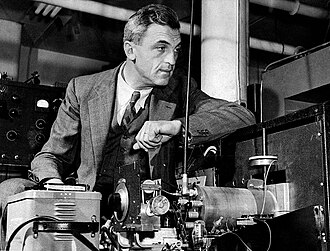
During World War II, Bloch's expertise was sought for the atomic bomb project at Los Alamos. However, he found the military atmosphere stifling and the theoretical work uninteresting, leading him to transfer to the radar project at Harvard University.
The Path to the Nobel Prize and MRI
Following the war, Bloch shifted his focus toward nuclear induction and nuclear magnetic resonance (NMR). NMR is a physical phenomenon in which nuclei in a strong constant magnetic field are perturbed by a weak oscillating magnetic field, causing them to absorb and re-emit electromagnetic radiation.
In 1946, he proposed the Bloch equations, which are mathematical formulas that determine the time evolution of nuclear magnetization. This breakthrough was fundamental to the development of MRI technology. For his pioneering work on nuclear magnetic induction, Felix Bloch was awarded the Nobel Prize in Physics in 1952, sharing the honor with Edward Purcell.
Leadership at CERN and Final Years
In the early 1950s, the founders of the European Organization for Nuclear Research (CERN) sought a leader with international prestige to guide the new laboratory. In 1954, Professor Bloch became CERN's first Director-General. He oversaw the early planning of the first machines and the construction of the Meyrin site.
After his tenure at CERN, Bloch returned to Stanford University. In 1961, he was appointed the Max Stein Professor of Physics, a position he held until his retirement in 1971.
| Period/Year | Role/Achievement | Key Contribution/Location |
|---|---|---|
| Early 1930s | Researcher | Bloch walls and spin waves (Ferromagnetism) |
| 1934 | Faculty Member | Joined Stanford University |
| 1946 | Theorist | Proposed the Bloch equations |
| 1952 | Nobel Laureate | Nobel Prize in Physics (Nuclear Magnetic Induction) |
| 1954 | Director-General | First head of CERN |
| 1971 | Professor Emeritus | Retired from Stanford University |
Frequently Asked Questions
What are Bloch walls?
Bloch walls are the transition regions or boundaries between different magnetic domains within a ferromagnetic material.
How did Felix Bloch contribute to the development of MRI?
Bloch's research into nuclear magnetic resonance (NMR) and his formulation of the Bloch equations, which describe the evolution of nuclear magnetization, provided the essential scientific foundation for Magnetic Resonance Imaging (MRI).
Why did Felix Bloch leave Germany in 1933?
Bloch left Germany immediately after Adolf Hitler came to power due to fear of anti-Jewish persecution.
What was Bloch's role at CERN?
Felix Bloch served as the first Director-General of CERN starting in 1954, overseeing the initial construction of the Meyrin site and the planning of the laboratory's first machines.
Who did Felix Bloch share the Nobel Prize with?
Felix Bloch shared the 1952 Nobel Prize in Physics with Edward Purcell for their independent discoveries regarding nuclear magnetic induction.