Fault Types
In geology, a fault is a fracture or zone of fractures between two blocks of rock. These faults are primarily classified based on the dip—the angle the fault plane makes with the Earth's surface—and the direction of the slip (movement) along that plane. Understanding these movements allows geologists to reconstruct the tectonic forces that have shaped the Earth's crust.
Based on the direction of slip, faults are categorized into three primary groups: strike-slip (predominantly horizontal movement), dip-slip (predominantly vertical movement), and oblique-slip (a combination of both).
Key Facts
- Strike-slip faults move horizontally and are divided into sinistral (left-lateral) and dextral (right-lateral).
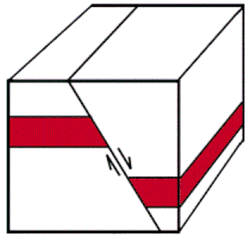
- Normal faults occur when the hanging wall moves downward, typically indicating extensional stress.
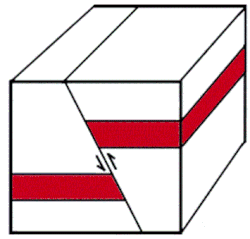
- Reverse faults occur when the hanging wall moves upward, indicating compressional shortening.
- Thrust faults are low-angle reverse faults (dip less than 45°).
- Transform faults are a specific type of strike-slip fault that form conservative plate boundaries.
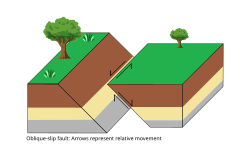
- Oblique-slip faults exhibit significant measurable components of both vertical and horizontal movement.
Strike-Slip Faults
A strike-slip fault, also referred to as a wrench, tear, or transcurrent fault, features a fault plane that is usually near vertical. In these faults, the footwall moves laterally with very little vertical displacement. These are categorized by the direction of movement as seen by an observer on the opposite side of the fault: sinistral for left-lateral motion and dextral for right-lateral motion.
When a strike-slip fault forms a plate boundary, it is called a transform fault. These are known as "conservative" plate boundaries because lithosphere is neither created nor destroyed. Examples include the Alpine Fault in New Zealand, the Dead Sea Transform in the Middle East, and offsets in mid-ocean ridges.

Dip-Slip Faults
Dip-slip faults are characterized by vertical movement and are divided into normal (extensional) and reverse faults. Interestingly, these faults can undergo fault inversion, where a change in regional stress (from tensional to compressional or vice versa) causes the fault to reactivate in the opposite direction.

Normal Faults
In a normal fault, the hanging wall moves downward relative to the footwall. While most normal faults have a dip of at least 60 degrees, some can dip at less than 45 degrees.
Basin and Range Topography
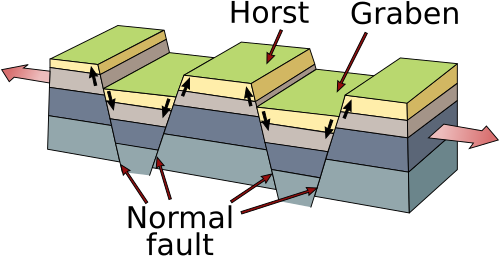
Normal faulting often creates distinct landscapes. A graben is a downthrown block located between two normal faults that dip toward each other. Conversely, a horst is a block stranded between two grabens, where the faults dip away from each other. Together, these structures create a characteristic basin and range topography.
Listric and Detachment Faults
A listric fault is a normal fault with a concave-upward shape; it is steeper near the surface and becomes more horizontal with depth. When these fault planes flatten completely into a near-horizontal plane, they are called decollements. Large-scale extensional decollements are known as detachment faults, which hold regional tectonic significance.
Because of the curvature in listric faults, a geometric gap can form between the hanging and footwalls. Depending on the rock's rheology (how it flows or breaks), this gap is filled either by rollover folding (where the hanging wall folds and slides) or by the creation of further faults, such as imbrication fans or domino faulting.
Reverse and Thrust Faults
A reverse fault is the opposite of a normal fault, where the hanging wall moves upward relative to the footwall, signaling compressive shortening of the crust.
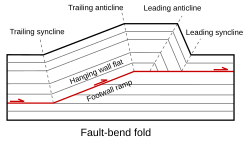
A thrust fault is a specific type of reverse fault with a dip of less than 45°. These faults typically move through a sequence of flats (where the fault follows a weak bedding plane) and ramps (where the fault cuts upward through stratigraphic layers). This process often creates fault-bend folds, nappes, and klippen. Subduction zones are the largest thrust faults on Earth and are responsible for the most powerful earthquakes.
Oblique-Slip and Specialized Faults
An oblique-slip fault combines both dip-slip and strike-slip components. While most faults have some of both, a fault is only classified as oblique if both components are significant and measurable. These often occur in transpressional or transtensional regimes.
Geologists also use the hade angle to describe these planes; it is the complement of the dip angle, representing the angle between the fault plane and a vertical plane parallel to the strike.
Ring Faults
Ring faults (or caldera faults) form circular outlines resulting from overlapping normal faults. These are typically found in collapsed volcanic calderas or bolide impact sites, such as the Chesapeake Bay impact crater. These fractures may be filled by ring dikes.
Synthetic and Antithetic Faults
Minor faults associated with a major fault are described as either synthetic or antithetic. Synthetic faults dip in the same direction as the major fault, while antithetic faults dip in the opposite direction. These are sometimes accompanied by rollover anticlines.
Summary of Fault Classifications
| Fault Type | Primary Motion | Stress Type | Key Characteristic |
|---|---|---|---|
| Strike-Slip | Horizontal | Shear | Sinistral or Dextral movement |
| Normal | Vertical (Down) | Tensional | Hanging wall moves down |
| Reverse | Vertical (Up) | Compressional | Hanging wall moves up |
| Thrust | Vertical (Up) | Compressional | Low angle (dip < 45°) |
| Oblique-Slip | Combined | Mixed | Both dip and strike components |
Frequently Asked Questions
What is the difference between a reverse fault and a thrust fault?
Both involve the hanging wall moving upward due to compression, but a thrust fault is specifically a low-angle reverse fault with a dip of less than 45 degrees.
What are grabens and horsts?
A graben is a block of crust that has dropped down between two normal faults dipping toward each other, while a horst is a raised block stranded between two grabens.
What is a transform fault?
A transform fault is a strike-slip fault that acts as a plate boundary, such as those found at mid-ocean ridges or the Alpine Fault in New Zealand. They are called conservative boundaries because they neither create nor destroy lithosphere.
Can a fault change its type over time?
Yes, through a process called fault inversion. If the regional stress changes from tensional to compressional (or vice versa), a normal fault can be reactivated as a reverse fault, and vice versa.
What is a listric fault?
A listric fault is a type of normal fault that is curved, meaning it is steeper near the surface and becomes more horizontal as it extends deeper into the Earth.