Fairy-bluebirds: The Vibrant Jewels of Asian Forests
In the lush canopies of tropical Southern Asia and the Philippines, a small group of passerine birds stands out for their striking appearance and unique evolutionary history. Known as fairy-bluebirds, these birds are the sole members of the genus Irena and the family Irenidae. While they may resemble bulbuls in shape, their brilliant coloration and specific dietary habits set them apart as some of the most visually captivating birds in their habitat.
Key Facts
- Family: Irenidae (sole genus Irena).
- Species: Three distinct species: Asian, Philippine, and Palawan fairy-bluebirds.
- Diet: Primarily frugivorous, focusing on Ficus figs.
- Appearance: Sexually dimorphic; males are typically deep blue, while females are duller green.
- Habitat: Evergreen and semi-evergreen forests and plantations.
- Closest Relatives: Leafbirds (family Chloropseidae).
Taxonomy and Evolutionary History
The classification of fairy-bluebirds has shifted significantly over the last two centuries. Early scientists initially placed them in the genus Coracias due to their iridescent blue plumage. By the 1820s, researchers Thomas Horsfield and Coenraad Temminck suggested a link to drongos, and they were later associated with orioles and bulbuls.
Modern science has provided a clearer picture. DNA-DNA hybridization studies by Sibley and Ahlquist first identified leafbirds as their closest relatives. This was later confirmed by a 2019 molecular phylogenetic study, which established that the family Irenidae is the sister group to the Chloropseidae (leafbirds). While some classifications group them together, the length of time since their divergence justifies treating them as separate families.
Physical Characteristics
Fairy-bluebirds are robust birds, similar in size and shape to Old World orioles, weighing between 50 and 100g. Their size varies based on sex and geography; following Bergmann's rule—which suggests that populations in colder, northern climates tend to be larger—the northernmost populations are generally the largest.
Their most striking feature is their plumage. The deep, rich blue of the upperparts is created by specialized naked feather-tip barbs. This coloration provides a unique camouflage effect: while they are highly visible in direct sunlight, they blend effectively into the deep shade of the forest canopy.
The species exhibit sexual dimorphism (distinct differences in appearance between males and females). In the Asian fairy-bluebird, the male is far brighter than the female. However, in the Philippine fairy-bluebird, the female is nearly as bright as the male. Additionally, they possess powerful, notched bills used for crushing fruit, with the Philippine species possessing the largest bill of the three.
Distribution and Habitat
Fairy-bluebirds are found across specific regions of Asia, each species occupying a distinct range:
- Asian fairy-bluebird (I. puella): Found across Southern Asia, from India (southwest and northeast) through Burma, Southeast Asia, Borneo, Sumatra, and the Andaman Islands. They are rare in Sri Lanka.
- Philippine fairy-bluebird (I. cyanogastra): Located throughout the Philippine archipelago, including Luzon, Polillo, Leyte, Samar, Mindanao, Dinagat, and Basilan.
- Palawan fairy-bluebird (I. tweeddalii): Endemic exclusively to the island of Palawan.
These birds are dependent on fruit-producing forests, inhabiting both evergreen and semi-evergreen environments, where they spend the majority of their time in the high canopy.
Behavior and Diet
Fairy-bluebirds are social creatures, typically foraging in pairs or small groups. Their diet is primarily composed of fruit, with figs from the genus Ficus being the most critical food source. They are known to crush larger fruits to make them manageable. While adults occasionally consume berries and nectar (reported in India), nestlings rely primarily on insects for protein.
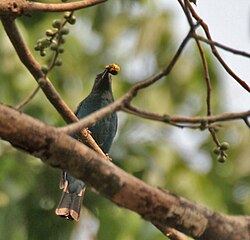
Interestingly, in the Philippines, these birds have been observed following troops of macaques, likely to catch insects flushed out by the monkeys' movement. Their social behavior extends to breeding; males perform elaborate vocalizations to attract females, who then respond by building nests from twigs, moss, and grasses in trees or tall bushes. Both parents cooperate to raise the two to three eggs laid per clutch.
| Species | Scientific Name | Primary Range | Plumage Dimorphism |
|---|---|---|---|
| Asian Fairy-bluebird | Irena puella | Southern Asia, SE Asia | High (Male bright blue, Female green) |
| Philippine Fairy-bluebird | Irena cyanogastra | Philippine Archipelago | Low (Female nearly as bright as male) |
| Palawan Fairy-bluebird | Irena tweeddalii | Palawan Island | Present |
Frequently Asked Questions
What do fairy-bluebirds eat?
Their primary diet consists of fruit, especially figs from the genus Ficus. They may also eat berries and nectar, while their young are fed mainly on insects.
How do fairy-bluebirds differ from bulbuls?
While they share a similar body shape, fairy-bluebirds are distinguished by their striking blue and green plumage and their specific taxonomic placement in the family Irenidae, whereas bulbuls are generally more drab.
Why are the males blue and females green?
This is known as sexual dimorphism. In the Asian fairy-bluebird, this difference is very pronounced, though it is less distinct in the Philippine fairy-bluebird where females are also quite bright.
Where can fairy-bluebirds be found in the wild?
They inhabit the canopies of evergreen and semi-evergreen forests across Southern Asia, the Philippines, and specifically the island of Palawan.
Who are the closest relatives of the fairy-bluebird?
Molecular phylogenetic studies have confirmed that their closest relatives are the leafbirds of the family Chloropseidae.