Eurasian Golden Oriole
The Eurasian golden oriole (Oriolus oriolus), often referred to as the common golden oriole, is a striking passerine bird known for its brilliant coloration and melodic song. Measuring approximately 24cm in length with a wingspan of 44-45cm, it holds the distinction of being the only Old World oriole that breeds in the temperate regions of the Northern Hemisphere.
These birds are summer migrants in Europe and the Palearctic, spending their winter months in central and southern Africa. Despite their bright appearance, they are notoriously shy and blend seamlessly into the dappled light of forest canopies.
Key Facts
- Scientific Name: Oriolus oriolus
- Conservation Status: Least Concern (IUCN 3.1)
- Migration: Breeds in Europe/Asia; winters in central and southern Africa.
- Diet: Primarily insects and fruit.
- Distinctive Feature: Bright yellow plumage in males; drabber green in females.
- Maximum Lifespan: Recorded up to 10 years and 1 month.
Taxonomy and Etymology
The species was formally described by Carl Linnaeus in 1758. Originally named Coracias oriolus, it was initially placed in the genus Coracias (which now only contains rollers) before being moved to the genus Oriolus in 1766. While the Eurasian golden oriole was once considered the same species as the Indian golden oriole (Oriolus kundoo), molecular phylogenetic studies in 2010 confirmed they are separate species.
The term "oriole" is an adaptation of the Latin aureolus, meaning golden. Interestingly, in medieval England, the bird was known as the "woodwele," a name derived from its song.
Physical Description and Identification
The Eurasian golden oriole exhibits significant sexual dimorphism. The male is striking, featuring the classic black and yellow plumage. In contrast, the female is a more muted, drabber green, which provides excellent camouflage. In flight, their movement is strong and direct, resembling a thrush with occasional shallow dips over long distances.
Their vocalizations are equally distinct. While their call is a harsh "kweeaahk," their song is a fluting, unmistakable "weela-wee-ooo" or "or-iii-ole," often featuring subtle variations between phrases.
Distribution and Habitat
The breeding range of the Eurasian golden oriole extends from western Europe and Scandinavia in the west to China in the east. They typically migrate at night, though spring migrations may occur during the day. During autumn, they travel via the Eastern Mediterranean, where their fondness for fruit sometimes leads them to be viewed as pests.
Their habitat preferences vary by region:
- Western Europe: Open broadleaf forests, plantations, riverine forests, orchards, and large gardens.
- Eastern Europe: Continuous forests, including mixed or coniferous types.
- Wintering Grounds: Savannas, woodland/savanna mosaics, and semi-arid to humid woodlands in Africa.
Behavior and Ecology
Breeding and Nesting
Eurasian golden orioles may not begin breeding until they are 2 or 3 years old. Males typically arrive at the breeding grounds several days before females. Evidence of territory and nest site fidelity suggests that pair-bonds may persist across multiple seasons.
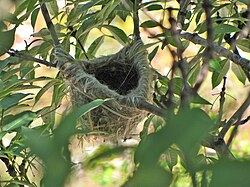
The female constructs a deep, cup-shaped nest suspended below a horizontal fork of thin branches, high in the tree crown. The nest is secured with plant fibers up to 40 cm long and lined with wool, feathers, and fine grass.
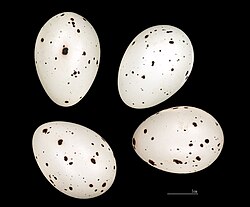
A typical clutch consists of 3 to 5 eggs, laid daily in the early morning. These eggs are white, cream, or pale pink with black markings. While the female handles most of the incubation, the male provides short periods of relief so she can feed. Eggs hatch after 16–17 days, and the young fledge after another 16–17 days.
Diet and Foraging
The species is omnivorous, feeding on a combination of fruit and insects. They use their specialized bills to pick insects out of narrow crevices in the bark and foliage of the canopy.
Species Summary
| Feature | Eurasian Golden Oriole (O. oriolus) | Indian Golden Oriole (O. kundoo) |
|---|---|---|
| Male Plumage | Black and yellow | More yellow; black eye-stripe extending behind eye |
| Bill Characteristics | Standard oriole bill | Longer and paler red bill |
| Distribution | Europe, Scandinavia to China | South Asia |
| Conservation Status | Least Concern | N/A (Source specific to O. oriolus) |
Frequently Asked Questions
How can you tell a male and female Eurasian golden oriole apart?
The male is easily identified by his bright yellow and black plumage, whereas the female is a more subdued, drabber green color.
Where do Eurasian golden orioles spend the winter?
They migrate to central and southern Africa for the winter season.
What do Eurasian golden orioles eat?
Their diet consists of insects, which they pick from crevices, and various fruits.
Are Eurasian golden orioles endangered?
No, they are currently evaluated as "Least Concern" by BirdLife International due to their large and stable populations.
How long do these birds live?
While average lifespans vary, the greatest recorded age for a male Eurasian golden oriole was 10 years and 1 month.