F1 Hybrids: The Science of Genetic Crossbreeding and Hybrid Vigour
In the complex world of genetics, the term F1 hybrid (or filial 1 hybrid) refers to the first generation of offspring produced by crossing two distinctly different parental types. Whether in the fields of agriculture or the study of animal evolution, these first-generation crosses play a critical role in shaping the traits of the resulting organisms. By combining the unique characteristics of two different parents, F1 hybrids often exhibit a uniform phenotype—the observable physical properties of an organism.
The study of these patterns was pioneered by Gregor Mendel. Through his experiments with true-breeding, or homozygous (having two identical alleles for a particular gene), parents, Mendel discovered that the F1 generation was typically heterozygous. This means the offspring carry different versions of a gene from each parent, often resulting in a consistent appearance based on the dominant genetic traits of the parents. These foundational discoveries paved the way for modern selective breeding and genetic science.
Key Facts
- F1 Generation: The first offspring from two different parental lines.
- F2 Generation: The offspring resulting from the selfing or crossing of F1 hybrids, which lack the uniformity of the first generation.
- Heterosis: Also known as "hybrid vigour," this is the phenomenon where hybrids show improved growth and performance compared to their parents.
- Uniformity: F1 hybrids are highly predictable and mature at the same time, making them ideal for mechanical harvesting.
- Homozygosity: To produce high-quality F1 hybrids, parent lines are often inbred for many generations to ensure they are nearly 90% homozygous.
F1 Hybrids in Plant Breeding
In agronomy, F1 hybrids are essential for high-yield agriculture. These are typically created through controlled pollination, sometimes involving manual intervention to ensure specific genetic combinations. For annual crops like maize and tomatoes, these hybrids must be produced fresh every single season.
The Process of Mass Production
To achieve a uniform phenotype in mass production, breeders must ensure the parent plants have predictable genetic effects. This is achieved by inbreeding two populations until they reach a high level of homozygosity, often requiring more than 10 generations. Once these stable lines are established, they are crossed while carefully avoiding self-fertilization. In plants, this is often managed by removing male flowers or utilizing differences in flowering times.
The impact of F1 hybridization in the United States is significant. As of 1960, the majority of major crops were F1 hybrids, including 99% of corn, 95% of sugar beet, and 80% of both spinach and sunflowers. However, some crops like beans and peas are not commercially hybridized because they are automatic pollinators, making hand pollination too expensive.
F1 Hybrids in Animal Breeding
In the animal kingdom, F1 crosses can occur between two inbred lines or between closely related species and subspecies. For example, a mule is an F1 hybrid resulting from a male donkey and a female horse, though such hybrids are almost always sterile.
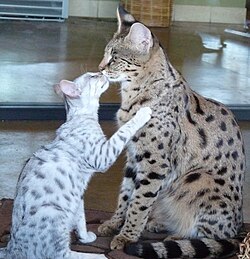
Modern domestic breeding also utilizes filial numbering to classify hybrids. In the case of the Savannah cat, an F1 hybrid is the direct result of breeding an African Serval with a domestic cat. This classification helps breeders track the genetic distance from the wild ancestor.
The Mechanics of Hybridization
According to research published in the International Journal of Fauna and Biological Studies, species hybridization can be driven by several factors:
- Small population size: Reduced mate availability can lead to breeding between distinct species.
- Habitat fragmentation and species introduction: Environmental changes like deforestation or urbanization can force species into new surroundings.
- Anthropogenic hybridization: Human-led or artificial hybridization used to study reproductive compatibility.
- Sensory interference: Visual, chemical, or acoustic cues that cause species to misidentify mates.
Advantages and Disadvantages of Hybridization
Hybridization offers significant biological and economic benefits, but it also presents unique challenges for breeders and farmers.
Benefits: Performance and Predictability
The primary advantage of F1 hybrids is heterosis, or hybrid vigour. This makes the offspring sturdier, more dynamic, and stronger than their parents. Additionally, hybrids can exhibit enhanced longevity and higher immunity to diseases. From a management perspective, the homogeneity of F1 offspring makes them highly predictable, which is ideal for large-scale mechanical operations.
Drawbacks: Cost and Genetic Variation
The main disadvantage is the lack of consistency in subsequent generations. If a farmer saves seeds from an F1 hybrid to plant the next year (the F2 generation), the resulting plants will vary greatly in appearance and performance. Furthermore, the intensive process of inbreeding parent lines and performing controlled pollination makes F1 seeds more expensive to produce than traditional varieties.
| Feature | F1 Hybrids | F2 Hybrids |
|---|---|---|
| Genetic Uniformity | High (Uniform phenotype) | Low (High variation) |
| Predictability | Very High | Low |
| Hybrid Vigour | Maximum | Reduced/Variable |
| Production Cost | Higher (Requires controlled pollination) | Lower (Can be self-pollinated) |
Frequently Asked Questions
What is the difference between F1 and F2 hybrids?
F1 hybrids are the first generation of offspring from two different parents and are characterized by high uniformity and vigour. F2 hybrids are the offspring of the F1 generation; they are much more genetically diverse and less predictable.
What is hybrid vigour?
Hybrid vigour, scientifically known as heterosis, is the tendency of a hybrid offspring to possess superior qualities—such as increased size, strength, or disease resistance—compared to its parents.
Why can't all crops be F1 hybrids?
Some crops, such as beans and peas, are automatic pollinators. The cost of performing the manual, controlled pollination required to create F1 hybrids for these species is prohibitively expensive for commercial production.
What is outbreeding depression?
Outbreeding depression occurs when a cross between two genetically distant populations results in offspring with reduced fitness or reduced ability to reproduce, potentially impacting the survival of the lineage.
Why do F1 hybrids mature at the same time?
Because F1 hybrids are genetically uniform, they respond to environmental conditions in a consistent manner. This allows them to ripen simultaneously, which is highly beneficial for efficient mechanical harvesting.