Ezeiza Massacre: The Violent Fracture of Peronism
On June 20, 1973, what was intended to be a triumphant homecoming for Juan Perón turned into one of the most violent episodes in Argentine political history. The Ezeiza massacre occurred at Puente 12, located approximately 10 kilometers from the Ezeiza International Airport in Buenos Aires. This event did not merely result in loss of life; it signaled the definitive and bloody collapse of the alliance between the left- and right-wing factions of the Peronist movement.
The atmosphere was charged with anticipation as an estimated three and a half million people gathered to welcome Perón back from an 18-year exile in Spain. Accompanying him was President Héctor Cámpora, a representative of the Peronist left who had assumed power on May 25, 1973. Cámpora had entered office during a period of intense political turmoil, famously declaring that "the spilled blood will not be negotiated," a stance that placed him in direct opposition to the Peronist right wing.
As the crowds gathered, camouflaged snipers positioned on Perón's platform began firing into the masses. The primary targets were the Montoneros and the Peronist Youth (JP), left-wing groups that found themselves trapped in the crossfire. At least 13 deaths were officially identified, and no fewer than 365 people were injured, though reports from the newspaper Clarín suggest the actual death toll was significantly higher.
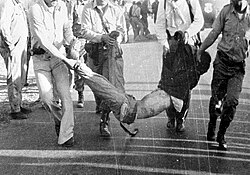
Key Facts
- Date: June 20, 1973.
- Location: Puente 12, Buenos Aires, Argentina.
- Casualties: At least 13 dead and 365 injured.
- Perpetrators: Right-wing "Orthodox" Peronists using sniper rifles.
- Primary Targets: Left-wing Peronist Youth and the Montoneros.
- Political Outcome: The end of the left-right Peronist alliance and the weakening of President Héctor Cámpora.
The Ideological Divide: Orthodox vs. Left-Wing Peronism
The massacre was the culmination of irreconcilable differences within the movement. While Juan Perón had historically managed to attract supporters from both the far-left and far-right, this fragile conjunction shattered in 1973. On one side was the left wing, which included the Peronist Youth (JP), the Montoneros, and the Fuerzas Armadas Revolucionarias (FAR). On the other was Orthodox Peronism, a right-wing faction composed of "Special Formations" such as the Iron Guard (GH) and the Movimiento Nacionalista Tacuara.
Tensions peaked on June 2, 1973, when José Ignacio Rucci, the Secretary General of the CGT (Confederación General del Trabajo), explicitly stated that the right wing was "against left-wing imperialisms." This ideological clash was further embodied by the rivalry between Héctor Cámpora and José López Rega. López Rega, Perón's personal secretary and a former police officer, would later found the Alianza Anticomunista Argentina, a right-wing death squad.
Organization of the Attack
The physical infrastructure of the event was controlled by the right wing. The tribune was set up by Lieutenant-Colonel Jorge Manuel Osinde and other far-right figures, including Alberto Brito Lima and Norma Kennedy. The mobilization of the crowds was managed by Lorenzo Miguel, Juan Manuel Abal Medina, and José Ignacio Rucci. Consequently, right-wing sectors, including members of the Unión Obrera Metalúrgica, occupied the platform, facing off against the left-wing groups in the crowd.
Investigations by Spanish judge Baltasar Garzón later indicated the presence of international actors, including Italian terrorist Stefano Delle Chiaie, who had links to Operation Gladio, the Chilean DINA, and the Turkish Grey Wolves. Carlos "El Indio" Castillo, a member of the Concentración Nacionalista Universitaria (CNU), was also implicated in the violence.
Political Context and Aftermath
The massacre was a calculated move to remove President Héctor Cámpora from power. During his first month in office, Cámpora's moderate left-wing approach had seen approximately 600 social conflicts, including strikes and factory occupations, which resulted in wage increases and improved conditions for workers. This surge in labor power gained sympathy from the middle classes but alarmed the Peronist right wing, which gradually seized control of the trade union organizations.
The event effectively ended Cámpora's transition period following the military dictatorship of General Alejandro Lanusse. Historian Hugo Moreno notes that while the general strike of October 17, 1945, was the founding act of Peronism, the June 20, 1973, massacre marked the violent entrance of the late right-wing Peronism onto the political stage.
| Category | Details |
|---|---|
| Date | June 20, 1973 |
| Location | Puente 12, Buenos Aires |
| Key Figures (Left) | Héctor Cámpora, Peronist Youth, Montoneros |
| Key Figures (Right) | José López Rega, José Ignacio Rucci, Jorge Manuel Osinde |
| Weaponry | Sniper rifles |
| Official Toll | 13 dead, 365 injured |
Frequently Asked Questions
What was the primary cause of the Ezeiza massacre?
The massacre was caused by an irreconcilable ideological conflict between the left-wing and right-wing (Orthodox) factions of Peronism, specifically regarding the influence of left-wing imperialism and the political direction of the movement under President Héctor Cámpora.
Who were the main targets of the snipers?
The snipers targeted left-wing Peronist groups, specifically the Peronist Youth (JP) and the Montoneros, who were trapped in the crowd facing the platform.
What role did José López Rega play?
José López Rega was the representative of the Peronist right wing and Perón's personal secretary. He is also known for founding the Alianza Anticomunista Argentina, a right-wing death squad.
Was the official death toll accurate?
While official records identify at least 13 deaths, the newspaper Clarín and other sources suggest the actual number of victims was much higher. No official investigation was ever conducted to confirm these higher estimates.
How did this event affect the Argentine government?
The massacre marked the end of the transition period for President Héctor Cámpora, facilitating his removal from power and signaling the dominance of the right-wing faction within Peronism.