Ezeiza: From Colonial Estancias to Latin America's Aeronautics Hub
Located on the outskirts of Buenos Aires, Ezeiza is a city defined by its evolution from indigenous lands and colonial estates to a critical center for international travel and scientific research. Once a quiet region of dairy farms, it has transformed into a strategic hub that connects Argentina to the rest of the world.
The Colonial Roots and Early Settlement
Long before the arrival of Europeans, the land was inhabited by the Querandí people. The Spanish Conquistadores claimed the territory in 1588, marking the beginning of colonial influence. By 1758, Juan Guillermo González y Aragón established the area's first chapel and estancia (a large agricultural estate), known as Los Remedios. Notably, one of González's great-grandsons, Manuel Belgrano, would later become a prominent leader in the Argentine War of Independence.
The land's ownership shifted over the next century. Gerónimo Ezeiza purchased nearby land in 1767, and by the late 19th century, his descendant José María Ezeiza had become the region's most significant landowner. Following his passing, his son-in-law donated land to the Buenos Aires Western Railway. This donation led to the official founding of the town on July 17, 1885, named in honor of José María Ezeiza.
Industrialization and the Aviation Era
During the early 20th century, the local economy was primarily driven by dairy farming. However, the city's trajectory changed forever in 1949 with the inauguration of Argentina's first international airport on the northern edge of the city. To support this massive infrastructure project, a new neighborhood called Barrio Uno was constructed in 1949 to house airport employees.
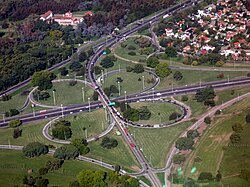
To facilitate travel between the new airport and the capital, the Ricchieri Freeway was opened in 1952.
Scientific and Political Milestones
In 1967, the National Atomic Energy Commission expanded the city's importance by establishing the Ezeiza Atomic Center, which became a primary producer of radioisotopes used for medical purposes.
The region also witnessed a dark chapter in Argentine history on June 20, 1973. The Ezeiza Massacre occurred on the freeway during the return of exiled former President Juan Perón. Clashes between left-wing and right-wing Peronists, competing for vantage points to see the motorcade, resulted in at least 13 deaths.
Modern Growth and Infrastructure
From the 1990s onward, Ezeiza evolved into a bedroom community (a residential area where inhabitants commute to a nearby city for work). This growth was characterized by the development of gated communities, particularly around Canning, located south of the city. For those seeking nature, the Bosques de Ezeiza (Ezeiza Woods) serve as a major local tourist attraction.
The city has also invested heavily in health and education. The Dr. Alberto Eurnekian Hospital opened in 2008, and in 2012, the Provincial University of Ezeiza was established. This institution is distinguished as the first university in Latin America dedicated specifically to aeronautics. Shortly after its opening, a proposal for its nationalization was submitted to the National University Council.
Administratively, Ezeiza was part of the Esteban Echeverría Partido from 1913 until 1994, when it became the seat of its own namesake county. This administrative independence was further symbolized by the inauguration of a postmodern city hall in 2007.
Key Facts
- Founded: July 17, 1885.
- Indigenous Heritage: Originally inhabited by the Querandí people.
- Aviation Milestone: Site of Argentina's first international airport (1949).
- Scientific Contribution: Home to the Ezeiza Atomic Center, producing medical radioisotopes.
- Educational First: Host to the first aeronautics-dedicated university in Latin America.
- Administrative Status: Became the seat of its own county in 1994.
| Year/Period | Event/Development |
|---|---|
| 1588 | Land claimed by Conquistadores |
| 1758 | Foundation of Los Remedios estancia and chapel |
| 1885 | Official founding of the town of Ezeiza |
| 1949 | Inauguration of the international airport and Barrio Uno |
| 1952 | Opening of the Ricchieri Freeway |
| 1967 | Establishment of the Ezeiza Atomic Center |
| 1973 | The Ezeiza Massacre (June 20) |
| 1994 | Establishment of Ezeiza as a county seat |
| 2012 | Opening of the Provincial University of Ezeiza |
Frequently Asked Questions
Who were the original inhabitants of the Ezeiza region?
The land was originally inhabited by the Querandí people before being claimed by Spanish Conquistadores in 1588.
What is the significance of the Provincial University of Ezeiza?
Opened in 2012, it is the first university in Latin America dedicated specifically to the study of aeronautics.
What was the purpose of the Ezeiza Atomic Center?
Established in 1967 by the National Atomic Energy Commission, the center is a leading producer of radioisotopes used for medical treatments.
What is Barrio Uno?
Barrio Uno is a neighborhood built in 1949 specifically to provide housing for the employees of the newly inaugurated international airport.
What happened during the Ezeiza Massacre?
On June 20, 1973, violent clashes broke out between opposing factions of Peronists who wanted to see former President Juan Perón's motorcade, resulting in at least 13 deaths.