Ezeiza: A Hub of Aviation and Growth in Greater Buenos Aires
Located within the expansive Greater Buenos Aires area, Ezeiza serves as the capital city of the Ezeiza Partido. Known for its rapid growth and affluent residential areas, the city has evolved from a colonial outpost into a critical infrastructure hub for Argentina. With a population of 160,219 as of the 2010 census, it is recognized today for its high-end gated communities and its role as the nation's primary gateway to the world.
Key Facts
- Founded: July 17, 1885.
- Primary Landmark: Home to the Ministro Pistarini International Airport.
- Education: Hosts the first university in Latin America dedicated to aeronautics.
- Economy: Transitioned from dairy farming to a bedroom community with affluent gated developments.
- Science: Site of the Ezeiza Atomic Center, producing medical radioisotopes.
Historical Evolution
The land was originally inhabited by the Querandí people before being claimed by Conquistadores in 1588. Early development began in 1758 when Juan Guillermo González y Aragón founded the first chapel and estancia (a large landed estate), Los Remedios. Notably, one of González's great-grandsons was Manuel Belgrano, a key leader in the Argentine War of Independence.
The city's namesake comes from the Ezeiza family; Gerónimo Ezeiza acquired land in 1767, and his descendant, José María Ezeiza, eventually became the region's largest landowner. Following his death, land was donated to the Buenos Aires Western Railway, leading to the official founding of the town on July 17, 1885.
Industrial and Infrastructure Growth
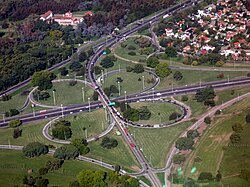
While dairy farming dominated the early 20th century, the city's trajectory changed in 1949 with the inauguration of the Ministro Pistarini International Airport. To support the airport's workforce, the neighborhood of Barrio Uno was established that same year. In 1952, the Ricchieri Freeway was opened to provide a direct link between the airport and the city of Buenos Aires.
The mid-20th century also brought scientific advancement with the 1967 establishment of the Ezeiza Atomic Center by the National Atomic Energy Commission. However, the area also witnessed political turmoil, specifically the Ezeiza Massacre on June 20, 1973, where clashes between opposing Peronist factions during the return of President Juan Perón resulted in at least 13 deaths.
Modern Development and Institutions
Since the 1990s, Ezeiza has expanded as a bedroom community, seeing a surge in gated communities, particularly around the southern area of Canning. The city also offers natural attractions such as the Bosques de Ezeiza (Ezeiza Woods).
The city has invested heavily in public services and education, including the opening of the Dr. Alberto Eurnekian Hospital in 2008. In 2012, the Provincial University of Ezeiza opened as the first institution in Latin America dedicated specifically to aeronautics. Administratively, Ezeiza became the seat of its own county (Partido) in 1994, later inaugurating a postmodern city hall in 2007.
Climate Profile
Ezeiza experiences a temperate climate with distinct seasonal variations. The following data, recorded at the Ministro Pistarini International Airport, illustrates the typical weather patterns from 1991 to 2020.
| Metric | Summer (Jan) | Winter (Jul) | Annual Average |
|---|---|---|---|
| Mean Daily Max (°C) | 30.3 | 15.0 | 22.7 |
| Daily Mean (°C) | 24.1 | 9.8 | 17.0 |
| Mean Daily Min (°C) | 17.9 | 5.2 | 11.5 |
| Avg Precipitation (mm) | 99.8 | 56.9 | 1,014.9 |
Frequently Asked Questions
What is the most famous landmark in Ezeiza?
The most prominent landmark is the Ministro Pistarini International Airport, which serves as the primary international gateway for Argentina.
What is the significance of the Provincial University of Ezeiza?
It is the first university in Latin America specifically dedicated to the study of aeronautics.
What is the Ezeiza Atomic Center?
Established in 1967, it is a facility operated by the National Atomic Energy Commission that serves as a leading producer of radioisotopes for medical applications.
How did Ezeiza evolve from a farming town to a city?
Originally dominated by dairy farming, the city grew rapidly following the construction of the international airport in 1949 and the Ricchieri Freeway in 1952, eventually becoming an affluent bedroom community with many gated developments.
Who were the original inhabitants of the Ezeiza region?
The land was originally inhabited by the Querandí people before Spanish Conquistadores claimed the area in 1588.