Villa Gobernador Gálvez: A Key Hub in Santa Fe, Argentina
Located in the heart of the Santa Fe province, Villa Gobernador Gálvez is a vibrant city that plays a significant role in the metropolitan area of Greater Rosario. Situated on the western ravine of the Paraná River, the city serves as a vital residential and commercial center, separated from the city of Rosario to the north by the Saladillo Stream.
As the fourth most populated city in the province and the second largest within its metropolitan area, Villa Gobernador Gálvez blends a rich immigrant history with modern urban development.
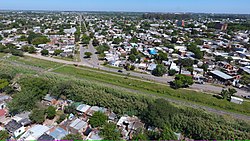
Key Facts
- Location: Santa Fe Province, Rosario Department, Argentina.
- Population: 74,509 (based on the 2001 census).
- Founder: Enrico Mosconi, an Italian immigrant engineer.
- Foundation Date: February 25, 1888.
- Composition: An aggregate of three towns: V. G. Gálvez proper, Villa Diego, and Pueblo Nuevo.
- Coordinates: 33°01′32″S 60°38′01″W.
The History and Foundation of the City
The origins of Villa Gobernador Gálvez are deeply tied to the expansion of Argentina's infrastructure in the late 19th century. The city was founded on February 25, 1888, by Enrico Mosconi, an Italian immigrant engineer. Mosconi was the father of General Enrique Mosconi, who later became the first director of YPF, the state oil company.
The city's establishment began when Dr. José Gálvez, the governor of Santa Fe since 1886, commissioned Mosconi to design the railway system connecting the province to Mendoza. During this process, Mosconi acquired land and, with the governor's authorization, established a village. This early settlement was primarily populated by immigrants from Italy and Spain.
Over the decades, the settlement grew steadily. On April 12, 1962, Governor Carlos Sylvestre Begnis officially declared the town a city. At that time, the population stood at approximately 18,000 inhabitants. Today, the city is actually a combination of three distinct towns: V. G. Gálvez proper, Villa Diego, and Pueblo Nuevo.
Preserving Local Heritage
The city's rich past is curated and preserved at the Dr. Raúl Malatesta Municipal Museum. Established in 1986, the museum is managed by a dedicated association of citizens to ensure the history of the region remains accessible to future generations.
Urban Infrastructure and Community
Villa Gobernador Gálvez is organized into approximately 20 barrios (neighborhoods), creating a structured community environment. The city provides essential public services and amenities to its residents, including the Anselmo Gamen Hospital and various smaller public healthcare centers.
The local economy and social life are supported by five banks, numerous sports clubs, and two FM radio stations. Notably, the city's telephone and internet services are managed by a local cooperative, emphasizing a community-driven approach to utility management.
| Category | Details |
|---|---|
| Province | Santa Fe |
| Department | Rosario |
| Time Zone | UTC−3 (ART) |
| Dialing Code | +54 341 |
| CPA Base | S 2124 |
Notable Personalities
The city has produced several high-profile figures, particularly in the world of professional sports. Among the most famous are:
- Ezequiel Lavezzi: A former professional soccer player who represented the Argentina national football team from 2007 to 2016.
- Ezequiel Barco: A professional soccer player who has played on loan for Club Atlético River Plate.
Frequently Asked Questions
Who founded Villa Gobernador Gálvez?
The city was founded by Enrico Mosconi, an Italian immigrant engineer, on February 25, 1888.
Where is Villa Gobernador Gálvez located?
It is located in the province of Santa Fe, Argentina, on the western ravine of the Paraná River within the Greater Rosario metropolitan area.
What towns make up the current city?
The city is an aggregate of three towns: V. G. Gálvez proper, Villa Diego, and Pueblo Nuevo.
When did the town officially become a city?
It was declared a city by Governor Carlos Sylvestre Begnis on April 12, 1962.
What is the population of the city?
According to the 2001 census conducted by INDEC, the city had a total population of 74,509 inhabitants.