Extraterrestrial Life: The Scientific Search for Life Beyond Earth
The question of whether we are alone in the universe has transitioned from the realm of philosophy to a rigorous scientific discipline known as astrobiology. Extraterrestrial life, colloquially referred to as "aliens," describes any life that originates from a world other than Earth. While no extraterrestrial life has been detected to date, the potential range of such life is vast, spanning from simple microscopic organisms to highly advanced intelligent civilizations.
The Mathematical Probability of Life
To estimate the prevalence of sapient life in our galaxy, scientists often reference the Drake equation. This mathematical framework attempts to calculate the number of active, communicative civilizations in the Milky Way (N) by considering several variables:
- R*: The rate of star formation suitable for intelligent life.
- fp: The fraction of those stars that possess planets.
- ne: The average number of planets per system that can potentially support life.
- fl: The fraction of those planets that actually develop life.
- fi: The fraction of life-bearing planets that evolve intelligence.
- L: The length of time such civilizations broadcast detectable signals.
Current astronomical data provides a staggering scale for these calculations. Observations from the Hubble Space Telescope suggest there are nearly 2 trillion galaxies in the observable universe. Within our own Milky Way, estimates suggest there are 100–400 billion exoplanets (planets orbiting stars other than our Sun). If even a tiny fraction of these systems are habitable, the number of life-supporting worlds could reach into the billions.

Searching for Habitable Worlds
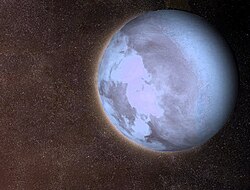
A primary focus of modern astronomy is identifying exoplanets located within the habitable zone—often called the "Goldilocks zone." This is the region around a star where temperatures are just right to allow liquid water to exist on a planet's surface.
As of recent data, thousands of exoplanets have been confirmed across thousands of planetary systems. Research indicates that approximately 1 in 5 Sun-like stars may host an Earth-sized planet within its habitable zone. In the Milky Way alone, this could mean 11 billion potentially habitable Earth-sized planets, a number that rises to 40 billion if red dwarfs are included in the calculation.
Detection Methods and Biosignatures
Scientists search for life both directly and indirectly. One indirect method involves looking for biosignatures—substances or phenomena that provide scientific evidence of past or present life. These can be detected by analyzing light from distant planets through telescopes.
![Lifeforms produce a variety of biosignatures that may be detectable by telescopes.[78][79]](/images/0e/e3/0ee38f117ddb8001047248d8cd55aaa8598a55855ced3941b8cfde00b1825e03.jpg)
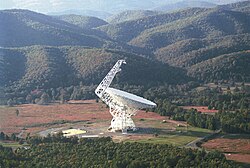
Direct searches also include monitoring for technological signals. Projects like Breakthrough Listen utilize massive radio telescopes to scan the skies for evidence of alien communications.
Life Within Our Solar System
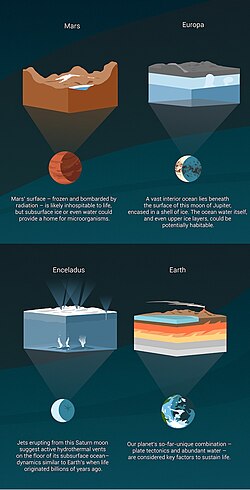
While we look to distant stars, our own celestial neighbors remain prime candidates for hosting primitive life, such as microorganisms. Scientists are closely monitoring several locations:
- Mars: Researchers have investigated the presence of methane as a potential indicator of biological activity.
- Venus: Studies have looked for signs of life via the detection of phosphine in the atmosphere.
- Ocean Moons: Icy moons like Europa (Jupiter) and Enceladus (Saturn) are of high interest due to the potential for subsurface liquid oceans.

Key Facts
- Astrobiology is the scientific study of extraterrestrial life.
- There are an estimated 100–400 billion exoplanets in the Milky Way.
- The habitable zone is the area around a star where liquid water can exist.
- Approximately 1 in 5 Sun-like stars may have an Earth-sized planet in its habitable zone.
- Biosignatures are detectable signs of life, such as specific gases or chemical patterns.
Summary of Planetary Potential
| Location | Type of Life Sought | Key Indicator/Reason |
|---|---|---|
| Mars | Microbial | Methane detection |
| Venus | Microbial | Phosphine in atmosphere |
| Europa/Enceladus | Microbial | Subsurface liquid oceans |
| Exoplanets | Various | Habitable zone/Biosignatures |
Frequently Asked Questions
What is the Drake equation used for?
The Drake equation is a probabilistic formula used to estimate the number of active, communicative extraterrestrial civilizations in the Milky Way galaxy.
What defines a "habitable zone"?
A habitable zone, or Goldilocks zone, is the range of distance from a star where the temperature is suitable for liquid water to remain stable on a planet's surface.
How do scientists look for life on other planets?
Scientists use telescopes to look for biosignatures (chemical signs of life) and radio telescopes to listen for technological signals from intelligent civilizations.
Has extraterrestrial life ever been confirmed?
As of current scientific records, no extraterrestrial life has been officially detected or confirmed.
What is astrobiology?
Astrobiology is the branch of science that studies the origin, evolution, and distribution of life in the universe, including life on Earth and potentially beyond.