extIPA: The Extended International Phonetic Alphabet for Disordered Speech
In the field of clinical linguistics, standard phonetic notation often falls short when describing the complexities of atypical speech. To bridge this gap, the Extensions to the International Phonetic Alphabet for Disordered Speech, commonly known as extIPA, provides a specialized set of symbols and diacritics. Originally devised by the 1989 Kiel Convention and later maintained by the International Clinical Phonetics and Linguistics Association (ICPLA), extIPA allows clinicians to transcribe speech patterns that do not fit within the standard International Phonetic Alphabet (IPA).
While the primary purpose of extIPA is to document disordered speech, some of its symbols are also used to represent specific features of normal speech and are recognized by the International Phonetic Association. This dual utility makes it an essential tool for speech-language pathologists and researchers alike.
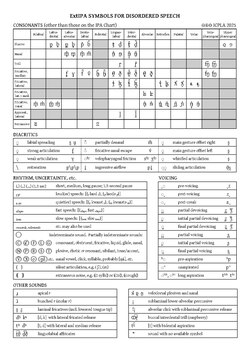
Key Facts
- Purpose: Designed specifically for the phonetic transcription of disordered speech.
- Governance: Maintained by the International Clinical Phonetics and Linguistics Association (ICPLA).
- Evolution: Substantially revised in 2015, with symbols added to Unicode in 2021 and further refinements in 2024.
- Transcription Approaches: Supports both purely phonetic transcription and semi-phonemic approaches using diacritics.
- Specialized Symbols: Includes dedicated letters for sounds like velopharyngeals, nasal fricatives, and percussive consonants.
Foundations of extIPA Transcription
Clinicians generally use one of two methodologies when applying extIPA. The first is a phonetic approach, where the transcriber records exactly what is heard without regard for the intended sound. For instance, if a person intends to say /m/ but it is produced as [b] due to denasalization, it is simply written as ⟨ b ⟩.
The second is a semi-phonemic approach, which uses diacritics to indicate how a target sound is being mispronounced. In this method, the denasalized /m/ would be written as ⟨ m͊ ⟩, using the denasalization diacritic. While this approach is common in academic literature, the ICPLA encourages caution; as of 2025, the denasalization diacritic specifically denotes a partially denasalized sound.
Specialized Letters and Categories
The extIPA expands the phonetic inventory to include sounds often associated with specific speech disorders, such as lisps or cleft palates. It also includes sounds that exist in certain world languages but lack standard IPA symbols, such as denasals and various lateral fricatives.
Lateral and Fricative Sounds
The system provides specific letters for complex lateral sounds, including voiced and voiceless retroflex lateral fricatives and palatal lateral fricatives. It also accounts for laminal fricatives (where the tongue is spread) and the distinction between an apical-r (tongue tip) and a molar-r (bunched-r), the latter of which is transcribed as ⟨ ɹ̈ ⟩.
Velopharyngeal and Percussive Sounds
One of the most critical areas for clinical transcription is the velopharyngeal region. extIPA includes symbols for velopharyngeal fricatives (noisy nasal airstream caused by turbulent airflow through the velopharyngeal port) and velopharyngeal trills, often described as a "snort." Additionally, the system includes percussive consonants, such as bilabial percussion (lip smacking) and bidental percussion (teeth gnashing).
| Category | Example Symbol | Description |
|---|---|---|
| Lateral | ʪ, ʫ | Voiced grooved lateral alveolar fricatives |
| Velopharyngeal | ʩ | Voiceless velopharyngeal trill |
| Velodorsal | 𝼃, 𝼁 | Voiceless and voiced velodorsal plosives |
| Pharyngeal | ꞯ, 𝼂 | Upper-pharyngeal plosives |
| Percussive | ʬ, ʭ | Bilabial and bidental percussion |
Diacritics and Articulatory Detail
Beyond unique letters, extIPA relies heavily on diacritics to provide granular detail about speech production. These can indicate changes in voicing, nasalization, or airstream mechanisms.
Phonation and Airstream
Diacritics can specify pre-aspiration (⟨ ʰ◌ ⟩) or ingressive airstream (inward airflow). They also allow for the notation of partial voicing or devoicing at the beginning or end of a sound, which is vital for identifying subtle articulatory errors.
Articulatory Strength and Position
To describe the physical mechanics of speech, extIPA uses symbols for:
- Articulatory strength: Indicating strong (f͈) or weak (v͉) articulation.
- Occlusion types: Such as interdental (tongue between teeth) or class-3 occlusion (protruding past upper teeth).
- Spreading: Such as labial spreading (s͍) or labioalveolar positioning.
Prosody and Indeterminate Sounds
The extIPA also incorporates notation for prosody (the rhythm and melody of speech) and extraneous noise. Using bracket notation, clinicians can indicate loud speech (forte), quiet speech (piano), or even the speed of speech (allegro or lento). If a sound is obscured by a cough or a knock, double parentheses ⸨ ⸩ are used to denote the interference.
When a sound is heard but cannot be identified with certainty, extIPA uses circled symbols. For example, a circled ◯ represents an indeterminate segment, while a circled Ⓚ might indicate a sound that is likely a click but remains unconfirmed. This allows for a high degree of accuracy in recording what is known versus what is inferred.
Frequently Asked Questions
What is the difference between phonetic and semi-phonemic transcription in extIPA?
Phonetic transcription records the actual sound produced (e.g., writing [b] if an /m/ is denasalized), whereas semi-phonemic transcription uses diacritics to show the intended sound and how it was altered (e.g., writing ⟨ m͊ ⟩).
How does extIPA handle sounds that are uncertain?
Uncertain or unidentifiable sounds are indicated using circles. An empty circle ◯ represents an indeterminate segment, while specific letters inside a circle (like Ⓚ) indicate a sound that is likely a specific category but not certain.
Can extIPA be used for normal speech?
Yes. While its primary purpose is disordered speech, some symbols are also used to represent specific features of normal speech and are accepted by the International Phonetic Association for that purpose.
What does the symbol ⟨ ɹ̈ ⟩ represent?
The symbol ⟨ ɹ̈ ⟩ is used specifically for an English molar-r (a bunched-r), distinguishing it from the apical-r (⟨ ɹ̺ ⟩). These are often acoustically indistinguishable in normal speech but are distinct in certain articulations.
Why were certain diacritics changed in 2024?
The ICPLA updated certain diacritics, such as the nareal fricative symbol, to reduce visual ambiguity and ensure they are easily distinguishable from other symbols like the denasal diacritic at small type sizes.