Evolution: The Mechanisms of Biological Change and Biodiversity
Evolution is the process by which the heritable characteristics of biological populations change over successive generations. This fundamental biological phenomenon occurs when evolutionary processes—such as natural selection and genetic drift—act upon genetic variation. Over time, these processes cause certain traits to become more or less common, ultimately giving rise to the vast biodiversity observed across every level of biological organization.
The scientific foundation of evolution was established in the mid-19th century. Two British naturalists, Charles Darwin and Alfred Russel Wallace, independently conceived the theory of evolution by natural selection to explain how organisms adapt to their physical and biological environments. Darwin later detailed these findings in his seminal work, On the Origin of Species.
![In 1842, Charles Darwin penned his first sketch of On the Origin of Species.[303]](/images/c9/ac/c9ac15e1f64bd3be5cfc91cefc072e2efb23f939f9d0ef9b3008cb010d23d070.jpg)
Key Facts
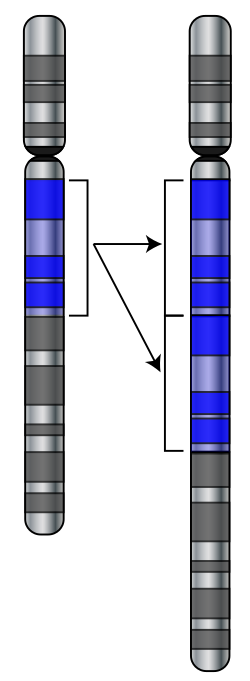
- Natural Selection: Occurs when individuals with favorable traits are more likely to survive and reproduce.
- Heritability: For evolution to occur, traits must be capable of being passed from parents to offspring.
- Genetic Variation: Differences in morphology, physiology, and behavior among individuals provide the raw material for selection.
- Modern Synthesis: The 20th-century integration of Darwinian evolution with Mendelian inheritance and population genetics.
- DNA: The molecule that serves as the basis for heredity, passing information across generations.
The Mechanics of Natural Selection
![Male moor frogs become blue during the height of mating season. Blue reflectance may be a form of intersexual communication. It is hypothesised that males with brighter blue coloration may signal greater sexual and genetic fitness.[129]](/images/34/c9/34c92f35464eef48bc324c8f6f4c7235e25aeac3fc7a2eb7b421382c815fc3a6.jpg)
Evolution by natural selection is supported by four observable facts about living organisms. First, populations often produce more offspring than the environment can support, leading to competition. Second, individuals within a population exhibit variation in their traits. Third, these variations result in differential fitness, meaning some traits provide a better chance of survival and reproduction than others. Finally, these advantageous traits are heritable.
Consequently, in each successive generation, individuals with characteristics best suited to their environment are more likely to leave offspring, gradually shifting the characteristics of the entire population.
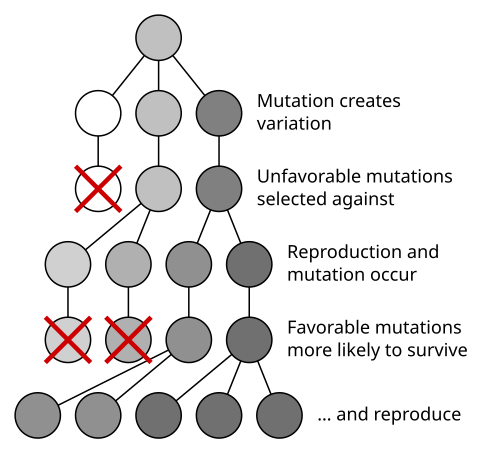
The Modern Evolutionary Theory
In the early 20th century, the scientific community refined these ideas into the "modern synthesis." This framework combined natural selection with population genetics and Mendelian inheritance, identifying DNA (deoxyribonucleic acid) as the primary carrier of genetic information.
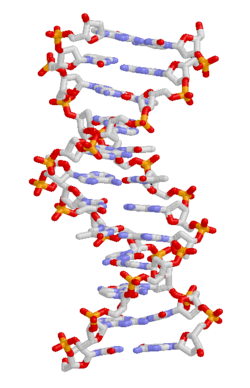
Several key processes drive changes in a population's DNA:
- Mutation: Random changes in the DNA sequence that create new genetic variants.
- Genetic Drift: Random fluctuations in allele frequencies, which have a more pronounced effect in smaller populations.
- Gene Flow: The transfer of genetic material between separate populations.
- Natural Selection: The non-random process where beneficial traits increase in frequency.
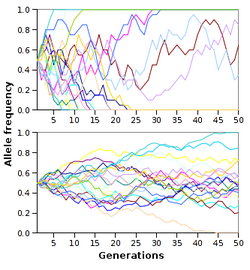
Types of Genetic Selection
Selection can act on a population in different ways depending on which phenotypes (observable traits) are favored:
- Directional Selection: Favors a single extreme phenotype.
- Stabilizing Selection: Favors intermediate traits over extreme ones.
- Disruptive Selection: Favors both extreme phenotypes over the intermediate.
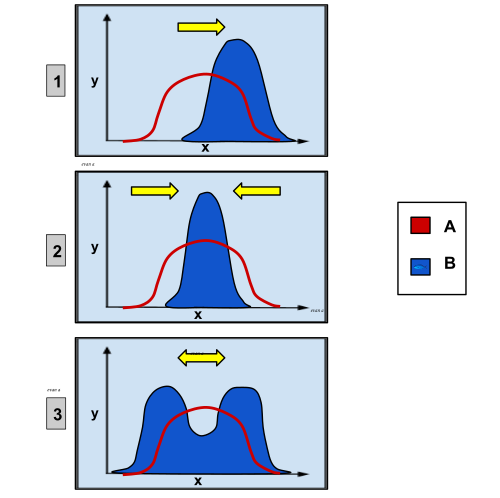
Outcomes of Evolutionary Processes
![Evolutionary tree showing the divergence of modern species from their common ancestor in the centre.[285] The three domains are coloured, with bacteria blue, archaea green and eukaryotes red.](/images/9f/dc/9fdcc9e04e9a8822da9e8eb540a4c5d4974663c0d16beb34a7b8718d4dda42ef.png)
Adaptation and Coevolution
Adaptation occurs when a population becomes better suited to its habitat. For example, the common garter snake evolved resistance to tetrodotoxin, a defensive substance used by its amphibian prey. In some cases, species undergo coevolution, where two or more species reciprocally affect each other's evolution.
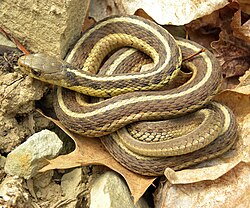
Speciation and Extinction
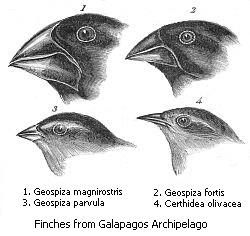
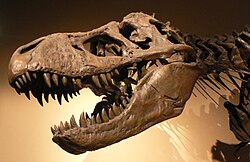
Speciation is the process by which new species arise, often through geographic isolation. A classic example is the diversification of finches on the Galápagos Islands. Conversely, extinction occurs when a species ceases to exist, such as the non-avian dinosaurs during the Cretaceous–Paleogene extinction event.
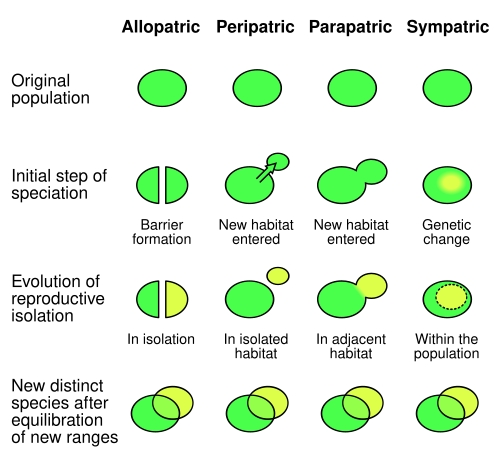
Common Descent and Homology
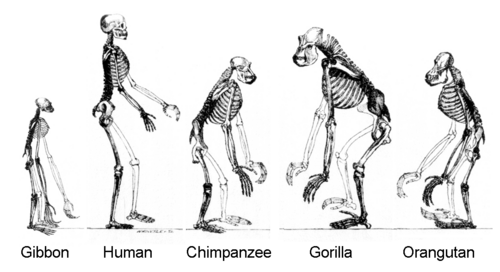
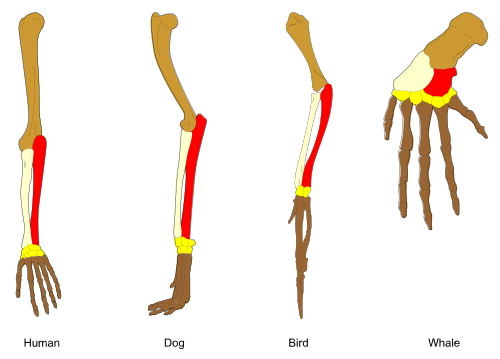
The theory of common descent posits that all living organisms share a common ancestor. This is evidenced by homologous structures—organs or skeletal elements that share a basic structure but have been adapted for different functions. For instance, the limb bones of tetrapods or the flipper bones of a baleen whale (adapted from land-dwelling leg bones) demonstrate this shared ancestry.
![A baleen whale skeleton. Letters a and b label flipper bones, which were adapted from front leg bones, while c indicates vestigial leg bones, both suggesting an adaptation from land to sea.[166]](/images/bc/f8/bcf8fb61ec0021651193178aa36e484fa5162a037fec4dbde752f19a7a309a5f.png)
Summary of Evolutionary Concepts
| Concept | Definition | Primary Driver |
|---|---|---|
| Natural Selection | Survival of the fittest individuals | Environmental Pressure |
| Genetic Drift | Random change in gene frequencies | Chance/Population Size |
| Mutation | Permanent change in DNA sequence | Chemical/Physical Errors |
| Speciation | Formation of new distinct species | Isolation/Divergence |
Frequently Asked Questions
![As evolution became widely accepted in the 1870s, caricatures of Charles Darwin with an ape or monkey body symbolised evolution.[347]](/images/f1/8b/f18b1a8a14fd562686bafd1a06c44b5f68ac0ddba70c86828060982c5702dbaa.jpg)
What is the difference between natural selection and genetic drift?
Natural selection is a non-random process where traits that improve fitness become more common. Genetic drift is a random process where allele frequencies change by chance, which is particularly impactful in small populations.
How does the "modern synthesis" differ from Darwin's original theory?
While Darwin proposed natural selection, he did not know the mechanism of heredity. The modern synthesis integrated his theories with Mendelian genetics and the discovery of DNA to explain how traits are actually passed and modified.
What are homologous structures?
Homologous structures are physical features shared by different species because they were inherited from a common ancestor, even if those features now serve different purposes (e.g., a whale's flipper and a human's arm).
What causes speciation?
Speciation often occurs through geographic isolation, where populations are separated by physical barriers, preventing gene flow and allowing them to evolve independently until they can no longer interbreed.
What is differential fitness?
Differential fitness refers to the fact that different traits confer different rates of survival and reproductive success, meaning some individuals are more likely to pass their genes to the next generation than others.