European Union Governance and Institutional Framework
The European Union (EU) is a unique supranational entity comprising 27 member states. It operates through a complex system of treaties, institutions, and agreements designed to foster economic integration, political stability, and shared legal standards across the continent. From the foundational Schuman Declaration of 1950 to the modern Treaty of Lisbon, the EU has evolved from a coal and steel community into a comprehensive political and economic union.
Key Facts
- Member States: 27 sovereign nations.
- Foundational Documents: Key treaties include the Treaty of Rome (1957), Maastricht Treaty (1992), and Treaty of Lisbon (2007).
- Executive Leadership: Led by the European Council and the Von der Leyen Commission.
- Monetary Union: The Eurozone manages the shared currency, the euro.
- Border Policy: The Schengen Area facilitates passport-free travel across most member states.
- Customs Management: DG TAXUD (Directorate-General for Taxation and Customs Union) manages the EU customs union and coordinates taxation policy.
The Institutional Architecture
The EU functions through a division of executive, legislative, and judicial powers to ensure democratic legitimacy and legal consistency.
Executive and Legislative Bodies
The European Council provides the general political direction, while the European Commission, currently led by President Von der Leyen, serves as the executive arm. The European Parliament, with its 10th session running from 2024 to 2029, represents EU citizens and shares legislative power. Major political groups within the Parliament include the EPP (led by Manfred Weber) and S&D (led by Iratxe García).
Judicial and Auditory Oversight
The Court of Justice of the EU ensures that EU law is interpreted and applied uniformly. This is supported by the European Court of Justice and the General Court. Financial transparency is maintained by the European Court of Auditors and the European Public Prosecutor's Office.
Economic and Financial Management
The European Central Bank (ECB), under President Lagarde, manages the Economic and Monetary Union (EMU). Other critical financial bodies include the European Investment Bank Group and the European Stability Mechanism.
Integrated European Zones
Beyond full EU membership, several specialized agreements define how countries interact regarding trade, travel, and currency.
The Eurozone and Economic Area
The Eurozone consists of member states that have adopted the euro. While most members use the currency, some, like Denmark, have an opt-out. The European Economic Area (EEA) extends the EU's single market to include Iceland, Liechtenstein, and Norway.
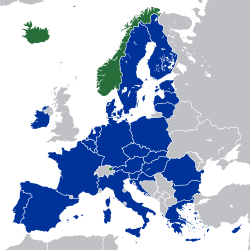
The Eurozone continues to evolve, with enlargement efforts targeting countries such as Czechia, Hungary, Poland, Sweden, and Romania.
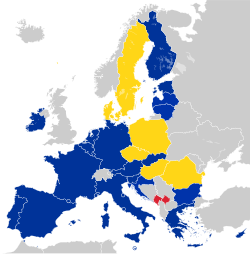
Schengen and Euratom
The Schengen Area allows for the abolition of internal border checks, incorporating both EU members and non-EU states like Switzerland. This area is supported by agencies such as Frontex and the Schengen Information System.
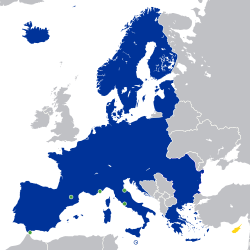
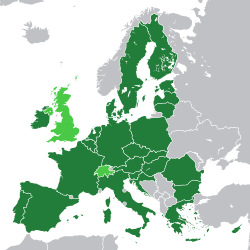
Separately, Euratom (the European Atomic Energy Community) coordinates nuclear power research and safety among its members, which includes the UK and Switzerland.
Legal Framework and External Relations
EU law is governed by the Acquis (the accumulated body of EU law) and principles such as primacy (EU law prevails over national law) and subsidiarity (decisions are taken at the most local level possible). Legal instruments include Regulations, Directives, Decisions, and Recommendations.
Externally, the EU maintains a robust diplomatic presence through the European External Action Service, led by High Representative Kaja Kallas. The EU manages strategic relations with global powers including the United States, China, and NATO, as well as neighborhood policies with countries like Ukraine, Georgia, and Moldova.
| Framework | Primary Purpose | Key Feature |
|---|---|---|
| European Union (EU) | Political and Economic Union | 27 Member States |
| Eurozone | Monetary Integration | Shared Euro Currency |
| Schengen Area | Border Integration | Passport-free Travel |
| EEA | Market Integration | Single Market Access |
| Euratom | Nuclear Energy | Atomic Energy Coordination |
Frequently Asked Questions
What is the role of DG TAXUD?
The Directorate-General for Taxation and Customs Union (DG TAXUD) is responsible for managing and developing the EU customs union to protect external borders and coordinating taxation policy across member states.
How does the Schengen Area differ from the EU?
While the EU is a political and economic union, the Schengen Area is specifically a zone of free movement. Some non-EU countries (like Norway and Switzerland) are in Schengen, while some EU countries may have different arrangements.
What is the 'Acquis' in EU law?
The Acquis refers to the entire body of common rights and obligations that bind all EU member states, encompassing treaties, legislation, and court rulings.
Who leads the European Commission?
The European Commission is currently led by President Von der Leyen.
What is the purpose of the European Economic Area (EEA)?
The EEA allows non-EU countries like Iceland, Liechtenstein, and Norway to participate in the EU's single market, ensuring the free movement of goods, services, people, and capital.