European Union: History, Governance, and Economic Integration
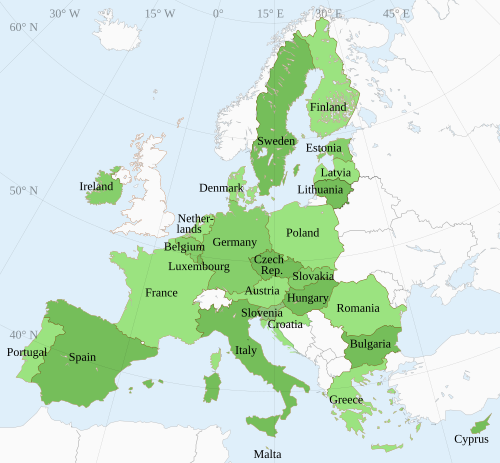
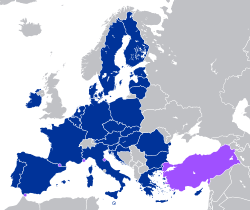
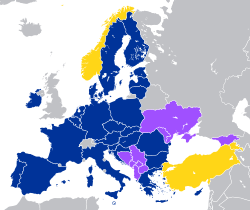
The European Union (EU) is a unique supranational union—an international organization where member states cede some of their sovereignty to shared institutions—comprising 27 European countries. Guided by the motto "In Varietate Concordia" (United in Diversity), the EU aims to foster economic cooperation, political stability, and the protection of fundamental rights across the continent.
From its origins as a coal and steel partnership to its current status as a global economic powerhouse, the EU has evolved through a series of landmark treaties that have expanded its scope from simple trade to a complex system of shared laws and a common currency.
Key Facts
- Membership: 27 member states.
- De Facto Capital: Brussels, Belgium.
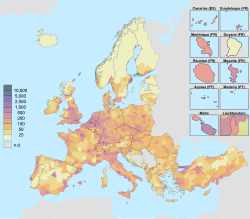
- Population: Estimated 451,990,314 (2026).
- Economy: Estimated nominal GDP of $23.035 trillion (2026).
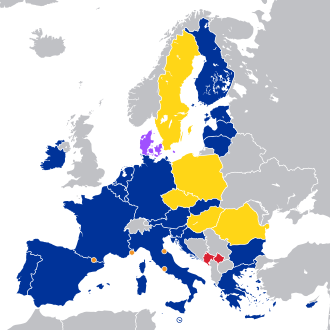
- Currency: The Euro (€), used by the majority of members (the Eurozone).
- Official Languages: 24 official languages.
- Land Area: Approximately 4,225,104 km², including outermost regions.
The Evolution of the Union
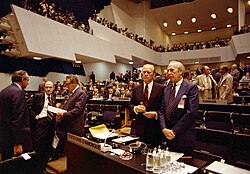
The EU was not created overnight but developed through a phased approach to integration, beginning in the aftermath of World War II to prevent future conflict.
Foundational Treaties
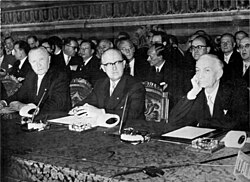
The journey began with the Treaty of Paris (1952), which established the European Coal and Steel Community (ECSC). This was followed by the Treaty of Rome (1958), which created the European Economic Community (EEC) and the European Atomic Energy Community (EAEC/EURATOM).
Expansion and Modernization
The union underwent significant transformations through the Single European Act (1987) and the Maastricht Treaty (1993). The latter was pivotal, as it formally established the European Union and laid the groundwork for the single currency. The most recent major structural update was the Treaty of Lisbon (2009), which streamlined the EU's decision-making processes and strengthened its legal personality.

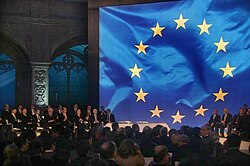
Governance and Political Structure
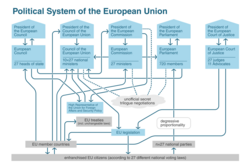
The EU operates through a mixed supranational and intergovernmental system, meaning decisions are made both by independent EU bodies and by the governments of the member states.
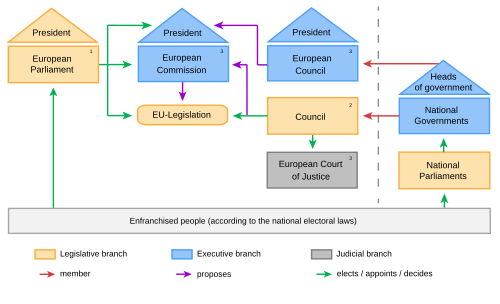
Branches of Power
- Executive: Led by the President of the European Commission (Ursula von der Leyen) and the President of the European Council (António Costa).
- Legislative: Power is shared between the European Parliament (representing EU citizens) and the Council of the European Union (representing member state governments).
- Judicial: The Court of Justice ensures that EU law is interpreted and applied consistently across all member states.
Competencies and Authority
The EU's authority is divided into three types of competence:
- Exclusive Competence: Areas where only the EU can legislate, such as the customs union and monetary policy for Eurozone members.
- Shared Competence: Areas where both the EU and member states can act, including the internal market, environment, and energy.
- Supporting Competence: Areas where the EU supports member state actions, such as culture, tourism, and education.
Economic and Geographic Integration
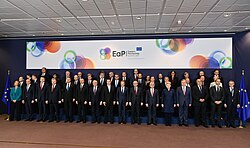
The EU is characterized by deep economic integration designed to allow the free movement of goods, services, capital, and people.
The Single Market and Eurozone
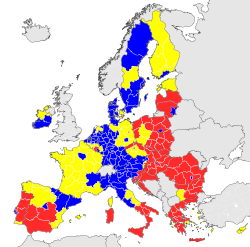
The Single Market removes trade barriers between members, while the Customs Union establishes a common external tariff for non-EU countries. The Eurozone consists of those member states that have adopted the Euro as their sole legal tender.
The Schengen Area
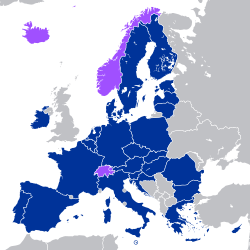
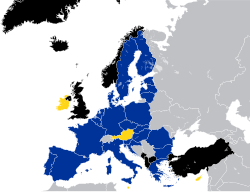
The Schengen Area is a zone where internal border checks have been abolished, allowing seamless travel. While most EU members participate, some have opt-outs; for example, Ireland maintains its own border controls due to its relationship with the UK.
Infrastructure and Resources
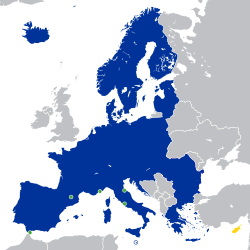
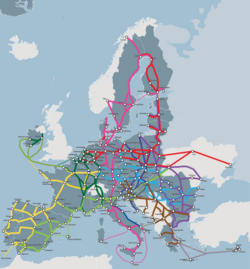
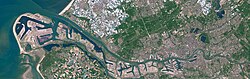
The EU manages massive infrastructure projects via the Trans-European Transport Network and maintains the world's largest exclusive economic zone (EEZ) at 25 million square kilometres.
![The EU's exclusive economic zone (EEZ). At 25 million square kilometres, it is the largest in the world.[241]](/images/9a/7b/9a7b3922a189f8275577320b735b33b9199b776b73856e5358e223ab8a87ce33.png)
EU Summary Table
| Category | Details |
|---|---|
| Member States | 27 Countries |
| Primary Currency | Euro (€) |
| GDP (Nominal 2026 Est.) | $23.035 Trillion |
| Population (2026 Est.) | 451,990,314 |
| Main Institutional Seats | Brussels, Frankfurt, Luxembourg, Strasbourg |
| Key Legal Frameworks | Treaties of Rome, Maastricht, and Lisbon |
Frequently Asked Questions
![Increase of average yearly temperature in selected cities in Europe (1900–2017)[183]](/images/ad/48/ad484ecbafab24ef09e059d29c3a0f45ddb651d79380f147b4526879da8e6160.png)

What is the difference between the EU and the Eurozone?
The European Union is the overall political and economic union of 27 member states. The Eurozone is a subset of the EU consisting only of those member states that have adopted the Euro as their official currency.
Which cities serve as the EU's institutional seats?
The EU distributes its institutions across several cities: Brussels (Commission, European Council, Council of the EU), Strasbourg (Parliament), Luxembourg (Court of Justice, Court of Auditors), and Frankfurt (European Central Bank).
What are "opt-outs" in the context of the EU?
Opt-outs are legal provisions that allow specific member states to exempt themselves from certain EU policies. For example, Denmark has an opt-out from the Eurozone, and Ireland has an opt-out from the Schengen Area.
How is the EU's budget allocated?
EU funding is distributed across several priorities. Based on 2014–2020 data, the largest shares went to Sustainable Growth/Natural Resources (38.6%) and Economic, Territorial, and Social Cohesion (34.1%).
What is the Schengen Area?
The Schengen Area is a region comprising several European countries (both EU and non-EU) that have officially abolished all passport and all other types of border control at their mutual borders.