European Hornet: Biology, Behavior, and Ecological Impact of Vespa crabro
The European hornet (Vespa crabro) stands as the largest eusocial wasp native to Europe. A member of the genus Vespa, it is a true hornet, distinguished by its complex social structures and impressive physical presence. While native to Eurasia, this species was introduced to North America as early as 1840 and is now well-established in the United States and Canada.
Beyond its size, the European hornet is a fascinating subject of biological study due to its unique nesting habits, social organization, and predatory behaviors. From constructing intricate paper homes to maintaining colony order through specialized social mechanisms, V. crabro plays a significant role in its ecosystem.

Key Facts
- Scientific Name: Vespa crabro
- Status: Largest eusocial wasp native to Europe.
- Diet: Primarily carnivorous (insects) and frugivorous (sugary fruits).
- Nesting Material: A paper-pulp mixture of chewed plant fibers and saliva.
- Social Structure: Eusocial, featuring queens, workers, and males.
- Defense: Uses alarm pheromones (notably 2-Methyl-3-butene-2-ol) to signal danger.
Taxonomy and Classification
The European hornet belongs to the kingdom Animalia, phylum Arthropoda, and class Insecta. Within the order Hymenoptera, it is classified under the family Vespidae and the subfamily Vespinae. Recent phylogenetic studies suggest that its closest relative is Vespa dybowskii.
Historically, the species was divided into numerous subspecies based on geographic color forms, such as the British form (V. c. vexator) or the Japanese form (V. c. flavofasciata). However, a 2020 taxonomic revision by Smith-Pardo, Carpenter, and Kimsey suggested these should be viewed as informal names for geographic color forms rather than distinct subspecies, though this remains a point of discussion among entomologists.
Physical Characteristics
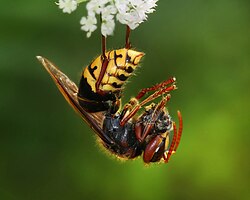
The European hornet is easily identifiable by its reddish-orange wings and a petiolate abdomen striped with brown and yellow. Its eyes are deeply indented and shaped like a "C". While it possesses hair on the thorax and abdomen, it is generally less hairy than most bee species. Due to its coloration, it is sometimes mistaken for the Asian giant hornet, though it is significantly smaller.
Size and morphology vary between sexes:
- Queens: The largest members, reaching up to 35 mm in length.
- Workers: Average approximately 25 mm in length.
- Mass: The typical mass size is approximately 477.5 ± 59.9 mg.
- Anatomy: Females possess a stinger (a modified ovipositor), whereas males cannot sting. Males also feature slightly longer antennae with 13 segments, compared to 12 in females.

Nesting and Construction
European hornets are master architects, building intricate paper nests. These structures typically consist of a central paper comb (the pedicle), an outer envelope, and a single entry hole. To create this material, female workers chew up dead bark, twigs, and other plant matter, mixing it with their saliva to create a paper-pulp cement.
This saliva-based cement serves a dual purpose: it acts as a glue to hold the organic and inorganic materials together and provides a waterproof barrier that protects the colony from wind and harsh weather. Interestingly, analysis of nests has shown that hornets incorporate minerals from the surrounding soil, such as iron and zirconium, into the comb walls. The average dry weight of a nest is approximately 80.87 grams.
Social Behavior and Life Cycle
The life of a colony begins when a queen selects a dark location, such as a hollow tree trunk, to build her nest and lay eggs. The queen's egg-laying rate averages about 2.31 eggs per day. The colony is maintained through a sophisticated social system.
Worker Policing
In many social insect colonies, the queen uses pheromones to suppress the reproduction of workers. However, in V. crabro, reproductive suppression is achieved through worker policing. While workers are capable of laying haploid male eggs, they generally do not. Instead, workers enforce sterility by physically destroying eggs laid by other workers or discriminating against those who attempt to reproduce. This behavior reduces internal conflict and ensures the productivity of the colony.
Alarm and Defense
When threatened, the hornet performs an "alarm dance" outside the nest, characterized by consistent buzzing and darting movements. This behavior is triggered by the release of alarm pheromones, primarily 2-Methyl-3-butene-2-ol, which are stored in internal venom sacs. While the hornets are generally non-confrontational, they can become aggressive if the nest is disturbed or if they are defending a food source.
Diet and Predation
European hornets are largely carnivorous, hunting a variety of large insects to feed their larvae, including beetles, wasps, large moths, dragonflies, and mantises. They are also known to engage in kleptoparasitism, a behavior where they steal prey from other animals, such as spiders. As the autumn season approaches, their foraging habits often shift from hunting to scavenging for sugary foods like fallen fruit.
Summary of European Hornet Traits
| Feature | Description |
|---|---|
| Primary Diet | Insects (larvae) and sugary fruits (adults) |
| Nest Type | Paper-pulp envelope nests |
| Reproductive Control | Worker policing |
| Main Alarm Pheromone | 2-Methyl-3-butene-2-ol |
| Key Predators/Competitors | Asilidae (robber flies) and spiders |
Frequently Asked Questions
Are European hornets dangerous to humans?
Most stings do not require medical attention. However, in rare cases, the venom—which contains compounds like dopamine, serotonin, and histamine—can cause serious reactions such as atrial fibrillation. Individuals with specific susceptibilities should exercise caution.
Do European hornets kill honey bees?
While they do prey on western honey bees (Apis mellifera), they do not typically pose the same level of threat to healthy colonies as invasive species like the Asian hornet. Some beekeepers actually value them for protecting hives against wax moths.
How can I identify a European hornet?
Look for reddish-orange wings and an abdomen with brown and yellow stripes. They are larger than common wasps but smaller than the Asian giant hornet.
Is it illegal to kill a European hornet?
In some regions, such as Germany, the species is legally protected, and destroying a nest can result in significant fines. This protection is intended to prevent the decline of the species caused by unwarranted fear.
What do European hornets eat?
Adults consume sugary substances like fallen fruit, while they hunt large insects like beetles, moths, and dragonflies to provide protein for their developing larvae.