Hunting Wasps: The Diverse Ecology of Predatory Hymenoptera
In the vast world of insects, few groups exhibit as much specialized predatory behavior as the hunting wasps. While "hunting wasp" is not a formal biological taxon, the term describes a fascinating ecological strategy shared by various members of the order Hymenoptera. These insects are defined by their parental care: they capture prey—typically other insects—to provide a vital food source for their developing larvae.
Whether they live as solitary individuals or in complex social colonies, hunting wasps generally construct nests or protective shelters. These structures serve as secure environments where prey is hidden and larvae can safely feed and undergo pupation (the process of transforming from a larva into an adult).
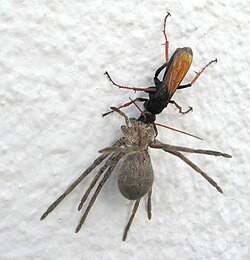
Key Facts
- Ecological Strategy: Hunting wasps are defined by their behavior of capturing prey for their larvae rather than a single taxonomic group.
- Paralysis vs. Butchery: Solitary hunters often paralyze prey to keep it fresh, while social wasps often butcher prey to feed larvae progressively.
- Taxonomic Diversity: Hunting wasps belong to the suborder Apocrita and the clade Aculeata, but they have evolved these predatory traits independently multiple times.
- Evolutionary Links: Molecular biology has revealed that true bees are actually a specialized group of wasps that transitioned to feeding on nectar and pollen.
Distinguishing Hunting Wasps from Solitary Wasps
In entomological literature, the terms "hunting wasp" and "solitary wasp" are often used interchangeably, but they are not scientifically identical. A solitary wasp is simply any wasp that does not live in a social colony. However, not all solitary wasps are hunters; for instance, parasitic wasps are solitary but do not hunt prey in the traditional sense. Conversely, some hunting wasps, such as those in the genera Vespa and Polistes, are highly social (eusocial) rather than solitary.
Taxonomy and Biological Strategies
The biology of hunting wasps is incredibly varied, with different families employing unique methods to secure food for their offspring. It is important to note that similar adaptations in different taxa do not always imply a direct evolutionary relationship; instead, they often represent convergent evolution.
Superfamily Chrysidoidea
While generally classified as parasitoids (organisms that live in or on a host), some members of the Bethylidae family exhibit hunting-like behaviors. They may hunt, paralyze, and even perform malaxation (the process of chewing or softening prey) before concealing the insect and laying eggs upon it.
![Katydid paralysed by a Sphecid wasp, and left outside the tunnel while the wasp performs a final inspection of the interior.[1]](/images/37/7e/377ec76d9b6eafbeaff487341b3dc2bf9f01ed0f438398c3189214cf5125a4f2.jpg)
Superfamily Apoidea
Modern molecular biology has reclassified bees as a group of wasps that primarily consume nectar and pollen. Within this superfamily, several families are definitive hunters:
- Ampulicidae: Known as cockroach wasps, these exhibit a primitive hunting style, often concealing prey in cracks or burrows rather than building elaborate nests.
- Crabronidae: A diverse family that builds tunnels to house larvae, with species specializing in hunting flies, bees, or cicadas.
- Sphecidae: This widely varied family includes well-known digger wasps and mud daubers.
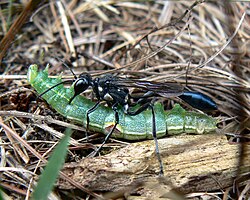
Superfamily Vespoidea
This superfamily contains some of the most recognizable wasps, including the Pompilidae (spider wasps) and the Vespidae. The Vespidae family is particularly diverse, containing both solitary potter wasps and highly social species like hornets and paper wasps.
Social wasps in the Vespidae family typically do not rely on paralysis to keep prey fresh. Instead, they often butcher the insect, carrying only the most nutritious portions back to the colony to feed the larvae incrementally.
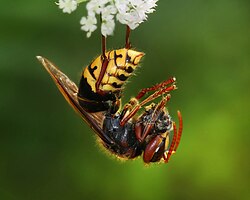
Summary of Hunting Wasp Families
| Family | Common Name/Type | Primary Strategy |
|---|---|---|
| Ampulicidae | Cockroach Wasps | Concealing prey in cracks/burrows |
| Crabronidae | Various | Building tunnels for larvae |
| Pompilidae | Spider Wasps | Hunting spiders |
| Tiphiidae | Subterranean Hunters | Hunting beetle larvae underground |
| Vespidae | Social Wasps/Hornets | Butchering prey for colony feeding |
Frequently Asked Questions
Do all hunting wasps paralyze their prey?
No. While many solitary hunting wasps paralyze prey to keep it fresh for their larvae, social wasps (like hornets) often butcher the prey and carry nutritious pieces back to the colony to feed the larvae progressively.
Is a "hunting wasp" a specific scientific classification?
No, "hunting wasp" is an ecological description of a strategy rather than a formal biological taxon. It describes various insects within the Hymenoptera order that hunt prey to feed their young.
What is the difference between a solitary wasp and a hunting wasp?
A solitary wasp is defined by its social structure (living alone), whereas a hunting wasp is defined by its behavior (capturing prey). Some solitary wasps are not hunters, and some hunting wasps are social.
How are bees related to hunting wasps?
Molecular biology has demonstrated that bees are essentially a group of wasps that evolved to feed primarily on nectar and pollen rather than hunting other insects.
Why do some wasps butcher their prey?
This is common among social, carnivorous wasps. Because they live in colonies, they do not need to preserve a whole insect; instead, they butcher it to transport the most nutritious parts back to the nest for the larvae.