Eurasian Blue Tit
The Eurasian blue tit (Cyanistes caeruleus) is a small, vibrant passerine bird belonging to the tit family, Paridae. Renowned for its striking blue and yellow plumage, this agile bird is a common sight across Europe and parts of Asia. Beyond its beauty, the blue tit is celebrated for its acrobatic foraging skills and remarkable adaptability to human environments.
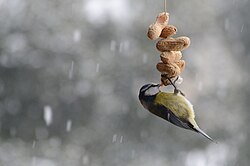
These birds are highly skilled foragers, capable of gripping the thinnest outer branches of shrubs and trees, often hanging upside down to reach their prey. Their diet primarily consists of insects and spiders, though they supplement this with seeds and other plant-based foods outside of the breeding season.
Key Facts
- Scientific Name: Cyanistes caeruleus
- Conservation Status: Least Concern (IUCN 3.1)
- Average Weight: Approximately 11 grams
- Diet: Primarily insects and spiders; seeds in winter
- Special Ability: Can see in ultraviolet (UV) light
- Population: Estimated 20 to 44 million pairs in Europe
Taxonomy and Classification
First described by Carl Linnaeus in 1758, the Eurasian blue tit was originally named Parus caeruleus. The term Parus is classical Latin for a tit, while caeruleus refers to a dark blue or caerulean color. In 2005, mitochondrial DNA (mtDNA) analysis of cytochrome b sequences revealed that the blue tit was an early offshoot from other tits, leading scientists to reclassify it into its own genus, Cyanistes (derived from the Ancient Greek kuanos, meaning "dark blue").
The genus Cyanistes currently includes three species: the Eurasian blue tit, the African blue tit, and the azure tit. In western Russia, these species occasionally interbreed, resulting in a common hybrid known as Pleske's tit (Cyanistes × pleskei).
Physical Description
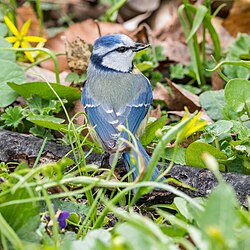
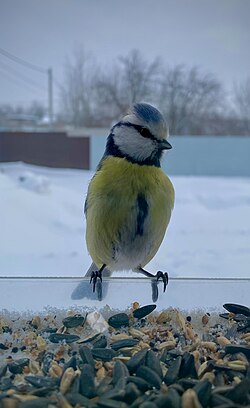
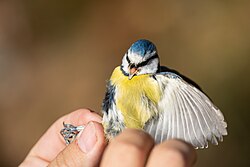
The Eurasian blue tit typically measures 10.5–12 cm in length with a wingspan of 17.5–20 cm. Its most distinctive feature is the intense blue crown and a dark blue line that encircles its white cheeks and chin. The nape, wings, and tail are blue, while the back is a yellowish-green. The underparts are a bright sulphur-yellow, featuring a dark line running down the abdomen.
Interestingly, the intensity of the yellow plumage is a biological indicator of the bird's diet; higher levels of carotene pigments from consuming yellow-green caterpillars result in a more vivid yellow color.
Ultraviolet Vision and Sexual Dimorphism
To the human eye, males and females appear nearly identical. However, blue tits possess ultraviolet vision, allowing them to see colors outside the human spectrum. Under UV light, the crown of the male is a significantly brighter blue than that of the female or juveniles, serving as a key visual cue for the birds themselves.
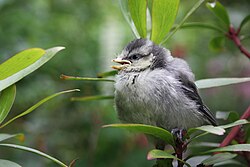
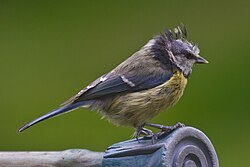
Juvenile birds are generally yellower and lack the sharp contrasting colors of adults. They typically transition to adult plumage by September, though some wing markings persist until the following May or June.
Distribution and Habitat
The Eurasian blue tit is widely distributed across Europe, with populations ranging from the United Kingdom and Ireland to the northern Urals and northern Turkey. In Great Britain, they are highly versatile, inhabiting deciduous woodlands, public parks, private gardens, and urban city centers.
There are several recognized subspecies based on geography, including C. c. obscurus (Britain and Ireland), C. c. balearicus (Majorca), and C. c. persicus (Zagros Mountains).
Behavior and Ecology
Breeding and Nesting
Blue tits are opportunistic nesters, utilizing tree holes, wall cavities, stumps, or artificial nest boxes. They are socially monogamous, though extra-pair copulations are common. The female handles all incubation duties while the male provides food. Once the eggs hatch, both parents feed the nestlings, sometimes at a rate of one feeding every 90 seconds during peak season.
The species is known for its protective nature; when defending the nest, they may hiss and bite intruders, earning them the nickname "Little Billy Biter" in southwest England.
Lifespan and Survival
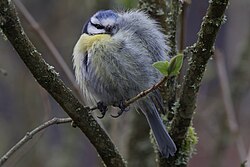
Survival rates vary significantly by age. In Britain, the first-year survival rate for juveniles is approximately 38%, compared to 53% for adults. The average life expectancy upon reaching breeding age is three years, although some individuals live much longer. The oldest recorded blue tit in the Czech Republic lived for 11 years and 7 months.
Learned Behavior and Intelligence
The Eurasian blue tit is a prime example of culturally transmitted learning. In the 1920s, these birds learned to open foil-topped milk bottles in Britain to reach the cream. This behavior spread through the population via observation. Additionally, their instinct to strip bark for insects has evolved into a tendency to peel man-made materials like wallpaper, stucco, and window putty.
Conservation and Status
The population trend for the Eurasian blue tit is positive, with a 30% increase in European numbers between 1980 and 2016. Climate change has shifted their range limit northwards by 500 km in Fennoscandia and led to earlier laying dates, which often allows for second broods. The species is currently classified as Least Concern by the IUCN.
Summary Table
| Feature | Detail |
|---|---|
| Scientific Name | Cyanistes caeruleus |
| Average Length | 10.5–12 cm |
| Average Weight | ~11 g |
| Primary Diet | Insects, spiders, seeds |
| Clutch Size | Typically 7–8 eggs (up to 14 recorded) |
| Conservation Status | Least Concern |
Frequently Asked Questions
How can you tell a male blue tit from a female?
To humans, the sexes are nearly indistinguishable. However, blue tits can see in ultraviolet light, and the males possess a brighter blue crown under UV illumination than females or juveniles.
What causes the yellow color in their feathers?
The intensity of the sulphur-yellow underparts is determined by the amount of carotene pigments in their diet, specifically from consuming yellow-green caterpillars.
Why are they called "Billy Biters"?
In southwest England, they earned this nickname because of their tendency to hiss and bite at fingers when protecting their nests.
Do blue tits live in cities?
Yes, they are highly adaptable and are frequently found in urban centers, as well as in gardens, parks, and deciduous woodlands.
What is the relationship between the Eurasian and African blue tit?
They both belong to the genus Cyanistes. While they were once considered the same species (conspecific), they are now recognized as distinct species.