Erythrina crista-galli: The Vibrant Cockspur Coral Tree
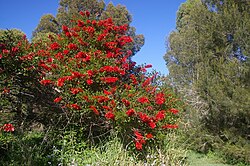
The Erythrina crista-galli, commonly known as the cockspur coral tree, is a striking flowering tree belonging to the Fabaceae family. Known as ceibo in Spanish and corticeira in Portuguese, this species is celebrated for its brilliant red blooms and its deep cultural significance in South America. Its specific epithet, crista-galli, is derived from Latin and translates to "cock's comb," referencing the unique shape of its flowers.
Beyond its aesthetic appeal, the tree holds prestigious national status: it is the national tree of Argentina, and its flower serves as the national flower for both Argentina and Uruguay.
Key Facts
- Native Range: Argentina, Uruguay, Bolivia, Paraguay, and southern Brazil.
- National Symbol: National tree and flower of Argentina; national flower of Uruguay.
- Conservation Status: Listed as Least Concern (IUCN 3.1) and Apparently Secure (NatureServe).
- Primary Habitat: Flood-prone lowlands, swamps, wetlands, and gallery forests.
- Distinctive Feature: Bright red, butterfly-shaped flowers and nitrogen-fixing root nodules.
Botanical Description
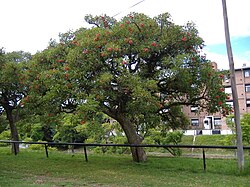
The Erythrina crista-galli is generally a small tree, typically reaching heights of 5 to 8 meters (16–26 ft), though some specimens in the Argentine provinces of Tucumán, Jujuy, and Salta can grow up to 10 meters (33 ft). The woody trunk usually measures around 50 cm (20 in) in girth and is characterized by irregular, thorny branches.
One of the tree's most important biological features is its taproot system. The roots host nitrogen-fixing bacteria in specialized nodules. This symbiotic relationship allows the bacteria to provide the tree with essential nitrogen in exchange for organic substances produced by the plant.
Flowers and Pollination
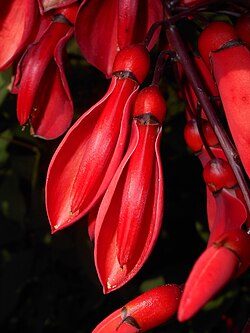
The tree produces vivid red flowers arranged in raceme-type inflorescences. These flowers exhibit bilateral symmetry and a complex structure: the calyx is gamosepalous (sepals fused into a tube), and the corolla is butterfly-shaped. Unlike many legumes, the largest petal, known as the "standard," is positioned at the bottom. The "wings" are small and mostly hidden, while the "keel" (carina) protects the reproductive organs.
The androecium consists of ten stamens, with nine united by their filaments. The gynoecium is unicarpel and tightly integrated among the stamens. These nectar-rich flowers attract insects, which pollinate the plant as they crawl beneath the carina.
Fruit and Seeds
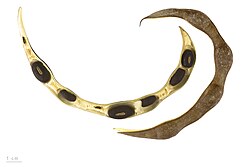
Following the flowering period, the tree produces a legume—a dry pod several centimeters long. Each pod contains approximately 8 to 10 chestnut-brown, bean-shaped seeds. Upon germination, the cotyledons (seed leaves) remain underground, a condition known as being hypogeal.
Distribution and Cultivation
Naturally, Erythrina crista-galli thrives in water-saturated soils. It is commonly found in gallery forests (forests along watercourses), swamps, and wetlands across northeastern and central western Argentina, eastern Bolivia, southern Brazil, Paraguay, and Uruguay. It avoids dry areas and high forests.
Due to its ornamental value, it has been planted globally as a street or garden tree, particularly in California. In the United Kingdom, it has received the Royal Horticultural Society's Award of Garden Merit. However, in parts of Australia, the species has become naturalized and is declared a weed in certain regions.
Uses and Applications
The cockspur coral tree is valued for both its medicinal and industrial properties:
- Bark: Used as a diuretic and antispasmodic, and applied to treat rheumatism and wounds.
- Resin: Utilized in the treatment of intestinal diseases.
- Leaves: Contain camphor, which provides anti-inflammatory properties for tumors and aids in wound healing.
- Dyeing: The plant has various dyeing applications.
| Feature | Details |
|---|---|
| Scientific Name | Erythrina crista-galli L. |
| Family | Fabaceae |
| Average Height | 5–8 meters (up to 10m in specific regions) |
| Flower Color | Bright Red |
| Native Habitat | Wetlands and gallery forests of South America |
| Conservation Status | Least Concern |
Frequently Asked Questions
When does the Erythrina crista-galli bloom?
The flowering season occurs during the summer. In its native South American habitat, this is from October to April, while in the Northern Hemisphere, it typically blooms from April to October.
What makes the root system of this tree unique?
The tree possesses a taproot with nodules containing nitrogen-fixing bacteria. These bacteria live in symbiosis with the tree, helping it absorb nitrogen from the air in exchange for organic nutrients.
Is the cockspur coral tree invasive?
While it is widely used as an ornamental tree in many countries, it has become naturalized in parts of Australia, where it is officially declared a weed in some areas.
What are the primary medicinal uses of the tree?
The bark is used for rheumatism and as a diuretic, the resin is used for intestinal issues, and the camphor-rich leaves are used for their anti-inflammatory properties and to heal wounds.